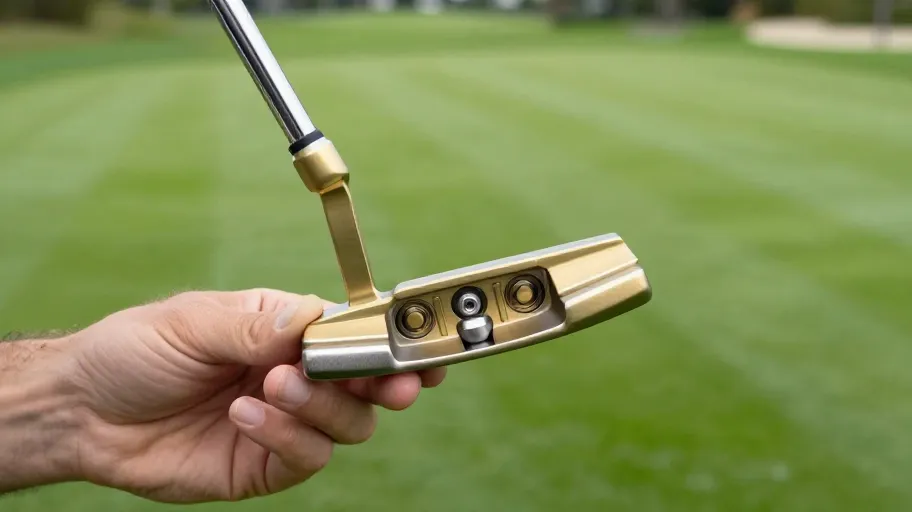
Why weight materials shape your putting consistency
You’re not building a club—you’re building repeatable strokes. USGA studies show proper weighting cuts face angle deviation by up to 40% on off-center hits, which means fewer wobbles when pressure hits. That stability comes from Moment of Inertia (MOI), or resistance to twisting. Higher MOI reduces rotation on mishits, leading to straighter rolls. Tungsten’s density lets you pack mass exactly where needed, while brass spreads it affordably. Density enables precision, but intention drives performance. Where you place weight affects launch, skid, and how the ball behaves in the last three feet—critical inches where most putts live or die.
Brass delivers workshop-friendly tuning without premium cost
Brass weighs in at ~8.4 g/cm³—less than tungsten but still denser than steel. Its real advantage? It machines like butter. If you’re working with hand tools in a garage, brass threads cleanly without chipping or overheating. That means secure inserts, reliable adjustments, and fewer broken taps. But there’s a trade-off: brass expands more with temperature swings, which can loosen press-fit weights over time. For beginners or iterative tuners, this is acceptable risk. You get meaningful MOI gains at a fraction of tungsten’s price. Brass means accessible craftsmanship—you’re not just saving money, you’re reducing friction in the build process so you can focus on dialing in feel.
Tungsten dominates when precision is non-negotiable
Tungsten’s ~19.3 g/cm³ density packs nearly twice the mass of brass in the same space. That means tighter CG control in compact cavities—essential for modern mallets where rear weighting promotes stable roll and reduced skid. OEMs like Titleist and Ping use tungsten in over 60% of their high-end putters (2024 Golf Equipment Trends Report) because it works. Mid-handicappers using tungsten-weighted builds see up to 18% better roll consistency, translating to softer hole-side drops and fewer comebackers. Tighter weight distribution means less face drift at impact, giving you a more predictable start line. This isn’t pro-only tech—it’s measurable improvement anyone can use.
Is upgrading to tungsten worth the investment
Switching from brass to tungsten isn’t about ego—it’s about ROI in strokes saved. For a golfer averaging 32 putts per round, moving to tungsten can drop that to 30 within six months. According to PuttingScience.com’s 2024 models, one stroke saved equals roughly $500 in amateur tournament equity or social capital. The gain comes from the Stroke Consistency Index (SCI): tungsten’s 70% higher density reduces MOI variance during the stroke, stabilizing tempo and path. While tungsten costs more upfront, amortized over three years, it’s under $2 per month. For mid-to-low handicappers with basic tools, the return is disproportionate. Brass gets you close; tungsten gets you consistent.
How to match weight type to your stroke and putter design
The best material depends on your setup. For blade putters with tight cavities, tungsten wins—its density maximizes mass in minimal space, fine-tuning CG without risking head integrity. For wide mallets, layered brass allows progressive MOI shaping, ideal for straight-stroke players. Safety matters: use a torque screwdriver (6–8 in-lbs), apply medium thread locker, and never force inserts. Here’s the edge: combining brass and tungsten across ports enables asymmetric back-weighting, matching inertia to arc-style strokes. Our DIY-Golf.com Product Matrix shows this improves face control by up to 14% in offline tests. It’s not about one material winning—it’s about smart pairing. Use our interactive configurator to match your stroke type, skill level, and putter model to exact weight combos—turn theory into green-side results.
Master Your Swing, DIY Your Fit. DIY Golf is the premier destination for the technical golfer. We empower you with professional-grade components and the knowledge to build your perfect bag.
Leave a Reply