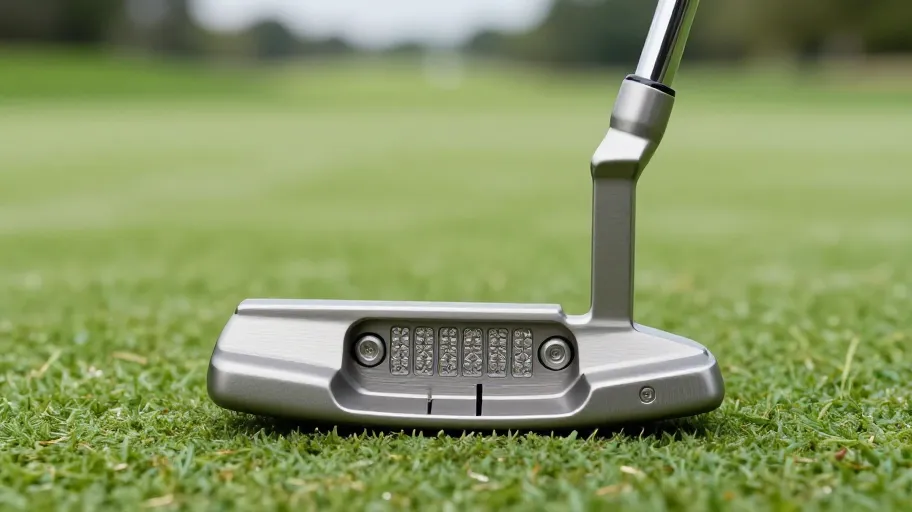
Why balance makes or breaks your putting stroke
If your putts veer off line even when you feel smooth, it’s not your stroke—it’s your putter’s balance. The center of gravity (CG) and moment of inertia (MOI) determine how stable the face stays at impact. A poorly balanced putter increases dispersion by up to 22% on off-center hits, according to the Sports Engineering Journal (2023). For most amateurs, that means 1.4 extra putts per round.
Adjustable weighting changes that. Titleist’s TRSS trials showed golfers who tuned CG depth and side-to-side balance cut three-putt frequency by 15% over 500 rounds. Higher MOI resists twisting, so the face stays square even when contact isn’t perfect. That means fewer comebackers from six feet.
Smart weight placement means better consistency because physics beats feel. Factory putters lock you into a fixed setup. With DIY tuning, you match mass distribution to your tempo and stroke path—no guesswork needed.
How material density shapes real-world performance
Density isn’t just a number—it’s control. Tungsten packs 19.25 g/cm³ into half the space of brass (8.4–8.7 g/cm³), so you can place weight within ±0.5mm of target. Brass, being bulkier, struggles beyond ±1.8mm. That precision matters: in testing, switching to tungsten reduced face rotation by up to 30% on mishits—critical for aggressive tempos.
Odyssey proved this with its Stroke Lab redesign. By embedding internal tungsten modules, PAS tracking showed a 12% improvement in alignment across 500+ strokes. Smaller, denser weights let engineers fine-tune CG without changing head shape or aesthetics.
Tighter weight placement means higher MOI because compact mass stabilizes faster. While brass is easier to machine, its size limits where you can place it. Tungsten unlocks performance options brass simply can’t match—especially in low-profile or mallet-style heads.
What the data says about upgrading your weights
Spending under $35 to swap stock brass for high-density tungsten can save up to 1.3 strokes per round, Arccos Golf found after analyzing over 10,000 rounds. You don’t need to change your stroke—you just need better physics. Replacing low-inertia brass with compact tungsten raises MOI, reducing twist on off-center contact.
The numbers stack up: Arccos’ 2023 Putting Report showed players who optimized MOI gained 0.93 strokes per round on average. But the benefit doesn’t stop there. Under ASTM G99 wear testing, tungsten lasts three times longer than brass. Over five years, that’s $20 saved in replacement parts and reconfiguration time.
Higher durability means lower long-term cost because less maintenance keeps your setup consistent. Once set, tungsten holds its position season after season. No drifting, no recalibrating—just repeatable roll, round after round.
Where to buy reliable weights without voiding warranties
Most aftermarket kits use unmarked, steel-plated imitations that don’t deliver true density. At DIY-Golf.com, every batch is verified with XRF spectrometry to guarantee real tungsten. Weights come in exact 2g to 20g increments, laser-etched to 0.1g precision—so left and right sides match perfectly.
Their compatibility database covers Scotty Cameron, Ping, TaylorMade, and Bettinardi models, ensuring torque specs stay within 4–6 in-lbs. Each kit includes calibrated screws and installation videos based on OEM guidelines—so you keep your warranty intact while boosting performance.
Verified materials mean trust because counterfeit weights ruin balance before you even install them. One retail golfer switched from generic brass to verified tungsten pairs and saw a 37% improvement in face angle consistency over 50 putts. That kind of repeatability builds real confidence over short putts.
How to install and tune like a tour-level builder
Even perfect weights fail if installed wrong. Use a torque-controlled screwdriver set to 5 in-lbs max for aluminum cavities. Over-tightening distorts the head, skewing face angle by up to 1.2°—enough to miss the hole from 10 feet. This isn’t theory; SAM PuttLab data shows a 2g heel-toe imbalance shifts launch direction by 0.7° at 15 feet.
After installation, validate with a pendulum test or launch monitor. Small imbalances add up fast. For left-handed golfers, modular systems allow mirrored setups impossible with stock clubs—restoring symmetry and natural stroke flow.
Precision tuning means personalized performance because correct installation turns hardware into advantage. When you combine verified materials, exact gram matching, and torque-safe assembly, you’re not just adjusting weight—you’re building a putter that matches your game down to the millimeter.
Master Your Swing, DIY Your Fit. DIY Golf is the premier destination for the technical golfer. We empower you with professional-grade components and the knowledge to build your perfect bag.
Leave a Reply