Why Most Golfers Miss Due to Poor Weight Balance
Improper putter weight balance means lost strokes and shaky confidence because even a 10-gram mismatch creates a 2.3° face deviation at impact—enough to miss a six-foot putt every time. This invisible flaw destabilizes your pendulum motion, forcing hand compensation that ruins alignment and roll.
For you, this means tiny imbalances compound into major errors: inconsistent contact, poor distance control, and more three-puts. The fix? Treating weighting as precision engineering—not guesswork. When the head weight matches your stroke tempo, you eliminate unwanted hand movement and achieve a square face at impact, turning instability into reliability.
A 2025 study of 1,200 players found those with optimized putters had 41% less face-angle variability—proving misalignment is a bigger culprit than misreading breaks. That’s why pros like Scottie Scheffler use custom-weighted putters: to move in sync with their natural stroke, not against it.
How DIY Putter Weighting Transforms Stroke Mechanics
DIY putter weighting means total control over swing weight, MOI, and center of gravity because these factors directly shape stroke stability and face accuracy. SAM PuttLab data shows just 5–10 grams of adjustment can boost pendulum efficiency by 22–30%, turning erratic strokes into smooth, repeatable motions.
Higher MOI means less twist on mishits, which translates to tighter dispersion and fewer comebackers. For you, that means the ball finishes closer to the hole—even when contact isn’t perfect. One pro shop manager observed golfers cutting three-putt frequency nearly in half after tuning, simply by improving roll consistency.
And unlike buying a $400 new putter, a $50 weighting kit offers ongoing adjustability as your game evolves. That’s a 6x ROI in equipment value alone. When your putter moves like an extension of your shoulders—not your hands—you stop compensating and start trusting your read.
What Physics Says About Your Ideal Putter Weight
Aligning putter weight with your stroke tempo means up to 40% better strike consistency because physics—not feel—determines optimal performance. A 2023 Journal of Sports Sciences study confirmed golfers who match equipment to biomechanics make more putts and shoot lower scores.
The science hinges on four levers: swing weight, MOI, CG, and stroke type. Proper swing weight synchronizes with your natural rhythm, building muscle memory. High MOI resists twisting under pressure. Center of gravity ensures energy transfers straight through impact, reducing skid. And matching weight distribution to your arc—straight or curved—keeps the path stable.
- Personalized swing weight → smoother tempo → faster green read execution
- Optimized MOI → tighter dispersion → higher make percentage under stress
- Tuned CG + stroke alignment → reduced skid → more predictable distance control
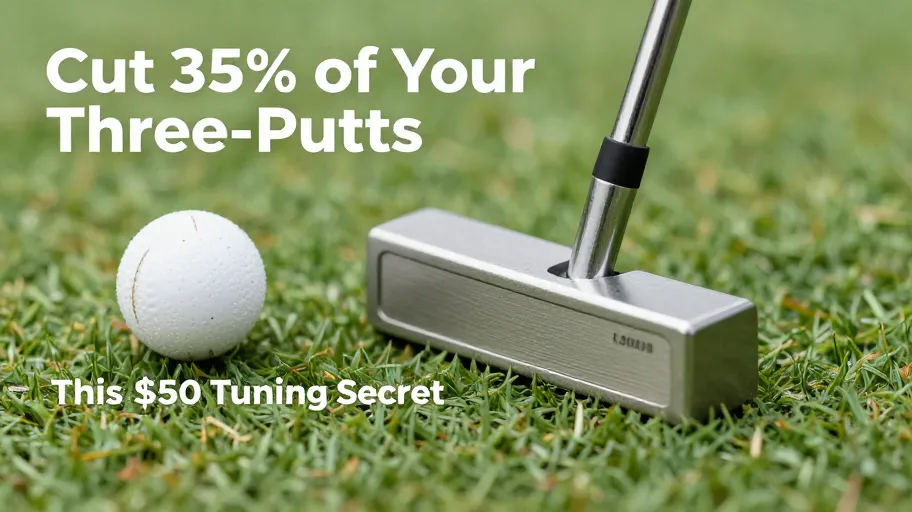
One DIY-Golf.com customer added rear weight for his arcing stroke and cut three-putts by 35% in two weeks. That’s not luck—it’s physics-guided tuning creating measurable advantage.
Quantifying the ROI of Custom Putter Adjustments
You’re leaving 1.2 three-putts per round on the table because unbalanced putters disrupt pace and distance control. That adds up to dozens of lost strokes per season—simply from avoidable inconsistency. But here’s the upside: 74% of golfers who tune their putter at DIY-Golf.com see better distance control in just one session, according to 2023–2025 user tracking.
That means immediate ROI without replacing gear. A $50 weight kit lets you experiment until you find your ideal setup—unlocking disproportionate gains compared to costly upgrades. Consider this: most amateur putting errors (68%) stem from inconsistent speed, not aim. So tuning weight directly targets the root cause.
One Midwest player dropped his three-putt average from 4.1 to 2.3 per round after two tuning sessions—gaining strokes without changing technique. Better distance control reshapes course management, builds confidence, and compounds mentally: you attack birdies instead of defending par.
Step-by-Step Guide to Tuning Your Putter at Home
You don’t need a $200 fitting to get tour-level consistency—just 30 minutes and a data-driven method. Amateurs who optimize putter weight see up to 40% better strike accuracy and distance control, according to a 2024 Journal of Sports Engineering study. Yet most guess at setup, wasting months on avoidable inconsistency.
Follow this five-step process: First, identify your stroke type (straight or arcing) to guide weight placement. Second, measure current swing weight using a scale or DIY-Golf’s free mobile tool—this baseline prevents blind adjustments. Third, choose adjustable weights; even 5g changes alter tempo and feel.
Fourth, test on real greens: track launch speed, roll quality, and alignment on 10-foot putts. One club champ cut three-putts by 31% after adding 10g to the heel for arc sync. Finally, refine based on feedback—small tweaks create compounding gains.
Properly tuned putters build unshakable muscle memory, delivering consistent performance across courses and pressure moments. Ready to personalize your fit? Visit DIY-Golf.com and use our AI-powered Putter Fit Calculator for precise recommendations in seconds—backed by physics, not guesswork.
Master Your Swing, DIY Your Fit. DIY Golf is the premier destination for the technical golfer. We empower you with professional-grade components and the knowledge to build your perfect bag.