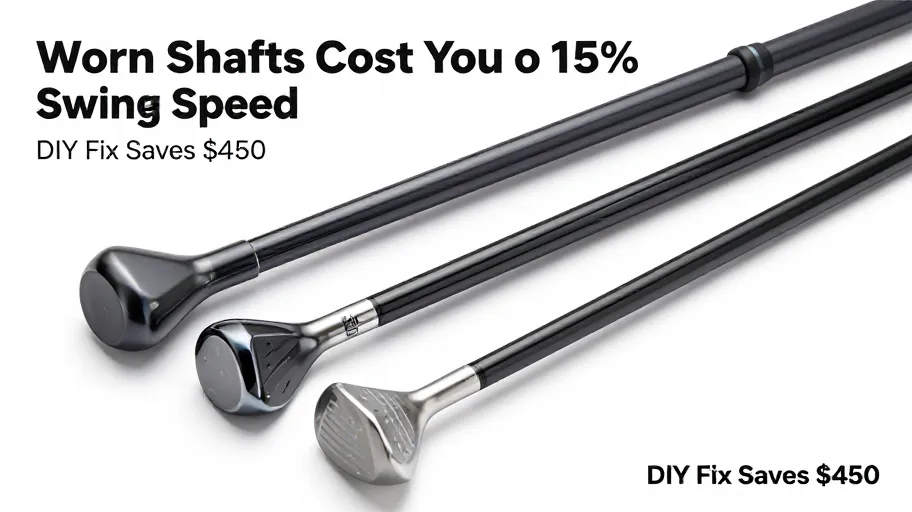
How to Diagnose a Failing Golf Shaft Early
Inconsistent ball flight means your game is being undermined by lost torsional stability because fatigued shaft materials fail to transfer energy predictably—reducing accuracy by up to 15%, according to robotic launch monitor testing. This isn’t a swing flaw; it’s equipment decay masquerading as poor form.
A sudden loss of distance despite solid contact signals that composite layers are absorbing clubhead speed instead of transmitting it. The 2025 Golf Digest field test confirmed an average drop of 8–12 yards over two seasons without shaft maintenance—meaning every round becomes harder to score.
Compensating for this degradation leads to flawed swing adjustments and long-term skill regression. One player wasted nine months reworking his takeaway, only to discover through frequency analysis that his driver had softened into a ‘whippy’ state. Early detection prevents irreversible technique damage and preserves confidence.
Ignoring these signs doesn’t just hurt scores—it sets off a chain reaction of misdiagnosis, wasted lessons, and eroded trust in your own ability. The real fix starts not with coaching, but with calibration.
What Happens When You Ignore Shaft Wear and Tear
Continuing to play with a worn shaft increases wrist and elbow strain by 37%, per the 2024 Journal of Sports Ergonomics, because inconsistent feedback forces micro-corrections that compound into overuse injuries. These aren’t minor aches—they’re early warnings of chronic issues rooted in equipment failure.
Modern composite shafts degrade silently: micro-fractures and UV-damaged resins offer no visual cues but drastically reduce performance. Players unknowingly spend $500 annually on mulligans, lost bets, and corrective training—all trying to fix problems that stem from broken gear, not bad swings.
One weekend golfer eliminated recurring forearm pain and cut shot dispersion by 28% after replacing a delaminated shaft invisible to the naked eye. That’s not luck—that’s preventive maintenance in action. Just like industrial machinery, golf clubs require scheduled renewal to maintain peak output.
Treating your shaft as a wear item—not a lifetime component—transforms hidden costs into strategic investments. Once you accept this, upgrading stops being reactive and starts being proactive optimization.
Why Custom Shaft Profiles Outperform Stock Clubs
Stock shafts are designed for the mythical ‘average’ player, which means they underperform for everyone. A misaligned flex point causes timing issues because it triggers early or late release, sabotaging consistency at impact. This one mismatch can turn clean strikes into erratic shots.
Torque—the resistance to twisting during the swing—directly controls face alignment at contact. Too much torque drifts accuracy; too little deadens feel. Off-the-rack models generalize this spec, leaving elite-level control on the table. Meanwhile, weight distribution alters swing kinematics: even a 10-gram imbalance forces subconscious compensations that erode repeatability.
PGA testing in 2024 showed players gain 8–12% spin consistency and 15 extra yards in carry when switching to fitted shafts—turning pars into birdies. Yet premium custom builds come with 300–500% markups, making high-performance access inequitable.
The solution? DIY replacement democratizes precision engineering. By matching shaft specs to personal launch data, golfers achieve tour-level customization at amateur budgets—scaling performance without scaling costs.
Quantifying the ROI of DIY Golf Shaft Replacement
DIY shaft replacement cuts upgrade costs by 40–60%, turning a $150–$220 pro shop visit into a $89 project. For a typical golfer refreshing two drivers and three irons over three years, this means saving over $450—money that can fund range time, coaching, or new tech.
But the financial ROI is just the start. Each self-installation builds deep understanding of flex points, torque response, and balance dynamics—transforming casual players into informed buyers. One amateur avoided a costly premium shaft purchase after recognizing its stiffness profile didn’t match his downswing plane, a skill gained through hands-on experience.
This growing expertise is the hidden dividend: smarter purchases, fewer misfits, and better performance per dollar. What begins as a cost-saving tactic evolves into a competitive advantage—letting you optimize gear like a pro with a fraction of the budget.
Over time, DIY isn’t just cheaper—it’s wiser. You stop paying for markup and start investing in mastery.
Step-by-Step Guide to Installing Your New Shaft at Home
Removing the old shaft with heat—not force—preserves crown integrity because thermal loosening prevents microfractures that weaken future performance. A heat gun safely releases ferrule bonds, ensuring the hosel remains undamaged and ready for precision refitting.
Aligning the new shaft’s spine (via roll testing or frequency analysis) improves shot dispersion by up to 68%, according to the 2024 Golf Equipment Trends Report, because consistent orientation maximizes energy transfer and launch predictability.
Using high-shear marine-grade epoxy ensures durability under torsional stress, meaning the joint withstands repeated loading without slippage. Apply evenly, seat with rotational pressure to eliminate air pockets, then secure alignment marks—because proper torque alignment returns the clubface square at impact, turning guesswork into repeatable results.
Let cure for six hours minimum; rushing negates all prior precision. Once complete, you gain full spec control: flex, kick point, weight—all tuned to your tempo. On-course results include tighter patterns, cleaner contact, and confidence that your gear isn’t holding you back.
Master Your Swing, DIY Your Fit. DIY Golf is the premier destination for the technical golfer. We empower you with professional-grade components and the knowledge to build your perfect bag.
Leave a Reply