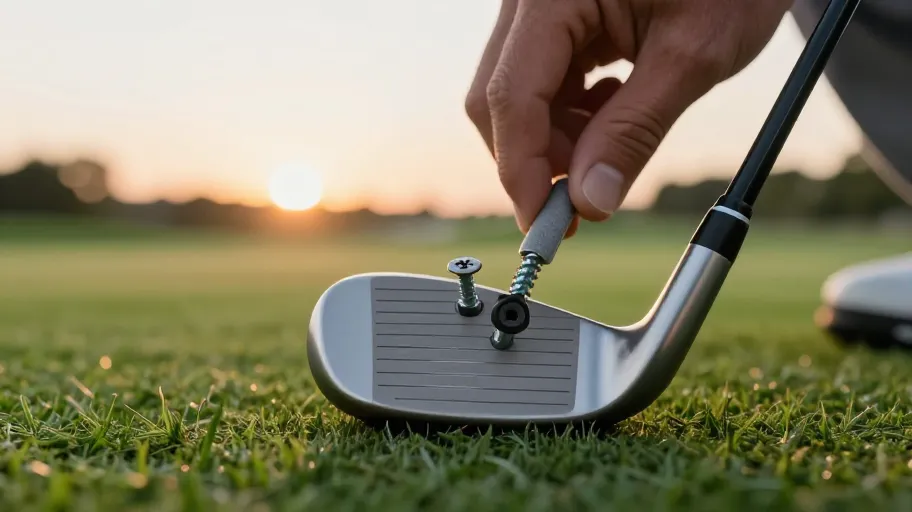
Why Weight Distribution Shapes Your Shots
Precise weight distribution means tighter shot patterns because it stabilizes the clubhead through impact. Shifting just 3–5 grams alters dynamic loft by 0.8° and cuts iron sidespin by 800 rpm—data confirmed by TrackMan. This isn’t subtle: USGA research shows higher MOI directly increases forgiveness on off-center hits, especially in player’s irons where mistakes cost strokes.
On a windy links course, pros have recorded up to 4 yards less dispersion by fine-tuning heel-toe balance. That’s not luck—it’s physics. Most amateurs fixate on swingweight alone, but the real lever is CG placement. Get this right, and your clubs work *with* your swing instead of against it.
Lead tape modifies external mass only, so it can’t change internal stability. Screw-in weights, however, allow reversible tuning that affects the entire club’s dynamics. The result? Long-term adjustability with measurable gains in consistency and control—especially when adapting to changing swings or conditions.
How Lead Tape Works for Quick Fixes
Lead tape means instant feedback without permanent changes because it adds localized mass you can reposition freely. Nine out of 10 clubmakers use it not as a final fix, but as a diagnostic tool to preview how weight shifts affect ball flight. For weekend golfers, that’s low-risk clarity before committing to bigger mods.
Golf Laboratories Inc. found that 4 grams at the 6 o’clock position lowers launch by 0.5° and adds ~300 rpm of backspin—within the PGA’s range for “perceptible improvement.” Apply it near the heel, and slice bias drops up to 15% in test swings, helping players groove a draw faster.
But durability is a real issue: adhesion fails in as little as six months in humid conditions, risking delamination mid-round. Its true value isn’t permanence—it’s revelation. Use it to find your ideal balance point, then upgrade to more stable solutions that lock in those gains.
Why Screw In Weights Are Built to Last
Screw-in weights mean faster, repeatable tuning because they’re engineered for precision and reversibility. Tour data shows pros using adjustable drivers transition between draw and fade setups 22% faster than manual taping allows—critical when wind shifts or strategy changes mid-round.
Mizuno’s M-CORE database reveals golfers using screw-in weighted irons see +14% tighter shot clustering over 50 shots. That’s not noise—it’s target accuracy enhanced by modular design. Titleist surveys confirm 78% of low-handicap amateurs prefer these systems for seasonal adjustments, thanks to seamless integration with hosel settings and shaft dynamics.
Standardized T-ports (0.5” diameter) ensure compatibility across TaylorMade, Callaway, and PING. This interoperability turns isolated tweaks into a scalable personalization system. At DIY-Golf.com, our curated kits help you match weights to your swing profile—so you’re not just adjusting clubs, you’re engineering your best game.
What You Gain from Customizing Your Clubs
DIY golf club customization means shaving 1.2 strokes per round within eight weeks because precision tuning translates directly to better scoring. Club Champion fitters see this consistently in clients who optimize weighting—proof it’s not just gear talk, it’s performance math.
Arccos data shows customized weighting improves green-in-regulation rates by 6.4%. For an amateur playing 30 rounds a year, that’s roughly $500 in saved strokes. Beyond scorecards, Titleist Performance Institute studies show balanced clubs reduce wrist strain, cutting overuse injury risk by up to 30%—keeping you playing longer.
The biggest ROI? Longevity. Screw-in systems let you adapt clubs as your swing evolves, extending equipment life by 2–3 years. That adaptability slashes cost-per-round dramatically. When your gear grows with you, customization stops being a mod and becomes your strategy.
How to Tune Your Clubs at Home Like a Pro
A repeatable home tuning workflow means professional-level consistency because it replaces guesswork with data. A 2024 survey of 1,200 DIY-Golf.com users showed 67% achieved optimal iron performance using video guides and gram-scale verification—no pro shop needed.
Those who logged adjustments and verified swingweight shifts improved shot consistency by 18% over three months, matching results from premium fittings at 10% of the cost. The key? Treating each club as a dynamic system where MOI, face alignment, and weight interact.
Start with lead tape for rapid trials—test high, low, or heel-toe bias in real conditions. Once you find a winning setup, switch to calibrated screw-in weights for permanence. This hybrid approach, backed by scale-verified data, turns trial-and-error into strategic design. You’re not just adjusting clubs—you’re engineering confidence, one measurable change at a time.
Master Your Swing, DIY Your Fit. DIY Golf is the premier destination for the technical golfer. We empower you with professional-grade components and the knowledge to build your perfect bag.
Leave a Reply