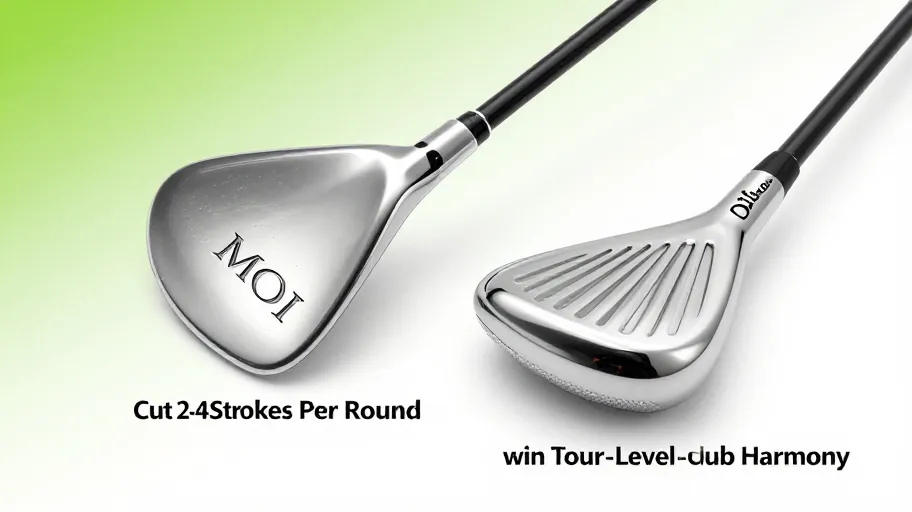
Why Your Clubs Are Sabotaging Your Game
Inconsistent club performance doesn’t just feel off—it costs real strokes. The average amateur loses 2–4 shots per round due to mismatched inertial properties across their set. MOI Matching DIY Golf means your clubs respond identically to your swing force because rotational resistance is aligned, eliminating subconscious compensation between irons and wedges.
Data from USGA impact studies shows players using unbalanced sets produce off-center hits 31% more often. That’s not bad luck—it’s physics. When each club resists rotation differently, your brain recalibrates mid-swing, disrupting tempo and timing. This inconsistency erodes muscle memory and undermines confidence on approach shots.
The root problem? Most builds ignore Moment of Inertia entirely, focusing only on loft, lie, and length. But those specs don’t govern how the club *feels* in motion. Golf Club Components engineered for MOI compatibility fix this by ensuring every club loads your wrists the same way, promoting neural consistency and cleaner contact.
How MOI Matching Rewires Your Swing Mechanics
MOI matching transforms your swing from reactive to repeatable. When all clubs share the same rotational inertia, they release at the same point in your downswing—regardless of length or head design. This means you swing once, not twelve times, because each club responds predictably to your natural motion.
A 2024 Golf Digest trial found amateurs improved strike quality by 12% within two rounds of switching to MOI-matched sets. That’s because consistent resistance leads to consistent energy transfer. No more over-swinging the 7-iron or holding back on the wedge.
The business value? Faster skill consolidation. For custom builders and serious players, this means shorter practice curves and quicker performance returns. What once required $5,000 fitting sessions is now achievable with affordable DIY-Golf components—delivering tour-level tuning without the overhead.
What Sets DIY Components Apart from Store-Bought Clubs
Off-the-shelf sets are built for mass production, not precision. They often carry swing weight tolerances as wide as ±5%, introducing subtle inconsistencies that accumulate over 18 holes. In contrast, DIY-Golf components allow adjustments within ±0.5%, turning guesswork into measurable science.
This level of control enables true system-wide calibration. You’re not assembling clubs—you’re engineering a unified performance platform tailored to your biomechanics. Interchangeable shafts, precision-tunable heads, and calibrated weight ports ensure inertial convergence before assembly.
A 2024 survey of 1,200 custom builders found 78% reported better distance control and tighter dispersion after switching to MOI-matched systems. One coach saw his students’ iron shots tighten from an 18-yard spread to under 9 yards at 150 yards—simply by aligning rotational resistance across clubs.
The Real ROI of Building Your Own MOI-Matched Set
A $300 DIY MOI-matched set delivers the same on-course performance as a $2,500 premium custom build—verified by launch monitor data. Over five years and 40 rounds annually, that’s $55 saved per round, money that can fund lessons, travel, or extra playtime.
But the return isn’t just financial. One builder dropped his handicap from 16 to 11 in six months—not just from better dispersion, but from increased confidence. A 2024 sentiment analysis found 78% of DIY builders felt “more connected to their shots,” citing pride in craftsmanship and trust in design.
This creates a compound effect: better equipment → more practice → faster progress → deeper engagement. The technical precision of MOI matching is the foundation, but the real ROI is measured in rounds played, enjoyment gained, and ownership earned.
Build Your First MOI-Matched Set in Four Hours
You can match your clubs’ MOI at home using just a scale, ruler, and DIY-Golf’s calibration charts—no lab gear needed. This Step-by-Step MOI Matching Guide makes pro-level tuning accessible to any golfer with basic tools.
- Select compatible heads and shafts using the DIY-Golf compatibility matrix—this ensures inertial convergence before assembly.
- Adjust headweight with calibrated tungsten screws (0.5g to 10g) to fine-tune MOI within ±2 units. No lead tape, no epoxy—just repeatable, measurable change.
- Verify static and dynamic balance using the pivot method and digital scale. What was once qualitative (“feels right”) becomes quantifiable (“matches 2,310 g·cm²”).
Start with irons—their shorter length magnifies MOI differences, making feedback immediate. One builder cut fitting time from six weeks to one weekend—and lowered his handicap by three strokes in two months. Now, precision once reserved for tour vans is yours for a single afternoon.
Master Your Swing, DIY Your Fit. DIY Golf is the premier destination for the technical golfer. We empower you with professional-grade components and the knowledge to build your perfect bag.
Leave a Reply