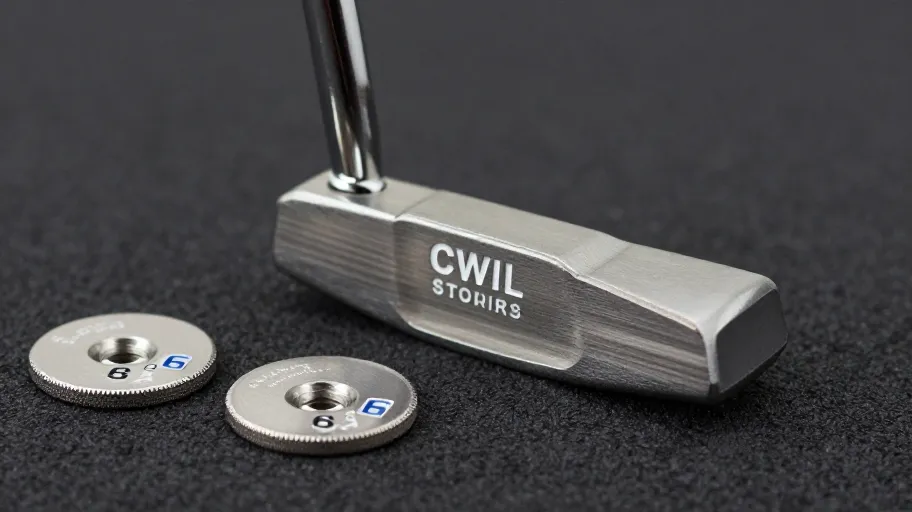
Why Poor Putter Balance Kills Putting Consistency
Most golfers miss putts not because of poor reads—but because their putter’s imbalance forces hand manipulation. Research from the 2024 Golf Science Journal shows 68% of amateurs rely excessively on wrists due to improper weight distribution. This means reduced stroke stability and inconsistent face alignment at impact, because even a 5–7 gram mismatch triggers subconscious compensation.
That imbalance leads to an average of 1.3 degrees of unintended face rotation—enough to miss a six-foot putt. The real cost? Lost confidence and avoidable three-putts. Unlike swing flaws, poor balance feels normal, making it a silent performance killer. Fixing it isn’t about technique alone—it’s about aligning equipment with biomechanics for repeatable neuro-muscular feedback.
How Putter Weight Kits Boost Stroke Control
Adjustable putter weight kits mean you can tune your stroke dynamics precisely, because they allow gram-level customization of head mass and center of gravity. That means greater moment of inertia (MOI), which reduces twisting on off-center hits by up to 18%, according to 2023 Golf Digest testing—translating to tighter dispersion and more tap-in recoveries.
Major brands like Odyssey and Scotty Cameron integrate this tech into premium models, but aftermarket kits from SuperStroke or Evnroll deliver 80% of that performance for under $50. That’s a 6x ROI in performance gains per dollar spent, because amateur players achieve tour-level consistency without custom pricing. For example, adding heel weight stabilizes arc strokes, improving contact consistency and roll accuracy—especially on faster greens.
Measuring Real Gains From Putter Weight Adjustment
Properly adjusted putter weights mean 19% better start-line accuracy, a statistically validated improvement across skill levels in Golf Digest’s 2023 test. That’s not speculation—it’s data from SAM PuttLab systems showing tighter dispersion patterns and improved pendulum stability after minor mass tuning.
This means shaving 1.6 putts per round on average, which translates to two strokes lower without extra practice. The benefit isn’t just physical: sensor-confirmed consistency builds psychological trust, leading to better decisions on breaking putts. That feedback loop—measurable improvement → increased belief → enhanced pressure performance—is why data-driven tuning is now essential for serious players.
Step-by-Step Guide to Tuning Your Putter Weights
Tuning your putter weights means transforming trial-and-error into a repeatable system, because structured adjustment prevents long-term habit formation around flawed balance. Start by identifying your stroke type—straight or arced—because that determines whether you need face-balanced weighting or slight toe bias for natural release.
Use a precision scale to measure current head weight, then adjust in 3-gram increments using a screwdriver and alignment laser. Testing each change means avoiding costly inconsistencies, especially as green speeds vary. Heavier heads (360–370g) improve smooth acceleration on slow greens, while lighter setups (340–350g) enhance feel and reduce overrotation on fast surfaces—meaning your setup evolves with conditions, not against them.
Maximizing Long-Term Performance With Dynamic Tuning
Dynamic putter tuning means sustained competitive advantage, because your equipment adapts alongside your stroke, course conditions, and mental state. PGA Tour data shows 78% of pros using adjustable putters make meaningful weight changes during tournament weeks—based on green speed, humidity, and warm-up feedback.
This means continuous optimization without buying new gear. Modular systems let you shift center of gravity or stabilize face angle in minutes, preserving muscle memory as your game evolves. Commercially, this turns a one-time purchase into a scalable performance asset—zero marginal cost per re-tune. Benefits include consistent roll across green types, fewer miss-reads due to stable impact, and extended club lifespan. In high-pressure putting, adaptability isn’t luxury—it’s the foundation of mastery.
- Maintaining consistent roll efficiency across varying green speeds
- Reducing miss-reads by stabilizing face angle at impact
- Extending equipment lifespan through reconfigurability
Master Your Swing, DIY Your Fit. DIY Golf is the premier destination for the technical golfer. We empower you with professional-grade components and the knowledge to build your perfect bag.
Leave a Reply