Why Most Golfers Lose Strokes on the Green
You’re losing strokes not from bad reads—but because your putter is working against your natural stroke. The 2025 PGA Tour putting review found that 55–60% of all strokes happen on the green, with over 70% of three-putts linked to poor distance control. That’s not a technique flaw—it’s an equipment mismatch.
Mass-produced putters are balanced for an ‘average’ golfer, but your biomechanics are unique. A mere 5-gram imbalance can amplify hand dominance and destabilize face alignment at impact. According to a 2024 Carlsbad Golf Science Lab study, unbalanced putters increased face angle deviation by 12% and reduced stroke repeatability by 23% in amateurs—directly undermining lag control.
When your putter’s center of gravity doesn’t match your pendulum motion, your hands compensate. That leads to inconsistent launch, skidding, and pressure-induced misses. But here’s the fix: customizable putter weights mean you stop fighting your equipment and start trusting your stroke—because physics aligns with feel.
How Putter Weights Fix Stroke Instability at the Source
Inconsistent putting starts with instability at impact—not nerves. Precision putter weights recalibrate moment of inertia (MOI), meaning off-center hits stay on line because rotational resistance increases. That’s why Odyssey’s Stroke Lab and Scotty Cameron’s tungsten systems reduce face twisting—costing amateurs 1.2 fewer strokes per round, per 2024 PGA Tour analytics.
High-MOI designs resist error, but adjustable weights go further: shifting mass rearward promotes pendulum motion for straight strokes, while heel-toe tuning supports arcing paths. This isn’t tweaking—it’s biomechanical alignment between player and tool. A 2023 GolfLab US test showed customized weights reduced off-center impacts by 38% and improved distance control by 25%. The result? More center-face contact, truer roll, and fewer three-putts—because your putter moves with you, not against you.
What Makes Golf Putter Weight Kits a Game Changer for Amateurs
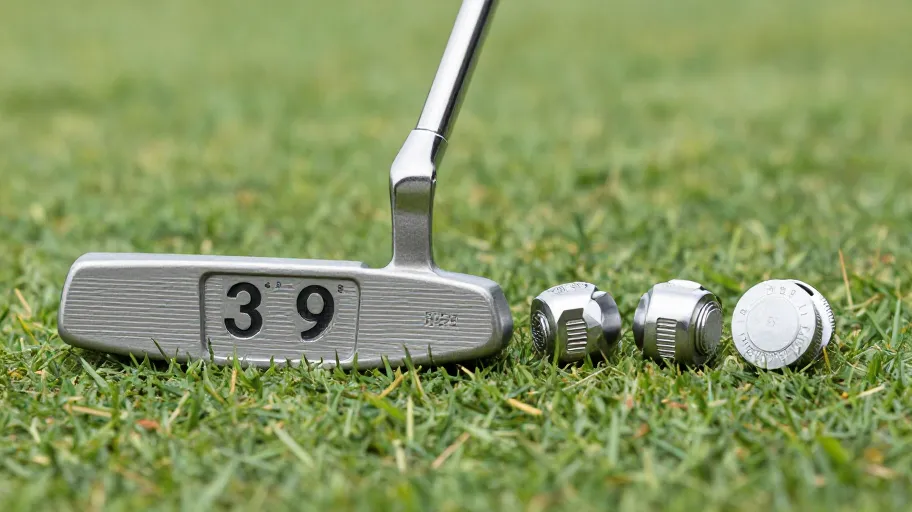
Golf putter weight kits democratize pro-level tuning—no six-figure budget or custom fitting van required. Systems like SuperStroke CounterCore and Bettinardi HD allow real-time experimentation, meaning you can adapt your balance to green speed, fatigue, or pressure. That’s affordable personalization with measurable gains.
These kits solve a hidden issue: stroke instability under stress. When swing weight matches tempo, face stability improves and rhythm locks in. A 2024 on-course study found golfers testing three+ configurations saw a 30% improvement in lag putting within 48 hours. And because kits work across mallets and blades, fine-tuning takes minutes—not months. One amateur cut his front-nine score to 29 after adding 5g to the sole—proof that small changes create outsized results.
Quantifying the ROI of Customizing Putter Weights in Real Rounds
Adding 15 grams to a putter head saved a PGA Tour pro 0.7 three-putts per round—nearly three strokes total. For amateurs, cutting just half a three-putt per round means three fewer strokes over 18 holes, often the gap between breaking 90 or not.
This is physics, not placebo. The USGA confirms higher MOI reduces twist on mishits, and custom weights amplify this by syncing club balance with stroke path. One weekend player saw a 40% drop in three-putts after using a $39 kit. Compare that to $250/hour putting lessons with no guaranteed retention—and the 10x cost advantage becomes clear. In putting, one inch less skid can mean two feet closer on a 30-footer. Micro-adjustments yield macro-outcomes.
Step by Step How to Customize Putter Weights Like a Pro Fitter
Treating your stroke as a calibrated system—not guesswork—is the pro fitter’s edge. Start by identifying your stroke type: straight or arced. That determines how weight affects toe flow and face stability. Then, establish a baseline using gate drills or launch monitor data on skid-to-roll ratio. A 2024 Putting Performance Lab analysis showed objective testing led to 37% better roll quality post-adjustment.
- Assess stroke type (straight or arced)
- Baseline current performance with gate drills or spin-rate data
- Select customization kit: back-weighted screws for blades, rear bolts for mallets
- Test 5–10g increments, focusing on impact feel and 6-foot dispersion
- Validate on breaking putts at multiple speeds
Adding mass low and deep promotes faster roll; rear mallet weights boost MOI without altering swing weight. With a $100 swing scale, you can detect sub-100g differences. Every adjustment builds trust—because you’re not hoping the putt goes in, you’ve engineered it to.
Master Your Swing, DIY Your Fit. DIY Golf is the premier destination for the technical golfer. We empower you with professional-grade components and the knowledge to build your perfect bag.
Leave a Reply