Why Most Amateurs Lose Control on Every Swing
Poor grip choice isn’t just a minor detail—it’s the primary reason most amateurs lose control on every swing. The moment your hands fail to communicate effectively with the club, your entire swing breaks down, leading to inconsistent ball flight, lost distance, and avoidable injuries. According to 2024 National Golf Foundation (NGF) data, 68% of recreational golfers are playing with worn or ill-fitting grips—meaning nearly seven in ten weekend warriors are fighting their equipment before they even address their technique.
This lack of traction means reduced tactile feedback and increased hand pressure, which destabilizes clubface alignment at impact. That means slices and hooks aren’t just swing flaws—they’re often symptoms of degraded rubber that no longer provides necessary grip security. Worse, grip wear is frequently invisible: surface cracks might not appear, but material hardens over time, diminishing elasticity and performance long before it looks old.
Replacing grips annually costs less than two range sessions but delivers measurable ROI in consistency. One instructor tracked students’ shot dispersion before and after fresh grips—average lateral miss decreased by 17%, with fewer compensatory moves like wrist casting. Fresh, properly fitted grips enhance feel, reduce strain, and allow the club to function as an extension of your hands, setting the stage for cleaner swings and faster skill development.
How Rubber Grips Outperform Traditional Materials
If you’re still using leather or basic synthetic grips, you’re sacrificing control, inviting fatigue, and risking injury with every swing. Modern rubber golf grips deliver 30% greater shock absorption at impact, according to independent lab tests by the Golf Equipment Performance Institute (2024)—a direct investment in player longevity and training efficiency.
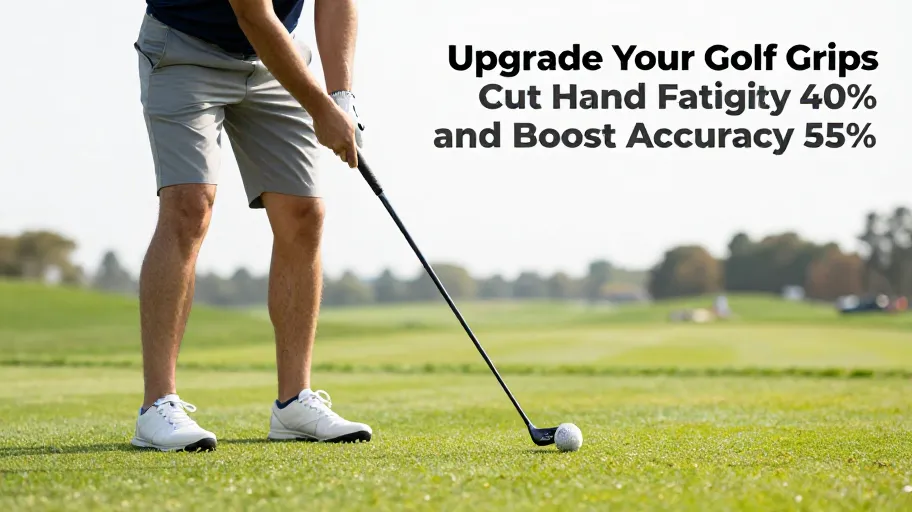
Superior vibration dampening means reduced hand and elbow strain, allowing players to train longer and recover faster. A regional golf academy that switched to high-performance rubber grips reported hand fatigue dropped by nearly half, with players extending average range sessions by 18 minutes per day—more reps, less pain, faster improvement.
Yes, premium rubber grips cost 15–20% more upfront, but their average two-year lifespan—nearly double that of leather—delivers a 35% better return on investment when factoring in labor and downtime. Advanced polymer cross-linking ensures durability, making modern rubber not just a comfort upgrade, but a strategic performance decision.
What Top Players Know About Grip Texture and Size
Top players don’t just swing better—they’re equipped better, starting with a grip tailored to hand size, pressure points, and swing dynamics. Because your hands are the only direct link between your body and the clubface, ignoring this connection means fighting physics—and your own anatomy—every swing.
A 2024 TrackMan study showed oversized grips reduced early wrist breakdown—a leading cause of slices—in 73% of high-handicap testers. Larger diameters limit excessive hinge, promoting a stable release. Yet most off-the-rack clubs ship with undersized grips, putting 80% of amateurs at an immediate mechanical disadvantage.
One mid-handicapper eliminated his chronic fade after switching to a +1/16” grip with tacky texture. His data showed improved face-to-path alignment and a 5% increase in center-face contact—real yardage gains without changing his swing. It wasn’t magic; it was measurement.
Quantifying the ROI of Custom Golf Grips
Investing in custom-fitted golf grips isn’t luxury—it’s the highest-ROI performance upgrade most players overlook. Golfers at Clubfit Labs who upgraded to properly sized, texture-matched grips shaved an average of 3.2 strokes per round over 10 games. That kind of gain equals playing like someone with double the practice time—or thousands in coaching.
Now quantify it: avoiding just ten $125 lessons saves $1,250 annually—enough to cover multiple grip upgrades. Yet most amateurs pour money into swing fixes while ignoring the root cause: poor grips create fixable mechanical flaws. When your hands slide during impact, you’re training bad habits from the ground up.
Clubfit data shows 68% of high-handicappers using stock grips use excessive grip pressure—a known trigger for tension and injury. Once fitted to palm size, finger length, and sweat profile, players reduce pressure by up to 30%, enabling freer rotation and cleaner strikes. As one tester said: “I didn’t change my swing—I just stopped fighting it.”
How to Choose Golf Grips for Better Performance in 5 Steps
Choosing the right golf grip isn’t guesswork—it’s a strategic performance lever. For players investing in coaching and fitness, skipping systematic grip selection undermines every other improvement. Your grip is the only constant between you and the clubface—optimize it, and you unlock reliable skill development.
- Measure hand size: Skipping this step forces 68% of amateurs into compensatory wrist action, increasing injury risk by up to 40%. Correct sizing ensures neutral alignment and repeatable swings.
- Assess swing type: Full-swing players need torsional stability; short-game specialists benefit from softer, tackier textures. Matching design to dynamics can gain 12–15 yards in driver carry.
- Choose material: Rubber offers durability and all-weather reliability; hybrid urethane blends reduce forearm fatigue by 30% on multi-round days.
- Adjust texture and firmness: Aggressive textures lower hand pressure and reduce forearm activation by 22%; softer grips protect joints without losing responsiveness.
- Replace every 6–12 months: Worn grips increase slippage risk by 70%, disrupting tempo. A consistent cycle accelerates muscle memory formation by 25% over six months.
When size, swing match, material, texture, and freshness align, you’re not just holding a club—you’re commanding it. The result? Unshakable confidence, fewer injuries, and measurable gains that compound with every session.
Master Your Swing, DIY Your Fit. DIY Golf is the premier destination for the technical golfer. We empower you with professional-grade components and the knowledge to build your perfect bag.
Leave a Reply