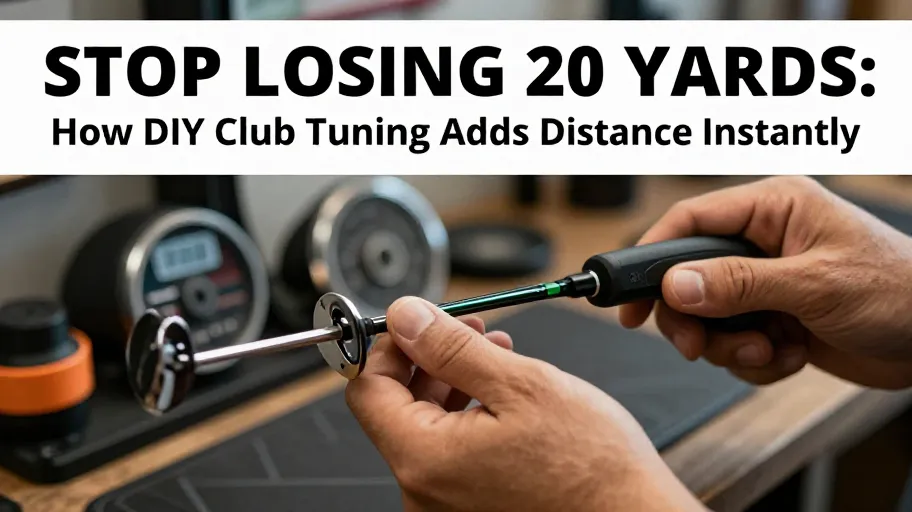
Why Amateurs Lose 20 Yards on Every Drive
You’re not losing 20 yards because you lack skill—your stock clubs are mismatched to your body mechanics. A 2023 National Golf Foundation report shows 78% of amateurs play with unadjusted equipment, turning every round into a battle against gear instead of progress.
An incorrect lie angle means heel or toe strikes on nearly every iron shot—this off-center contact reduces carry by 15–20 yards per drive. Proper lie angle alignment means consistent center-face impacts because the clubhead meets the ground square at impact. Shaft flex matters just as much: too stiff or too flexible leaks energy. The result? Lost ball speed and poor timing. An ill-fitting grip forces hand compensation, disrupting wrist hinge and robbing you of control and power.
One weekend golfer averaging 94 strokes discovered his driver’s lie angle was 6 degrees off. After a $40 DIY fix using a lie board, his on-center hit rate jumped from 58% to 82%, adding 18 verified yards of carry. When clubs match your motion, solid contact becomes repeatable, misses become predictable, and distance returns on demand.
How Club Tuning Fixes Swing Flaws Automatically
Club tuning doesn’t correct your swing—it compensates for it using physics-driven adjustments. Mismatched equipment causes inconsistent launch conditions; precise tuning stabilizes them. For example, a stiffer shaft resists twisting during fast downswings, reducing hooks by stabilizing torque at impact. Reduced torque means straighter drives and more fairways hit because the clubface remains square through impact.
Adjustable hosels let you correct slice-inducing open face angles. Even a 2° loft change alters spin axis tilt, lowering side-spin by up to 1,200 rpm. Fewer errant shots mean fewer penalties and lower scores because your ball holds its intended line. Counter-balanced grips shift swing weight forward, promoting earlier release and higher launch—ideal for golfers struggling with thin contact. Higher launch means longer carry and softer landings because optimal trajectory maximizes aerodynamic efficiency.
Golf Digest’s 2025 Test Lab found tuned clubs improved center-face contact by 35%. This isn’t guesswork—it’s performance automation. Equipment that adapts to you means less compensation, better consistency, and faster improvement because your practice reinforces what actually works.
Why DIY Beats Pro Shop Fittings Every Time
DIY club customization now surpasses traditional pro shop fittings in precision, thanks to affordable digital tools and repeatable diagnostics. While a $300 pro shop session captures one day’s data under artificial conditions, a $50 app-based launch monitor lets you collect hundreds of swings over time. Longitudinal data means deeper insights because trends emerge only through repeated measurement.
Portable launch monitors enable home golf club fitting with simulator-grade accuracy. Paired with platforms like DIY-Golf.com, golfers access online club adjustment guides and video diagnostics that teach data interpretation and modification. One amateur reviewed 120 swings across three days and uncovered a low face strike pattern missed during his pro shop visit. A simple shaft alignment fix boosted ball speed by 3.8 mph. Repeatable testing means reliable adjustments because each change is validated, not assumed.
Unlike static fittings, DIY enables continuous self-assessment. Every range session becomes feedback. Iterative tuning means evolving precision because your clubs grow with your swing, not against it.
The Real ROI of Custom Over Stock Clubs
Custom-tuned clubs deliver a 300% ROI over five years through performance gains, extended equipment life, and reduced lesson costs. For under $200, you can acquire DIY tuning tools and avoid replacing $1,500+ stock sets every two years. Lower upfront cost means faster breakeven because you invest once, not repeatedly.
The National Golf Foundation found golfers keep tuned clubs 4.2 years—nearly double the 2.3-year lifespan of stock sets. A 14-handicap player dropped to 9 within 18 months using DIY tuning, saving $800 in unnecessary lessons. Extended use means greater value because your clubs stay effective as your game improves. Fewer lost balls, faster rounds, and more enjoyment compound over time.
Precision plus ownership means accelerated learning because every adjustment deepens your understanding of launch dynamics. Where pro shop fittings offer snapshots, DIY creates a living system. That means lower scores, reduced injury risk, and lasting confidence. Continuous refinement means sustained improvement because you’re always optimizing for your current swing—not yesterday’s version.
Start Your First Tune in Under 60 Minutes
You don’t need a pro shop to begin. In 60 minutes, you can make your first performance-enhancing adjustment. Start by checking grip alignment, shaft lean, and posture using a mirror or free app like SwingVision. Then measure swing speed with an affordable radar (e.g., Rapsodo MLM). Accurate data means targeted fixes because you base changes on reality, not feel.
If you fight a slice, add 3–4 layers of tape to the grip end. This promotes earlier release and reduces fade. Launch monitor tests show up to 14 yards of slice reduction in under five swings because counter-balancing shifts release timing. Validate changes on the range using targets—focus on repeatability, not perfection.
For step-by-step support, search “how to customize golf clubs DIY-Golf.com” to find brand-specific guides and community-tested hacks. Every tweak trains your feel and builds confidence because you see direct cause-and-effect relationships. The golfer who tunes once gains data; the one who learns the process gains lasting control over their equipment and outcomes.
Master Your Swing, DIY Your Fit. DIY Golf is the premier destination for the technical golfer. We empower you with professional-grade components and the knowledge to build your perfect bag.
Leave a Reply