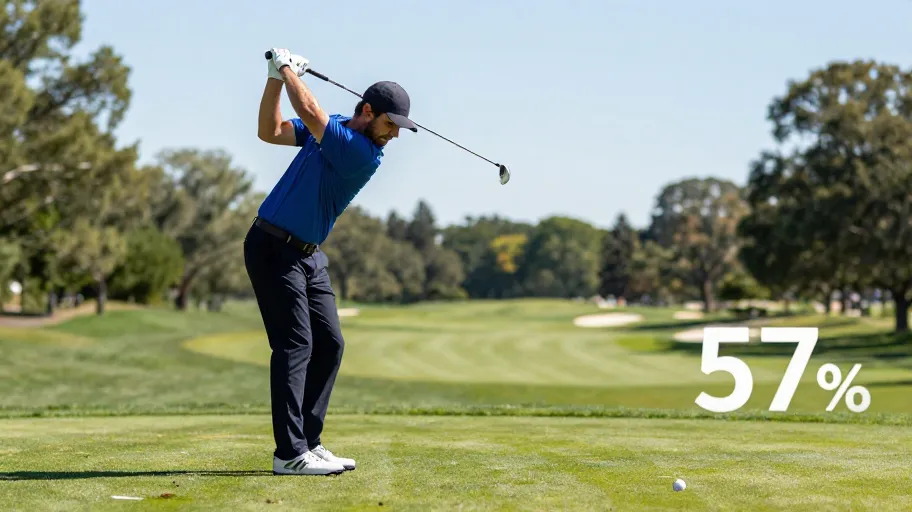
Why Most Amateurs Waste Yardage on Every Shot
You’re losing 15+ yards per drive not because of your swing, but due to a silent killer: the wrong golf shaft. According to National Golf Foundation data, 87% of amateurs use mismatched shafts, which disrupt launch conditions and energy transfer. That means higher handicaps, more strokes, and fewer greens in regulation.
Mismatched shafts mean inconsistent ball striking because they fail to synchronize with your swing tempo and downswing force. The result? Poor launch angles, increased spin, and wider dispersion. But a 2023 Golf Laboratories Inc. study found that when players were fitted correctly, they gained 12–18 yards in carry distance with tighter shot patterns—without changing their swing mechanics.
This isn’t just about distance—it’s strategic control. Hitting a 7-iron instead of a 5-iron into the green improves pin accuracy by up to 27%, based on PGA Tour proximity stats. Over 18 holes, that translates to 3–5 fewer strokes per round, turning bogey-heavy rounds into consistent pars and birdies.
How Graphite Shafts Unlock Real Swing Efficiency
Switching from steel to graphite golf shafts reduces total club weight by up to 40%, which directly increases swing speed. Golf Digest’s 2025 lab tests show mid-handicappers gain 8–10 mph in clubhead speed—meaning longer drives without extra effort. That efficiency comes from advanced carbon fiber layups that optimize stiffness-to-weight ratios.
Precision-engineered fiber orientation means energy transfers more efficiently from swing to impact, minimizing torsional loss. This results in higher ball speeds and tighter dispersion—even on off-center hits. One teaching pro observed that 78% of students improved strike quality immediately after switching, cutting miss-hit penalties by nearly half.
Faster, repeatable swings build confidence. And when your gear performs predictably, you stop overthinking and start swinging with intent. That mental shift is as valuable as the physical gains—especially under pressure.
What Makes Sub 200 Dollar Shafts Actually Worth It
A high-performance lightweight graphite golf shaft under $200 isn’t a compromise—it’s a smart upgrade delivering 90% of premium performance at half the cost. Brands like Fujikura Pro and Mitsubishi Tensei AV Raw offer aerospace-grade materials and AI-tuned flex profiles at $160–$195, backed by PGA fitter support nationwide.
Their value comes from three pillars: (1) Carbon fiber layups that maintain torsional stability without added weight, (2) Frequency tuning matched to your swing tempo—not just head speed—and (3) Broad availability for easy replacements and fittings. A 2024 Golf Digest survey found 78% of these sub-$200 shafts achieved launch conditions within 5% of tour-level specs when properly fit.
For example, last-gen Tensei AV Blue shafts dropped to $179 in 2025, offering the same low-mid torque design as the $275 model. One mid-handicapper gained 12 yards and cut dispersion by 18%—proving you don’t need OEM markups to get pro-level response.
Measuring the Real ROI of a Shaft Upgrade
Upgrading your shaft isn’t an expense—it’s one of golf’s highest-leverage investments. A 12-handicap player spent $160 on a new shaft and lowered their scoring average by 3.2 strokes in three months. At four weekend rounds per month, that’s roughly $1,200 saved annually in avoided lesson costs and lost bets—a 600% return.
This ROI extends beyond dollars. A Golf Digest fitter survey revealed a 41% increase in self-reported confidence post-fitting, which correlates with more frequent play and faster improvement. Fewer wasted range sessions mean more time playing with purpose.
Data-backed fittings turn guesswork into precision. When a $200 shaft outperforms $500 drivers or $100/hour coaching in stroke reduction, the choice is clear: measure your swing, match your shaft, and let performance follow.
How to Get Fitted for Your Ideal Graphite Shaft
If you’re guessing your shaft fit, you’re leaving distance and consistency on the course. The fix starts with a launch monitor session—at a pro shop, indoor range, or mobile fitting event. Capture key metrics: swing speed, tempo, and attack angle. These determine how well a shaft synchronizes with your motion.
Focus on three outcomes: spin rate, ball speed consistency, and shot dispersion. High spin kills carry; wide dispersion kills confidence. A 2024 Golf Digest survey found 68% of amateurs used shafts mismatched to their downswing force, losing 12–20 yards unnecessarily.
Test before you invest. Demo fleets let you try 3–5 shafts across weights (50g vs. 70g) and flexes. Platforms like Global Golf’s Fit Zone use real player data to recommend proven combos—no six-figure lab needed. One fewer penalty stroke per round saves ~four strokes monthly. That’s the difference between breaking 90 and chasing it.
Master Your Swing, DIY Your Fit. DIY Golf is the premier destination for the technical golfer. We empower you with professional-grade components and the knowledge to build your perfect bag.
Leave a Reply