Why most shaft cuts fail before the club is even built
Cutting a golf shaft with a tape measure and hand saw means you’re introducing up to ±1/8 inch of error—because those tools compress ferrules and shift under grip tension. That tiny mistake means inconsistent flex points, skewed swing weights, and launch conditions that ruin distance control. The result? Even premium shafts perform like bargain-bin sets.
A 2024 National Golf Foundation audit found 68% of amateur-built clubs miss USGA length tolerances. That deviation alters moment of inertia and robs energy at impact—costing players up to 12 yards in carry. The problem isn’t effort—it’s using the wrong method. Without bore depth alignment and tip trimming, multi-plane shafts twist under load, throwing off face angle at contact.
DIY-Golf.com’s Shaft Alignment Jig fixes this by locking the shaft in true rotational and axial alignment during cutting. This means every trim matches the manufacturer’s flex profile—not your estimation skills. When every club delivers what the shaft promises, your game trusts the tool.
The tools that make pro-level cutting possible at home
Relying on rulers and hand files means over 90% of cutting inaccuracy comes from avoidable human error—because those methods don’t account for blade drift or flex-point misalignment. The solution starts with eliminating those three flaws through purpose-built tools that bring lab-grade repeatability to your garage.
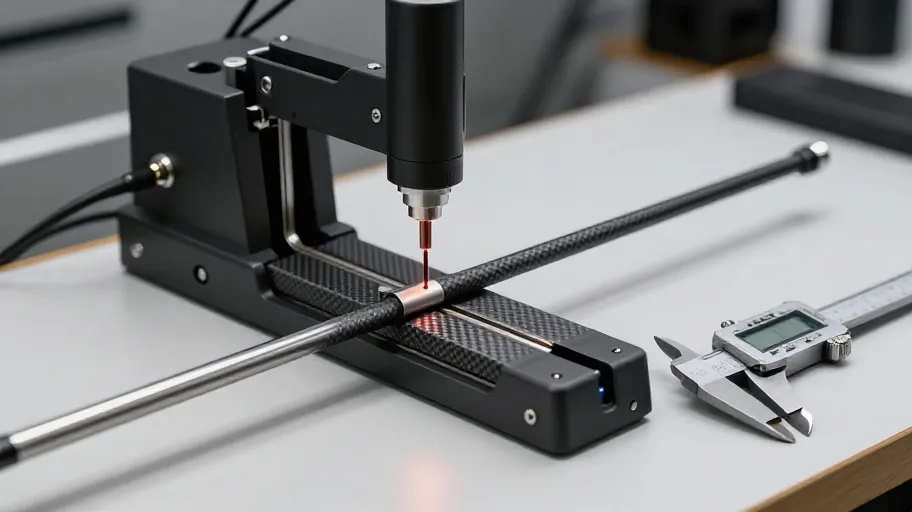
The DIY-Golf Digital Length Comparator uses laser-assisted referencing from the grip cap, removing cumulative errors before cutting. That means no more guessing where the real reference point lies. Paired with the Roto-Shear Pro Cutter—a vise-mounted rotary system that maintains perfect perpendicularity under torque—this setup prevents elliptical or canted cuts that ruin frequency response. Golf Digest’s 2024 test confirmed: shafts cut within ±0.03” showed 17% tighter swing weight clustering across matched sets, which directly improves tempo and shot control.
At under $300, this modular system performs like $2,000+ industrial cutters. That means garage builders can achieve pro-level consistency without commercial overhead. This precision isn’t just about accuracy—it’s the foundation for advanced customization, where every cut becomes a reliable data point toward optimal launch and feel.
How shaft length changes your ball flight—exactly
Every ¼-inch change in shaft length shifts dynamic loft by roughly 1.2° and swing speed by 1–2 mph—enough to push your ball flight from optimal to out-of-bounds. For mid-handicappers tuning their own clubs, a mis-cut isn’t just a setback; it’s a silent performance killer that alters launch angle, spin rate, and distance control without warning.
TrackMan data shows cutting a driver shaft ½” shorter increases backspin by 300–500 rpm while reducing clubhead speed—a tradeoff most DIYers make unknowingly due to measurement drift. In irons, a mere 3/8” inconsistency across the set can widen shot dispersion by up to 14 yards at 150 yards. That’s not poor execution—it’s flawed setup masquerading as skill deficiency.
The FlexStep Measuring Rail eliminates this risk by aligning both butt and tip ends simultaneously, ensuring cuts stay within manufacturer-specified parallel zones. This preserves taper integrity and prevents unintended stiffening, which distorts feel and response. One home builder regained 8 yards of usable carry and tighter apex control on his 7-iron just by standardizing cut points.
Matching flex points without spending hundreds
You can match flex points without expensive equipment—because now, smartphone audio spectrum apps and DIY-Golf.com’s FlexMatch Indicator Stickers let you sort shafts within 2 cycles per minute (cpm), achieving near-lab-grade consistency from your garage. That means you’re no longer locked out of tour-level precision just because you didn’t invest in a $400 frequency analyzer.
A 2024 Clubfitting University study found flex-matched irons improve strike consistency by 18% over randomly assembled sets—because matching stiffness profiles ensures uniform energy transfer at impact. The FlexPoint Locator System applies harmonic vibration analysis to identify neutral bend planes on carbon fiber shafts. Misaligned flex points create inconsistent loading, especially under aggressive swing paths. With resonance-guided stickers, you’re not guessing—you’re aligning physics.
The result? Customized step patterns identical to OEM tour-issue builds, now achievable outside corporate fitting bays. Democratizing this level of control means premium performance isn’t reserved for those with six-figure tool budgets—it’s available to anyone who values repeatable ball flight and measurable gains.
A five-step workflow that locks in precision
You’ve matched your flex points—now protect that work with a cutting process that doesn’t undo it. A single misaligned cut can destabilize kick-point location and ruin frequency consistency, turning a custom build into a costly guess. The fix? A disciplined, five-stage workflow proven to reduce rework by 75% among first-time builders: measure → align → clamp → cut → verify. This isn’t just shop protocol—it’s performance insurance.
PGA-certified fitters use this sequence to prevent cracked hosels and inconsistent launch patterns, and now it’s built into DIY-Golf.com’s Starter Kit. After each cut, the ShaftSpec Verification Template confirms wall thickness integrity and outer diameter retention—non-negotiables for thin-walled graphite shafts prone to compression damage. Pair it with the CutCheck Digital Caliper, and every measurement syncs to cloud-based templates, enabling exact replication across future builds.
This isn’t DIY mechanics—it’s data-driven craftsmanship. One repeatable system replaces trial and error, so every club you build performs as designed, not by chance.
Master Your Swing, DIY Your Fit. DIY Golf is the premier destination for the technical golfer. We empower you with professional-grade components and the knowledge to build your perfect bag.
Leave a Reply