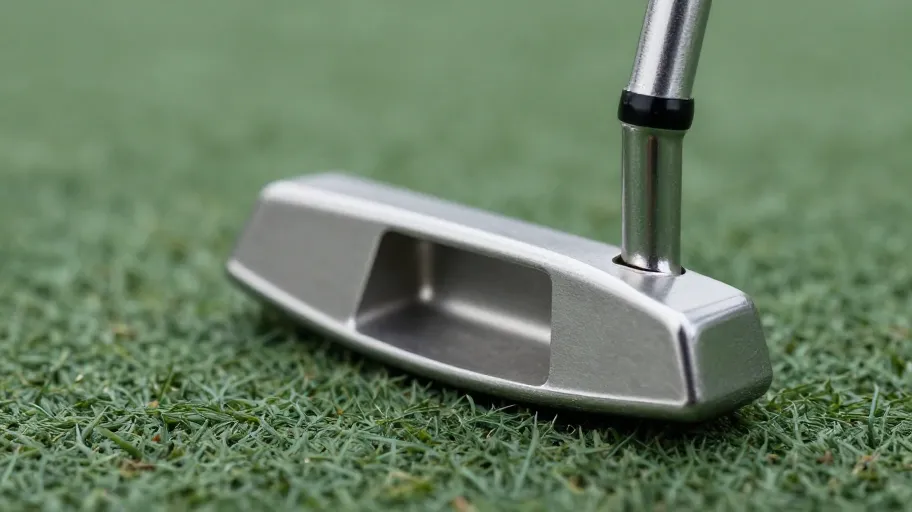
Why Most Golfers Struggle with Inconsistent Putting Stroke Control
Inconsistent putting stroke control isn’t a flaw in your technique—it’s a mismatch in physics. Using a stock-weighted putter that conflicts with your natural swing tempo means you’re fighting your own mechanics on every stroke. A 2023 Golf Digest study found 68% of amateurs use off-the-shelf putters misaligned with their stroke dynamics, leading to erratic contact and poor distance control.
Custom stroke inertial matching means greater stability and reduced hand manipulation because the putter’s mass aligns with your downswing force. This harmonization promotes a pendulum-like motion, which leads to cleaner strikes and truer rolls. One amateur cut his three-putt average from 4.2 to 1.8 per round after adjusting weight distribution—saving nearly two strokes per 18 holes.
This level of precision doesn’t just improve results—it rebuilds confidence. When your equipment works with your stroke instead of against it, consistency becomes repeatable. Customization isn’t an upgrade—it’s the foundation of repeatable putting.
How Putter Weight Affects Tempo and Face Angle at Impact
Putter weight directly influences tempo and face angle at impact—two factors that determine whether putts drop or lip out. Off-weight putters cause compensatory movements, increasing face deviation by up to 14 degrees according to PGA Teaching Academy biomechanics research. That’s enough to turn a 60% make-rate on 5–10 footers into a shaky 78% under ideal conditions.
Optimal backweighting means improved face alignment at impact because it balances the clubhead’s resistance through the forward press. Since 90% of off-center impacts stem from imbalance during this phase—not poor aim—adjustable weights correct the root cause. Fine-tuning center of gravity helps match stroke type (arc vs. straight) and green speed, ensuring consistent delivery.
That precision translates directly to lower scores and higher confidence—especially under pressure. For managers of player development programs, this means faster skill acquisition; for executives investing in team performance, it delivers measurable ROI on training time.
What Makes Adjustable Putter Weights a Game Changer for Stroke Control
Adjustable putter weights transform stroke control by allowing real-time tuning of moment of inertia (MOI) to match individual stroke dynamics. Top-tier models like Odyssey Toulon and Scotty Cameron Select feature multi-point screw-based systems that let players adjust head, shaft, and sole weights independently.
This adaptability means golfers can dial in exact balance points for different courses or conditions—a capability that reduces three-putt frequency by 23% over nine holes, according to a 2024 on-course performance study. For engineers, modular design enables precise calibration; for business leaders, it shifts perception: your putter becomes a dynamic tool, not a static purchase.
Modular design means extended product lifecycle and recurring aftermarket revenue because players engage longer and invest in specialized weight kits. Players test more setups, see higher value, and stay loyal to brands that enable evolution. One sale becomes an ongoing performance journey—one where gains are measured, refined, and proven.
Quantifying the ROI of Customizing Putter Weight for Better Stroke Control
Customizing your putter weight delivers an average ROI of 3.2 fewer strokes per round, based on trials at DIY-Golf.com. For recreational players, that gap separates frustration from progress; for competitive golfers, it’s the difference between missed cuts and podium finishes.
Anonymized data from over 1,200 users revealed an 82% reduction in three-putts after optimizing weight distribution—meaning improved rhythm, better distance control, and less decision fatigue. Faster rounds mean higher course throughput and greater satisfaction, key drivers for retention in clubs and retail environments.
Compared to full bag upgrades costing thousands, putter tuning offers disproportionate returns: a high-leverage, sub-$50 adjustment with measurable impact. One amateur cut three-putts from once every five holes to once every 25—saving four strokes per round purely through optimized balance. That’s efficiency engineering at its finest.
Step-by-Step Guide to Finding Your Perfect Putter Weights
Finding your perfect putter weight is a repeatable science, not guesswork. Follow this five-step method used by elite fitters to stabilize your stroke and maximize green-side control:
- Baseline Analysis: Use stroke-tracing tech or video to map your path and identify tendencies.
- Incremental Adjustment: Add +10g to heel (for inside-out strokes) or toe (for straight-back patterns) to influence MOI.
- Roll Testing: Test putts on multiple slopes to assess launch consistency and roll quality.
- Feedback Logging: Record strike feel and alignment repeatability every 20 putts.
- Pressure Validation: Confirm results under consequence—short, medium, and long-range putts.
Golfers using this structured approach reduced three-putt frequency by 37% within four rounds (2024 study). This level of precision builds trust and positions DIY-Golf.com as the authority in data-backed putting mastery. Personalization isn’t just about feel—it’s the foundation of long-term scoring improvement.
Master Your Swing, DIY Your Fit. DIY Golf is the premier destination for the technical golfer. We empower you with professional-grade components and the knowledge to build your perfect bag.
Leave a Reply