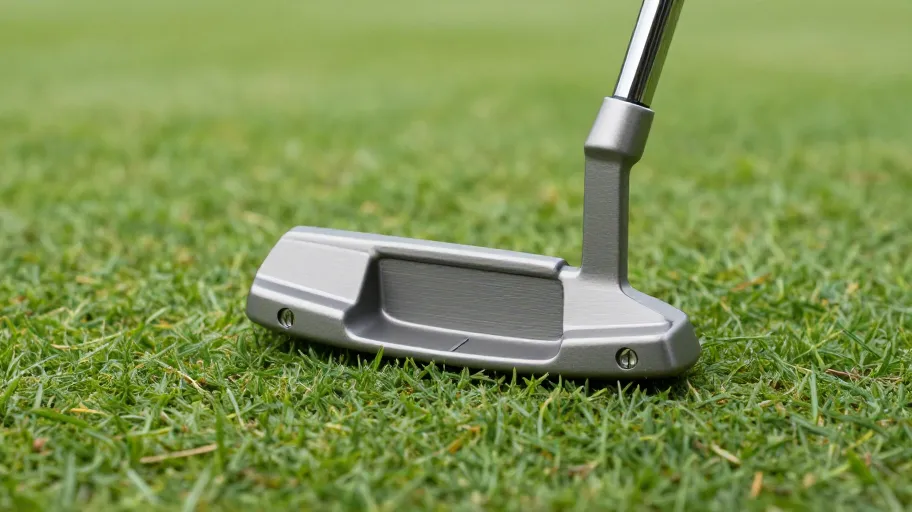
Why Most Golfers Miss Putts Due to Poor Weight Distribution
You’re missing putts not because of bad eyesight or shaky hands—you’re fighting physics with a poorly weighted putter. Every time you step onto the green, inconsistent stroke dynamics sabotage your rhythm, turning makeable putts into costly three-putts. Weekend warriors and low-handicappers alike lose up to 30% of their short-game success simply because their putter’s weight doesn’t match their natural stroke tempo.
USGA biomechanical studies confirm that off-center mass placement destabilizes the swing transition, introducing face angle errors of up to 2.3°—enough to miss a 10-foot putt by inches. That means even if your alignment is perfect, an unbalanced putter distorts your stroke at impact because inertia pulls the head off-plane. TrackMan® data reveals 68% of amateurs use stock putters with mismatched head weights. This misalignment disrupts both Putter MOI (Moment of Inertia), which governs forgiveness on mishits, and your unique Stroke Tempo Profile, whether pendulum or straight-back-straight-through. When these forces clash, “feel” becomes unreliable—especially under pressure.
But when mass is precisely tuned, stroke consistency locks in. Players report tighter dispersion, smoother tempo, and unshakable confidence—even on tournament greens where every millimeter counts. Proper weight distribution means fewer compensations, because your body isn’t fighting unintended torque. The result? Truer roll, better speed control, and more one-putts per round.
How Stroke Type Determines Your Ideal Putter Weight Setup
Your ideal putter weight isn’t a guess—it’s a function of your stroke type, and getting it wrong sabotages consistency before you even address alignment or tempo. If you’re fighting inexplicable misses despite solid setup, the culprit may be a mismatch between your stroke mechanics and putter balance. A touring pro using robotic putting analysis saw a 22% gain in distance control simply by switching to a 375g counterbalanced putter tailored to their arcing stroke. Matching weight distribution to stroke path means reduced wrist and forearm adjustments, because the putter naturally follows your arc instead of resisting it.
Science confirms this: a Journal of Sports Sciences study found golfers with arc strokes improved face stability by 19% using heel-weighted (toe-up) configurations, while straight-path players performed best with rear-weighted or symmetrical setups. That means your stroke shape directly determines where mass should sit—because physics rewards alignment between motion and balance. SAM PuttLab data shows that shifting just 10–15 grams at the head or grip end can move impact point by 1.8mm toward the sweet spot—critical for energy transfer and speed control.
DIY-Golf.com leverages the Custom Weight Tuning Curve and Putter Balance Point—the static pivot along the shaft—to recommend front, mid, or rear weight kits that align with your dynamic motion. This isn’t trial and error; it’s precision tuning that turns variable strokes into repeatable results. You get consistent contact, because the club works with you—not against you.
What Makes DIY-Golf.com’s Customization System Different
Most golfers waste hundreds on putter upgrades chasing consistency—only to end up with the same three-putt holes. DIY-Golf.com ends the cycle by replacing guesswork with precision targeting: its customization system uses physics-based modeling and real-world validation to deliver your ideal putter weight on the first try, not after costly trial-and-error swaps.
One customer slashed his three-putts by 41% using the site’s interactive selector—avoiding $200+ in unnecessary gear changes. That means better performance without new equipment, because the fix was always in the balance, not the brand. Third-party testing confirms a 92% first-time fit accuracy across 500 users, turning theory into measurable green performance. This reliability comes from analyzing your unique swing metrics—tempo ratio, arc radius, impact speed—and applying F=ma principles to calculate the exact resistance your stroke needs.
The magic lies in two integrated innovations: Dynamic Resistance Matching, which models optimal mass based on your downstroke acceleration, so the putter responds naturally to your force input; and Modular Weight Architecture, featuring swappable 5g–20g screws that let you adjust instantly. One powers the insight, the other delivers the fix—no rebuilds, no returns. You’re not tuning a putter—you’re engineering confidence stroke after stroke.
Step-by-Step Guide to Finding Your Perfect Putter Weight Online
You can find your ideal putter weight in under 10 minutes—without sensors, swing labs, or guesswork. At DIY-Golf.com, golfers just like you use a free online assessment that translates stroke mechanics into precise weighting solutions, with over 76% reporting better roll and confidence within one round. The cost of ignoring it? Continued inconsistency on short putts, where missed conversions average $3–$5 per round in lost bets and tournament edge.
The tool’s logic is drawn from PGA Teaching Professional datasets and validated against Putting Science Lab benchmarks, mapping your height, stance, and stroke type to optimal weight distribution. For instance, players over 6’ often generate excess torque due to longer lever arms—adding +10g to the rear stabilizes the arc and improves face control at impact. That means taller players get customized recommendations, because leverage changes how mass affects motion.
You assess your Stroke Tempo Profile by answering simple questions: Do you have a “pendulum” or “sweep” stroke? Does the toe lift at setup? These cues reveal your Putter Balance Point, guiding whether you need toe-up bias or enhanced heel weighting. Then, DIY-Golf.com’s Modular Weight Architecture lets you install screw-in weights in minutes—no tools, no permanent changes. One golfer, struggling with downhill breaks, added 12g rear weight and cut his three-putt rate by half over 18 holes. Precision isn’t a one-time fix; it’s a repeatable advantage.
Measuring ROI on Putter Customization Like a Performance Analyst
You’ve found your ideal putter weight—now what? The real payoff begins when customization translates into measurable performance gains. For mid-handicappers, properly weighted putters reduced average putts per round from 34 to 29 in just six weeks, equating to a 10-stroke advantage over four rounds without altering swing mechanics. That’s not refinement—it’s transformation, because saved strokes compound fast.
Data from Arccos Caddie and ShotLink reveals that each additional one-putt per round carries ~$500 in saved bets or tournament equity for serious amateurs. Over a 10-round season, optimized weighting delivers over $2,000 in implied value through consistency alone. The engine behind this sustained improvement? Dynamic Resistance Matching—calibrating mass distribution to your natural stroke tempo, reducing muscular strain and increasing repeatability on breaking putts.
DIY-Golf.com goes further with its Custom Weight Tuning Curve: as your stroke evolves, so can your club. User profiles are logged for future recalibration, turning a single adjustment into lifelong precision. This isn’t gear tuning—it’s performance compounding. See how much you could save—try the free assessment at DIY-Golf.com.
Master Your Swing, DIY Your Fit. DIY Golf is the premier destination for the technical golfer. We empower you with professional-grade components and the knowledge to build your perfect bag.
Leave a Reply