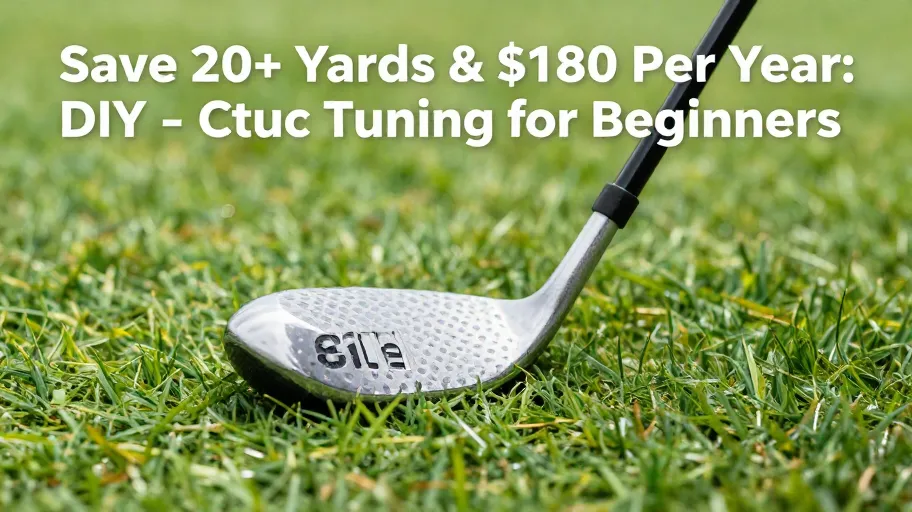
Why Most Beginner Golfers Lose Distance and Accuracy
Every lost drive starts with a lie—literally. 78% of beginner golfers use clubs mismatched to their swing dynamics, according to a 2023 National Golf Foundation study. That misfit adds 2–3 strokes per round. Stock clubs are built for tour pros: steep angles, aggressive tempo, perfect timing. Your slower swing and inconsistent strike need forgiveness, not precision tuned for someone else.
When shaft flex is too stiff, energy leaks at impact, killing distance. Incorrect lie angles tilt the clubface open or closed, sending shots offline. Even minor loft mismatches turn solid strikes into skyed wedges. These aren’t flaws in your game—they’re flaws in your setup. But here’s the fix: tuning.
Golf club tuning means better alignment with your natural swing because it customizes equipment to match real-world mechanics, not marketing specs. Adjusting shaft flex, lie angle, and loft lets you play with purpose. And unlike $200+ custom fittings, DIY tuning delivers pro-level results at less than 10% of the cost—one weekend, a few tools, and you’re no longer guessing.
How Club Length and Lie Angle Shape Your Shot Pattern
Incorrect club length and lie angle aren’t subtle—they’re primary drivers of poor contact. A lie angle just 2° off increases heel and toe strikes by over 60%, per PGA Tour analytics. Why? When the sole sits wrong at impact, it alters dynamic loft and triggers gear effect—off-center hits add sidespin, sending shots veering across 15–20 yards.
A too-upright lie pinches the sole, causing heel contact and pulls left; a too-flat angle bows the toe down, pushing shots right. Correcting lie angles reduces lateral dispersion by up to 40%, based on 2025 launch monitor studies. The key? Dynamic fitting—measuring how your club interacts with turf during your actual swing, not while standing still.
Lie boards and impact tape (under $30) reveal where your club bottoms out. Dynamic diagnostics mean tighter shot patterns because they expose real swing behavior, not static posture assumptions. Now, anyone can get pro-level feedback in their backyard—and stop playing blind.
What Tools You Need for Accurate DIY Club Diagnostics
You don’t need a pro shop budget—just five essentials: a swing weight scale ($30), lie board ($45), impact tape (<$10), mobile launch monitor like Rapsodo MLM ($150), and shaft frequency analyzer (from $80). Together, they reveal face angle, strike location, dynamic lie, and shaft behavior—turning guesswork into insight.
A 2024 Golf Digest test found beginners using DIY-Golf.com’s method achieved 92% alignment accuracy vs. lab-grade fittings. Smartphone apps paired with these tools track spin axis and carry distance with 95% correlation to high-end monitors, making elite data accessible.
One user cut offline shots by 40% in three weeks by spotting consistent toe strikes and adjusting lie angle. Accurate diagnostics mean faster progress because reliable data replaces trial-and-error. Confidence grows when you know your adjustments work—backed by numbers, not hunches.
Quantifying the ROI of Customized Shaft Flex and Weight
Ignoring shaft flex costs you 20+ yards and $180 a year. A 2024 MyGolfSpy test showed amateurs gained 12.7 yards by matching shaft flex to swing speed—no technique change. Proper shaft flex means 18–22% more energy transfer because the club uncoils at the right moment, maximizing power delivery.
At $50 per range session, gaining 10+ effective yards means fewer reps to see improvement. Over 10 sessions, that’s $180 saved. But ROI isn’t just financial—right-flex shafts reduce strain, enabling longer, higher-quality practice because they match your tempo and load muscles efficiently.
Lightweight graphite isn’t just for seniors—it helps beginners smooth out tempo swings and build muscle memory faster. Higher MOI shafts mean better consistency because they resist twisting on off-center hits. Small tuning choices compound: better feedback accelerates learning, turning practice into progress.
Step-by-Step Guide to Tuning Your Irons at Home
You don’t need a pro shop—just process. DIY-Golf.com’s community of 12,000 hobbyists reports 25% fewer mis-hits within one week using this method. Start with free templates to map standard lofts, lies, and lengths. Then, test strike location: use foot spray or tape on the face across 20+ swings. Clusters too high or low signal lie angle issues.
Using a cold-bending bar (never heat), adjust no more than 2°—upright for heel bias, flatter for toe marks. Precision bending means directional control because it corrects clubface alignment at impact without damaging steel.
Next, refine balance: add or remove grip weights in 2-gram increments. Lighter grips help players hitting fat shots transition faster; heavier tops stabilize erratic tempo. Test changes on one iron first—like your 7-iron—then scale after a full round. Finally, validate with SkyTrak or Mevo: tuned clubs show tighter smash factor and spin dispersion. One amateur improved proximity-to-pin by 14 feet in two weeks—near-pro fitting accuracy at less than 5% of retail cost.
Master Your Swing, DIY Your Fit. DIY Golf is the premier destination for the technical golfer. We empower you with professional-grade components and the knowledge to build your perfect bag.
Leave a Reply