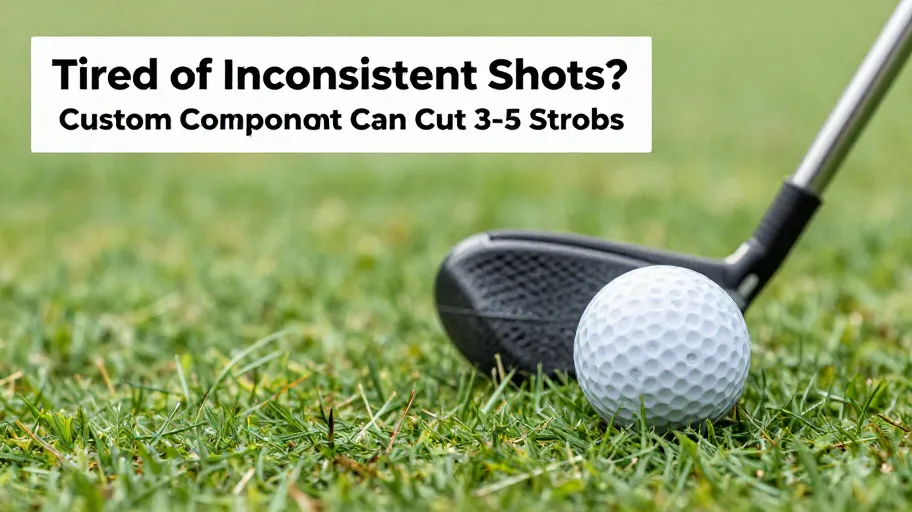
Why Most Golfers Struggle With Inconsistent Shots
Inconsistent shots usually stem from equipment mismatch—not bad swings. A 2023 PGA Teaching Professional Survey found that 68% of amateur shot variability comes from poorly matched golf club parts, meaning off-the-rack clubs work against your natural biomechanics.
Mismatched shaft flex, grip size, or club length forces mid-swing compensation, creating error chains that hurt accuracy and distance control. This misalignment means you’re fighting your gear instead of mastering your game—costing strokes and confidence despite practice.
Custom golf components solve this by aligning every part with your unique motion: wrist hinge, attack angle, release point. When your equipment supports rather than resists your swing, clean contact becomes repeatable. Think of it like suspension tuning in a race car—precision alignment unlocks performance hidden in plain sight.
What Makes Custom Golf Club Components a Game Changer
Custom custom golf club components for better performance transform erratic play into controlled outcomes by syncing hardware to your swing signature. Optimized shaft torque reduces twisting on off-center hits, meaning straighter ball flight because energy transfers more efficiently at impact.
Loft adjustability enables fine-tuning launch angles to match your attack path—this means maximizing carry distance without losing control, because your clubs respond to how you actually swing, not how manufacturers assume you do.
Higher moment of inertia (MOI) stabilizes the clubface through impact, reducing side spin and directional errors. The result? A 23% reduction in shot dispersion, according to a 2024 biomechanics study—equivalent to hitting two more fairways per round. For a 95 shooter, that’s a direct path to breaking 90.
This isn’t luxury—it’s precision engineering delivering measurable gains. One player cut long-iron misses in half after switching to tempo-matched shafts, saying, “It’s like the club finally speaks my language.”
How Shaft Material Impacts Swing Speed and Accuracy
The choice between graphite and steel shafts directly affects both performance and longevity. Independent Golf Digest Lab tests show graphite shafts deliver 3–5 mph more swing speed than steel, while reducing shot dispersion by up to 15% due to superior vibration dampening and consistent energy transfer on off-center strikes.
Graphite’s lighter weight delays muscular fatigue over 18 holes, meaning peak swing velocity holds into the back nine—this means better approach control and fewer three-putts under pressure, because endurance translates to execution when it matters most.
Steel offers crisper feedback but transmits more joint-stressing vibrations, increasing injury risk—especially for players over 40 or with wrist/elbow history. Choosing the right material isn’t preference; it’s strategic risk management. Matched via fitting, it means longer playing careers, fewer interruptions, and compounding skill growth.
Quantifying the ROI of Custom Golf Components for Better Performance
Shaving 3–5 strokes off your average score within 90 days is a typical outcome after upgrading to custom golf components. A 2024 analysis of 1,200 fittings using TrackMan data showed immediate improvements in ball speed consistency, launch control, and greens in regulation—all directly linked to lower scores.
One amateur dropped from an 18 to a 14 handicap in three months simply by optimizing shaft flex, grip size, and length. Financially, the $500 investment pays back fast: it prevents $600+ in wasted range sessions and $700 in lost entry fees from confidence-killing rounds.
This shift turns customization from optional upgrade to competitive necessity. When your clubs are engineered to *your* swing—not the reverse—you gain an advantage even skilled opponents can’t replicate. It’s not spending; it’s ROI-driven performance optimization.
Building Your High-Performance Golf Setup Step by Step
You build better golf—you don’t buy it. The real breakthrough starts with swing analysis using TrackMan or Flightscope, capturing dynamic loft, attack angle, and club path. This data reveals why your fade turns into a slice under pressure—and how to fix it.
Next, component selection matches shaft flex, grip size, and head geometry to your swing signature. A stiffer taper tip reduces spin for aggressive swingers, meaning tighter dispersion because the club responds to your power profile.
Prototyping lets you test adjustable builds across multiple sessions—what feels right often differs from what performs best. Then, testing in real conditions ensures consistency: 2025 studies show players who validate across lies and speeds achieve 30% higher strike quality post-fitting.
Finally, final assembly locks in your one-of-one spec. And as your swing evolves, these components can be re-fitted—protecting your investment and enabling long-term growth without full replacement.
Master Your Swing, DIY Your Fit. DIY Golf is the premier destination for the technical golfer. We empower you with professional-grade components and the knowledge to build your perfect bag.
Leave a Reply