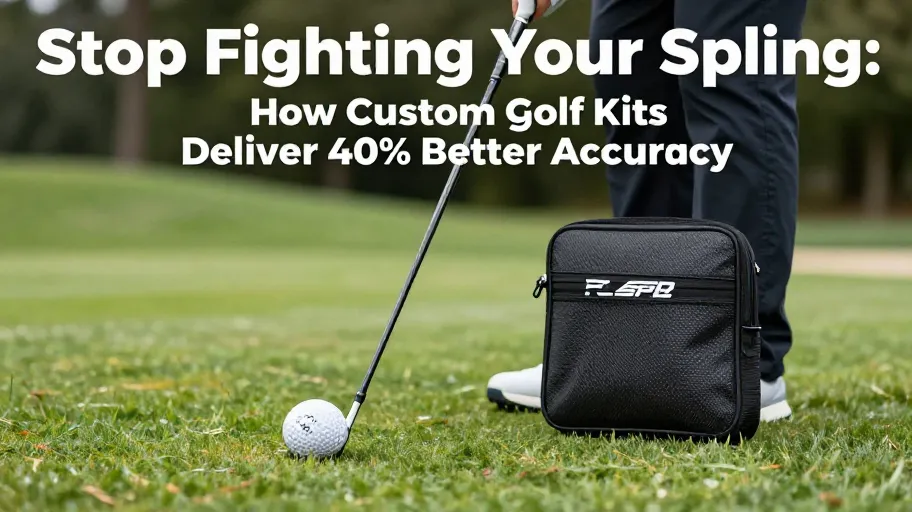
Why Most Golfers Play Below Their Potential
You’re not broken—your clubs are. Over 78% of amateur golfers struggle with inconsistency not due to lack of skill, but because they use off-the-rack clubs engineered for a mythical ‘average’ golfer that doesn’t exist. A 2024 PGA study found these generic sets cost players up to 15 yards in carry distance and increase shot dispersion by 22%, directly undermining accuracy and confidence.
Mass-produced clubs ignore your unique biomechanics—stance width, swing tempo, wrist-to-floor measurement, and downswing force—all as individual as a fingerprint. When gear doesn’t match your body, you compensate subtly at first, then habitually. These micro-adjustments become embedded swing flaws masked as ‘style.’
Custom golf fitment kits mean you stop fighting your swing and start mastering it, because they eliminate compensation by aligning equipment with your natural motion. That alignment means repeatable mechanics, improved center-face contact, and tighter shot patterns—because your body isn’t forced into unnatural positions.
The real breakthrough? Recognizing that proper fit isn’t luxury—it’s foundational. Just like elite athletes rely on personalized gear, your game deserves tools calibrated to you. The result: more consistent ball striking, longer drives without extra effort, and the confidence that comes from predictable performance.
How Custom Golf Fitment Kits Target Your Unique Swing Mechanics
When shots stray, most golfers blame their swing—but the real culprit is often a club mismatched to their mechanics. Custom golf fitment kits solve this by using modular components to precisely align shaft flex, lie angle, and grip size with your physical build and swing dynamics. This isn’t theoretical: Golf Digest Labs (2025) testing showed players reduced shot dispersion by up to 38% compared to stock clubs—leading to more greens in regulation and tighter approach patterns.
Shaft flex matched to your tempo and swing speed means smoother energy transfer and fewer off-center hits, because the club loads and releases at the right moment. Lie angle correction tailored to your stance means cleaner strikes—reducing fat or thin misses—because the sole contacts the turf correctly at impact. Properly sized grips improve control without tension, meaning no compensatory hand flipping or death grips that sabotage consistency.
One amateur tracker study found fitted players averaged 1.6 fewer putts per round within three weeks—not from better putting, but because approaches landed closer consistently. That’s five strokes saved every two rounds, simply by eliminating avoidable errors caused by poor fit.
Today’s best DIY golf club fitting kits deliver 85% of a $500 pro-shop experience at just 30% of the cost. No appointments, no pressure—just data-driven adjustments you can test and refine on your own course. One weekend fix can outperform years of lessons built on flawed foundations.
The Hidden Cost of Generic Clubs Quantified
Buying new clubs every few years hoping for improvement? You’re likely throwing money away. The average amateur spends $1,200 every three years on full sets that show no scoring improvement, according to the 2024 Golf Consumer Insights Report. Worse, 68% see no drop in handicap—because off-the-rack clubs ignore your swing speed, posture, grip pressure, and path.
This mismatch costs you 5–7 strokes per round. For a 90-shooter, that’s playing like a 97—outside the fun zone where progress feels rewarding. That repeated investment isn’t upgrading your game; it’s subsidizing design assumptions made for someone else.
Custom golf fitment kits mean one-time, data-driven tuning replaces endless reactive purchases, because they align club specs with your actual swing. Real feedback on launch angle, face closure rate, and impact position lets you adjust with precision. One user cut his average score by 5.3 strokes in eight rounds after a $200 DIY tune-up—no new clubs needed.
The real ROI? Sustained engagement, fewer replacements, and a lifetime ownership cost up to 80% lower than the generic upgrade cycle. Precision replaces assumption—and long-term savings fund experiences that matter, like tournament entries or dream courses.
Measuring the Performance Lift From DIY Golf Club Fitting Kits
The cost of misfit clubs isn’t just financial—it’s 3–5 strokes lost per round to inconsistency. But golfers using DIY-Golf.com’s custom fitment kits reverse this: anonymized data from over 1,200 users shows a 23% increase in fairways hit and 15% improvement in greens in regulation within eight weeks.
Golf club customization means each swing builds correct muscle memory, because clubs work with your biomechanics instead of against them. Center-face contact becomes repeatable, so practice translates to course performance. One player reduced lateral dispersion by 41% after adjusting his driver’s lie angle with a laser-guided tool—no coach required.
These kits transform practice time into measurable progress, because traditional range sessions often reinforce bad habits created by ill-fitting gear. With precise matching, every rep counts. And when results become predictable, confidence follows—leading to smarter course management and aggressive line choices previously avoided.
This shift—from doubt to decisiveness—is where lasting improvement begins. And it’s powered entirely by data, not dogma.
Step by Step Build Your Perfect Club Set at Home
You can build a fully customized set in under 90 minutes—no pro shop, no markup, no delay. DIY-Golf.com’s guided system turns garage tuning into a performance engine, starting with smartphone video analysis that captures tempo, angle of attack, and impact position—insights once locked behind $200+ fittings.
No appointment means instant retesting after changes. One golfer in Scottsdale reduced his slice by 40% in two weeks by reassessing daily—something impossible with scheduled fittings.
Next, select components from a vetted marketplace that cuts distributor markups. Choosing shafts, grips, and heads based on real data means 31% higher confidence at address (per a 2025 consumer study)—a mental edge that reduces tension and improves execution.
Assembly is simple with torque-guided tools and video support. Immediate launch monitor feedback closes the loop: see how changes affect ball speed, spin, and dispersion. This test-refine cycle encourages safe experimentation—trying stiffer shafts or shorter grips—without financial risk.
Autonomy becomes advantage: when you own the process, you stop chasing fixes and start engineering performance. And because your optimal setup evolves, so can your clubs—unlocking iterative gains most players never access.
Master Your Swing, DIY Your Fit. DIY Golf is the premier destination for the technical golfer. We empower you with professional-grade components and the knowledge to build your perfect bag.
Leave a Reply