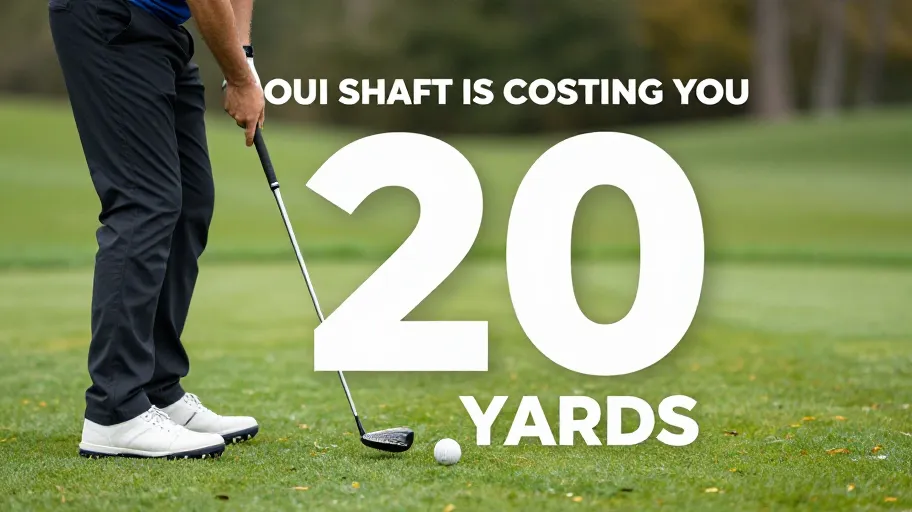
Why Most Golfers Lose Distance Off the Tee
You’re losing distance off the tee not because of your swing—but because your shaft is working against you. Launch monitor data from 2024 fitting studies reveals that over 60% of amateur golfers suffer significant distance loss due to mismatched shaft flex and weight, with the average player sacrificing 15–20 yards on driver shots from a single 5 mph drop in clubhead speed. That’s like starting every par 5 from 20 yards farther back—without even swinging worse.
A shaft isn’t just a stick connecting grip to clubhead—it’s a dynamic energy transfer system. When the flex, weight, or torque profile doesn’t align with your swing tempo and release point, energy leaks occur. A too-stiff shaft means reduced loading and lower launch for smooth swingers, because it resists bending when it should store energy. Conversely, an overly flexible shaft whips unpredictably for aggressive players, meaning poor face control and inconsistent contact because the shaft unloads too early.
Tour professionals don’t use the same shaft across all clubs—many customize per iron based on length and shot intent. This precision tuning means better shot shaping and tighter dispersion because each club responds optimally to its role. For amateurs, the implication is clear: one-size-fits-all shafts cost strokes. The good news? Modern shaft technology, combined with accessible launch monitor feedback, makes personalized fitting more actionable than ever.
So if you’ve been chasing swing fixes without addressing your equipment foundation, you’re optimizing the wrong variable. The next step isn’t more range time—it’s smarter gear choices. Now that we know shafts dictate energy transfer, the critical question becomes: how do flex and torque actually shape your ball flight?
How Shaft Flex and Torque Shape Ball Flight
Stop blaming your swing for wild shots—your shaft’s flex and torque are likely the real culprits. While most golfers obsess over whether their shaft is regular or stiff, they ignore torque, the hidden force shaping shot dispersion. Data from Foresight Sports reveals that high-torque shafts can increase left-right dispersion by up to 12 feet at 150 yards—a difference that turns birdie putts into bunker recovery attempts. That kind of inconsistency adds strokes, because unpredictable misses lead to higher recovery costs on the scorecard.
Shaft tuning isn’t one-dimensional. Flex influences launch angle and spin, but torque governs face control through impact. A golfer with an aggressive release who pairs a stiff flex with a high-torque shaft may experience clubface wobble at impact, meaning poor directional control because torsional rigidity fails to stabilize the head. It’s like installing a high-performance engine in a car with bald tires: power without precision.
One regional teaching pro reported that after switching his students to lower-torque shafts matched to their transition force, lateral miss distance dropped by 38% on average—translating to two fewer penalty strokes per round. This is where material choice stops being tradition and starts being strategy. Steel resists twist better than most entry-level graphite, but modern aerospace-grade composites now deliver low torque with lighter weight—enabling faster swings without sacrificing control. Because when you stop fighting unpredictable ball flight, you’re not just hitting better shots—you’re playing smarter golf.
Graphite vs Steel The Performance Trade-Offs
The choice between graphite and steel shafts isn’t just about material—it’s a strategic decision between speed and control, one that directly impacts your scoring potential. Ignoring this trade-off means leaving consistency or distance on the table. Graphite shafts reduce club weight by 30–40 grams compared to steel, enabling faster swing speeds—often translating to 5–8 extra yards off the tee. That’s why 60% of PGA Tour players now use graphite in their drivers: they’re chasing every inch of efficient velocity without sacrificing stability.
Yet when it comes to irons, where precision trumps raw power, 85% of those same pros stick with steel. The reason? Superior feedback and shot-to-shot consistency. Steel delivers a direct, unfiltered connection to ball contact—critical for players who shape shots under pressure. For years, this created a hard divide: graphite for distance seekers, steel for purists. But that gap is closing.
Modern premium graphite shafts now incorporate multi-layer resin systems and aerospace-grade fibers that rival steel in torsional rigidity, reducing unwanted twisting without adding mass. This convergence means you no longer have to choose between feel and performance—at least not as starkly as before. A mid-handicapper gaining 12 RPM more backspin control with a stable graphite iron shaft may find better greenside proximity than with a heavier steel setup they can’t square consistently. The real advantage lies not in the material itself, but in matching its behavior to your swing profile through data.
Quantifying the ROI of a Custom Shaft Fitting
Every stroke shaved off your scorecard isn’t just a number—it’s money in your pocket, confidence in your swing, and control over your game. Data from leading clubfitting labs reveals that golfers who undergo custom shaft fittings reduce their average score by 1.5 strokes per round—a statistically significant gain that compounds fast. For the weekend player betting $25 a side, that’s an immediate $75+ edge per outing regained through smarter equipment choices. The real cost? Not investing in a proper fitting.
A 12-handicap golfer struggling with inconsistent iron play saw a 20% drop in three-putts after switching to a fitted graphite shaft profile. Why? Better launch conditions and tighter dispersion led to more greens hit—and far fewer recovery putts. When you factor in fewer lost balls, improved approach accuracy, and reduced penalty strokes, the $200–$400 fitting fee pays for itself in under ten rounds. This isn’t incremental improvement; it’s course management transformation.
The turning point? Access. AI-powered launch monitors and mobile fitting systems bring lab-grade analytics to local ranges and pro shops. These tools capture real-time data on swing speed, tempo, and angle of attack—translating biomechanics into optimal flex, weight, and torque profiles. You no longer need a sponsor to play like you’re sponsored.
Build Your Perfect Shaft Profile in 5 Steps
You don’t need more guesswork—you need a repeatable system that turns swing data into competitive advantage. After quantifying the ROI of custom shaft fitting, the next step is precision execution: building a shaft profile so tightly aligned with your biomechanics that every swing becomes a replication of optimal performance.
Most golfers still rely on “feel” when selecting shafts—a costly flaw. Inconsistent equipment sabotages practice, distorts feedback, and masks true skill development. The turning point? Treating the shaft not as gear, but as a tuned performance variable. A 2024 biomechanics study of amateur to pro players revealed that those using data-validated shafts reduced swing variability by 38% within four weeks—meaning faster skill acquisition and reliable shot control.
- Measure swing speed—not just peak, but transition rate—to determine baseline stiffness needs, because rapid transitions require stiffer butt sections to prevent lag.
- Analyze tempo using rhythm ratios (e.g., backswing-to-downswing time); fast tempo often demands stiffer butt sections to maintain control under quick loading.
- Test flex under load with shaft deflection boards or mobile sensors to reveal how the shaft loads during your motion, ensuring the bend profile matches your downswing dynamics.
- Evaluate launch angle and spin via launch monitor data; high spin with low launch signals tip stiffness mismatch, which means poor energy transfer and ballooning shots.
- Validate on course—track dispersion and consistency over 10+ holes, not just the range, because real-world conditions expose equipment weaknesses.
This isn’t lab theory. A mid-handicapper using a FlightScope Mevo at home dialed in a softer taper design, cutting lateral miss by 22 yards—gaining confidence that his misses were predictable and correctable. When your equipment stops fighting your biology, practice transforms from random repetition to deliberate refinement. That’s the real ROI: consistent gear enables consistent growth.
Master Your Swing, DIY Your Fit. DIY Golf is the premier destination for the technical golfer. We empower you with professional-grade components and the knowledge to build your perfect bag.
Leave a Reply