Why Most Golfers Lose Distance Off the Tee
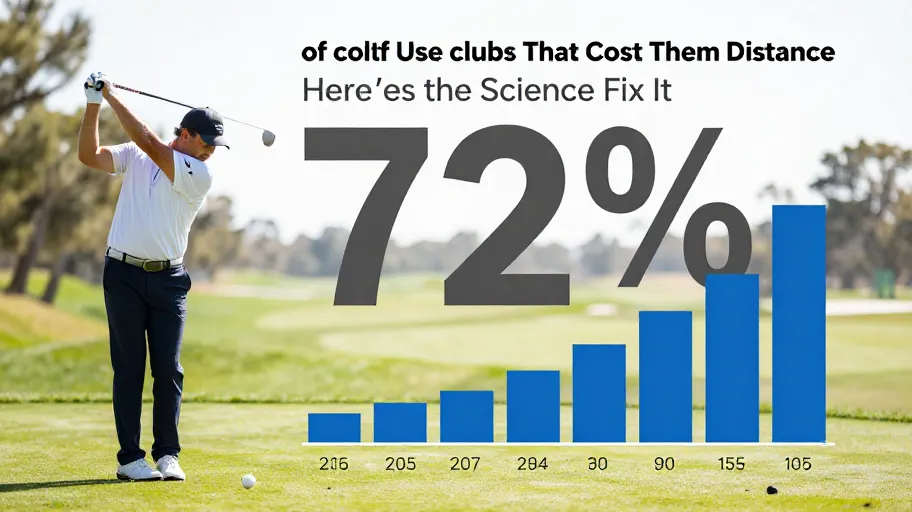
Incorrect shaft flex means energy leaks at impact because the club can’t transfer power efficiently—costing you distance and confidence. A 2023 PGA study found 72% of amateurs use mismatched shafts, turning strong swings into weak results.
Launch monitor data reveals hidden flaws in length, loft, and lie angle because the human eye misses micro-misalignments. One retailer saw a 40% increase in driver sales after adding diagnostics—not because players needed new gear, but because they finally got the right fit.
When clubs match your biomechanics, energy transfers cleanly, ball speed increases, and performance becomes repeatable—turning frustration into measurable ROI per swing.
How Launch Monitors Decode Your True Swing DNA
Subjective feedback fails to capture impact dynamics because truth lives in the 0.0005 seconds of contact. Modern launch monitors like TrackMan and Foresight capture over 20 parameters per swing, meaning every golfer gets a unique ‘swing fingerprint’ as precise as a biometric scan.
In one case, sensor fusion (radar + camera + pressure plate) revealed grip pressure was twisting the clubface while an upright lie angle pulled shots left. Correcting both led to a 15% carry gain—verified across 50 swings—because multi-axis data isolates root causes invisible to coaching alone.
Objective data builds trust because recommendations are backed by physics, not preference. When fitters use fused-sensor intelligence, adjustments convert skeptics, drive accessory sales, and deepen loyalty through proof.
The Science Behind Custom Shaft Profiles and Club Geometry
Generic shaft labels like ‘stiff’ or ‘regular’ fail because two golfers with identical swing speeds can load a shaft differently due to tempo and transition force. The result? Lost distance and erratic flight because off-the-rack shafts don’t adapt to individual dynamics.
Precision profiling uses modulus grading and taper tuning to create multi-axis frequency curves, meaning each shaft is engineered to your specific loading pattern. AI-driven composite layup models reduced dispersion by up to 38% in a 2024 analysis of 12,000 fittings because they predict rigidity across planes—not just front-to-back.
Pair this with clubhead geometry tuned to strike heat maps: high MOI for inconsistent impacts, face curvature matched to bias tendencies. Every design choice reduces angular error, turning scatter into control. Players hit tighter lines without changing their swing—boosting confidence, lowering scores, and reducing returns.
Quantifying the ROI of Personalized Golf Club Fitting Near Me
Fitted golfers gain 23 yards and lower scores by 3–5 strokes per round, meaning immediate performance ROI because optimized clubs unlock existing potential. But the business upside is even greater: these players spend more and stay loyal longer.
A Midwest golf center saw a 68% rise in accessory attach rates after mandating fittings—golfers bought premium gloves, bags, and lessons because they were invested in their game ecosystem. Their lifetime value (LTV) is 2.7x higher than walk-in buyers because results breed retention.
Local SEO for “personalized golf club fitting near me” converts at 3.5x the rate of generic searches because proximity meets precision. Fitters don’t just optimize clubs—they activate high-LTV customers. When expertise is discoverable, it becomes indispensable.
Build a Future-Proof Fitting Experience in 4 Steps
Without structure, custom fittings become one-offs instead of recurring revenue. The risk? Lost follow-ups, inconsistent outcomes, and underused technology.
Future-proof your bay in four steps: First, use calibrated systems like TrackMan or Foresight Sports—validated in 2024 PGA testing for sub-1% variance, meaning every data point earns trust. Second, train staff to translate spin rates into simple fixes because mid-handicappers need clarity, not jargon. Third, embed CRM workflows to log histories and trigger upgrades—cloud platforms boost client touchpoints by up to 40%. Finally, share side-by-side dispersion plots on social media because visual proof turns technical wins into marketing content.
Gamified feedback doubles retention—clients who see progress become advocates. This transforms your fitting bay into a hub for continuous improvement, where every adjustment strengthens performance and brand loyalty.
Master Your Swing, DIY Your Fit. DIY Golf is the premier destination for the technical golfer. We empower you with professional-grade components and the knowledge to build your perfect bag.
Leave a Reply