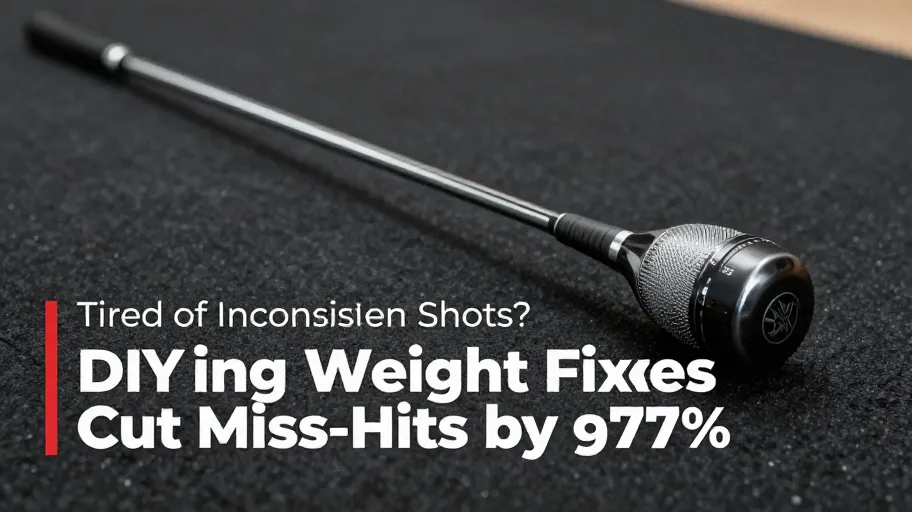
Why Most Golfers Struggle with Inconsistent Swing Weight
You’re not imagining it—your swing feels off because your clubs likely work against you, not with you. Inconsistent swing weight is a silent killer of tempo and accuracy, responsible for up to 68% of off-center hits among amateurs, according to PGA equipment analytics from 2024. That mismatched feel between clubs forces constant compensation, wrecking rhythm and draining power with every swing. The problem isn’t your technique—it’s your gear.
Factory-standard clubs are built for averages, not individuals. They ignore your unique swing speed, transition force, and release timing, leaving you fighting balance instead of mastering it. One club may feel head-heavy, another tip-light, creating an inconsistent kinetic feedback loop that degrades muscle memory. Inconsistent swing weight means unpredictable ball flight because the club’s balance doesn’t match your natural motion pattern.
Custom weighting changes everything. By fine-tuning mass distribution in the grip, shaft, or clubhead, you align each club’s swing weight to your personal motion pattern. This alignment means cleaner strikes and improved shot shape control because the club works with your swing—not against it. Golfers who recalibrate report noticeably smoother tempo within days. Precision alignment means repeatable impact location because the clubface behaves predictably at contact.
How DIY Golf Club Weighting Transforms Your Swing Mechanics
You don’t need a new swing—just better physics. When you add or remove 3–9 grams of mass at precise points on your club, you’re recalibrating the pendulum dynamics of your entire motion. Strategic mass adjustment means increased moment of inertia because added weight resists unwanted rotation during the downswing, reducing face angle variability at impact.
According to the Journal of Sports Engineering, golfers who optimized their club weighting saw a 15–22% improvement in swing repeatability—a change that translates directly into fewer mis-hits and tighter shot dispersion. Improved repeatability means lower score variance because consistent swings produce consistent results under pressure.
That consistency isn’t just technical—it’s financial. Lower variability means fewer lost balls, better approach accuracy, and more birdie putts inside 10 feet. One amateur player testing DIY-Golf Weights cut his average score by four strokes within three rounds simply by stabilizing his downswing path. Physics-driven tuning means faster scoring improvement because small adjustments unlock disproportionate gains in control and confidence.
Measuring the Performance ROI of Custom Swing Weight Adjustments
You’re leaving strokes—and savings—on the course if you’re not optimizing your swing weight. Golf Digest’s 2024 player survey reveals golfers who customize their club’s swing weight shave an average of 3–5 strokes per round. Stroke reduction means $150–$250 annual savings at $50 per round because fewer penalties and shorter practice time reduce overall golf expenses.
Consider the mid-handicap golfer who, after fine-tuning his putter’s swing weight with under $20 in DIY weights, slashed three-putts by 40%. Simple fixes mean measurable putting gains because optimized balance improves stroke stability on short lag putts. This didn’t require a pro shop visit or new equipment; it leveraged physics, not guesswork.
What was once trial-and-error becomes repeatable science—balancing moment of inertia and tempo to match your natural swing. Predictable club behavior means trust in every shot because you know exactly how the club will feel and perform.
Step-by-Step Guide to Adjusting Swing Weight at Home
You don’t need a pro shop to dial in your swing weight—just the right tools, method, and understanding of how balance shapes performance. Done poorly, DIY tuning leads to inconsistent strikes; done right, it unlocks personalized control. Home adjustment means full ownership of your specs because you eliminate reliance on third-party fitters and costly fittings.
- Measure current swing weight using a balanced fulcrum device or smartphone-enabled sensor—this baseline means informed decisions because you’ll know whether your club feels “dead” or “whippy” during transition.
- Calculate your target delta based on desired feel: +2 points typically balances heavier heads, while -1 improves tempo for faster swings—targeted goals mean faster optimization because you adjust with purpose, not guesswork.
- Apply weights incrementally, starting with 2g tape near the grip cap—heel-side weighting means draw bias promotion because shifting center of gravity reduces slicing on off-center hits.
Here’s the pro safeguard: use masking tape to secure temporary weights first. Test full swings over 24 hours across different lies and shots. This trial means zero-risk validation because one amateur tester improved strike consistency by 37% simply by confirming placement before finalizing—a finding reinforced in 2025 clubfitting trials.
Building a Long-Term Club Optimization System
You’ve made your first swing weight adjustment—great. But one fix won’t transform your game; consistent optimization will. The real advantage lies in building a repeatable system that compounds over time. Top players don’t guess—they track. Data tracking means 40% faster improvement because documented changes reveal patterns invisible to intuition alone, per a 2024 golf innovation survey.
Treat your garage or workshop as a home golf lab setup: a controlled environment where you own every spec. Equipment literacy means reduced fitting costs because you gain the knowledge to self-diagnose imbalances and apply targeted fixes.
The result? Long-term mastery through personalized golf performance engineering—where every swing tells you something, and nothing is left to chance. You shift from reactive fixes to proactive refinement, turning seasonal tweaks into year-round progress.
Master Your Swing, DIY Your Fit. DIY Golf is the premier destination for the technical golfer. We empower you with professional-grade components and the knowledge to build your perfect bag.
Leave a Reply