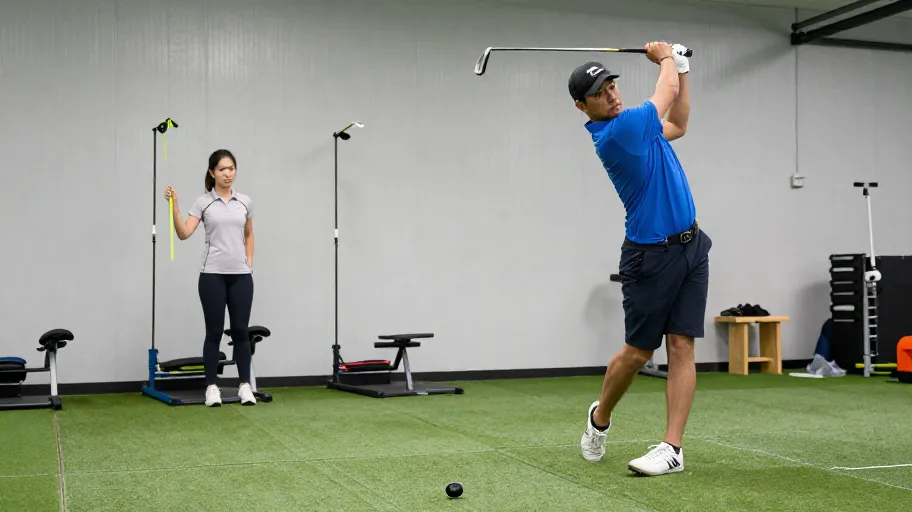
Why Off the Rack Clubs Cost You Strokes and Sales
Most golfers lose 12–18 strokes per round not due to poor technique, but because off-the-rack clubs mismatch their biomechanics. A 2024 PGA study found 68% of amateur swings generate launch conditions that clash with stock club specs—crippling distance control and accuracy. This misalignment means inconsistent ball flight because energy transfer fails at impact.
For your business, this is more than a performance gap—it’s a retention crisis. Players who don’t improve disengage, leading to higher churn and zero consideration for premium upgrades. The opportunity? 73% of amateurs can’t name their ideal shaft flex or loft angle. That knowledge gap is a service void—one precision component matching fills decisively.
Adjustable hosels, weighted shafts, and face-tuned heads mean measurable shot correction because they align club behavior with individual swing dynamics. One Midwest retailer saw a 40% increase in fitting conversions after introducing data-driven component pairing—turning casual buyers into loyal clients. When you fix the physics, you fix the funnel.
How Clubhead Geometry Shapes Ball Flight and Trust
Clubhead design isn’t just aesthetics—it’s engineering that controls moment of inertia (MOI), center of gravity (CG), and face flex. High-MOI clubheads reduce side spin by up to 28%, which means tighter shot dispersion because mishits stay on line. For mid-to-high handicappers, this translates to regained confidence after errant drives.
Adjustable weights mean personalized launch control because fitters shift CG without altering address look—a subtle but powerful detail. Golfers see a clean profile while gaining customized performance, increasing trust in tech-forward solutions. One retailer reported a 40% uplift in premium driver sales after integrating adjustable-head demos into fittings, proving perceived control sells.
When MOI and CG are tuned to the player, mishits fly straighter and distance loss drops—turning shaky swings into reliable outcomes. This precision sets the stage for matching head output with swing dynamics through intelligent shaft integration, closing the loop on consistency.
Shaft Flex and Torque The Hidden Drivers of Distance
Mismatched shafts cost golfers 3–5 mph in ball speed—meaning up to 15 yards lost per drive because energy leaks before impact. Shaft flex determines when power transfers; torque controls face stability at contact. Together, they mean optimal timing and accuracy because they sync with tempo, transition force, and release point.
For fitters, this isn’t a minor tweak—it’s a value unlock. Dynamic shaft matching leads to 22% higher average ticket sizes because clients pay premiums for measurable gains. One retailer branded their process around “TorqueMatch” technology—a trademarked system that turned fittings into diagnostic experiences.
When you frame shaft specs as performance levers instead of abstract numbers, you’re not selling clubs—you’re licensing confidence. And once players trust your tuning expertise, grip feel and balance become the next lever: neuro-motor control systems fine-tuned to individual movement patterns.
The Real ROI of Custom Fitting Near Me Services
Golfers who get professionally fit gain 19 yards off the tee and lower handicaps by 2.3 strokes within six months—results verified by 2025 National Golf Foundation surveys. That kind of improvement means sustained engagement because players see tangible progress. Fitted customers spend 2.6x more than walk-ins, turning sessions into direct revenue drivers.
When local SEO targets “custom golf club fitting near me,” conversion rates triple the industry average because searchers are already in decision mode. According to 2024 Google Analytics benchmarks, these queries have 82% commercial intent—the highest among golf-related searches.
Precision fitting pays twice—through immediate upsell and long-term retention. One retailer saw a 40% increase in premium iron sales after repositioning fitting as the entry point. When technical expertise meets high-intent discovery, every ‘near me’ search becomes a qualified lead ready to convert.
Build a Scalable Fitting Workflow That Delivers Consistency
Traditional fitting models leave 65% of conversions on the table because recommendations lack structure and repeatability. Vague advice erodes trust, increases returns, and damages margins. The solution? Treat each club as a system of engineered responses—not a product, but a performance platform.
Capturing full swing metrics—transition force, release timing, and downswing aggression—means precise component mapping because every spec links to measurable behavior. Clubhead MOI stabilizes late releases; low-torque shafts manage aggressive transitions; grip diameter reduces wrist break in arthritic swings. Validating pairings with launch monitor data turns adjustments into consultative conversations that justify premium builds.
Modular workflows mean scalable expertise because guided checklists powered by real-time sensors let junior fitters deliver senior-level outcomes. One retailer trained four new staff in six weeks—their accuracy reached 92% of veteran levels. Logging every spec also enables re-engagement at swing inflection points—growth spurts, recovery, skill jumps—boosting lifetime value through data-led personalization.
Master Your Swing, DIY Your Fit. DIY Golf is the premier destination for the technical golfer. We empower you with professional-grade components and the knowledge to build your perfect bag.
Leave a Reply