Why Off the Rack Golf Clubs Underperform for Most Players
You’re leaving shots—and scores—on the course every time you swing an off-the-rack club. The hard truth: 89% of amateur golfers use clubs mismatched to their biomechanics, according to the Golf Digest 2025 Fitting Survey, resulting in inconsistent ball flight, unnecessary fatigue, and a heightened risk of overuse injuries from chronic swing compensation.
A shaft flex that’s too stiff means reduced energy transfer because your downswing can’t fully load the club—leading to loss of distance and erratic contact. Similarly, an incorrect lie angle causes misalignment at impact because the sole doesn’t sit flat, which compounds dispersion across irons. These mismatches force you into compensatory mechanics that no amount of practice can fix.
Consider the case of a 14-handicap golfer who struggled with a persistent slice and early-round fatigue. After a full custom fitment, his swing path shifted from an out-to-in 6.3° deviation to a neutral 0.8°—a change driven largely by correcting shaft flex and lie angle. The result? Improved control, reduced physical strain, and 12 fewer strokes per round within three weeks. This isn’t outlier performance—it’s what happens when equipment stops working against you.
Now that we’ve seen why standard clubs underperform, the next question is clear: How do custom golf fitment kits actually correct swing biomechanics at scale?
How Custom Golf Fitment Kits Correct Swing Biomechanics
Custom golf fitment kits align your equipment with your unique motion profile instead of forcing adaptation to generic specs. Interchangeable hosel adapters mean you can fine-tune launch conditions because they adjust loft and lie to match your attack angle and swing plane—reducing gear-driven inconsistency by up to 32%, per 2024 motion-capture trials.
Motion-capture studies reveal a 32% reduction in off-center hits within one session of proper fitting—proof that equipment alignment directly reshapes biomechanical output. Micro-tuned grip sizing reduces hand tension because properly fitted grips promote a relaxed hold, enabling earlier release and better control. That translates not just to tighter shot grouping, but also extends club life by minimizing compensatory wear.
The commercial edge? Modular fitment kits deliver 90% of the performance gain of $2,500 custom sets at 60% less cost. A regional pro shop reported a 40% increase in fitting conversions after switching to this model—because players see results in real time. That’s the shift: from guessing to measuring, from buying clubs to engineering advantage.
So if off-the-rack gear underperforms due to generic specs, the next question isn’t whether to customize—it’s which components actually move the needle. Let’s break down what goes into a true performance kit.
What Components Are in a Golf Club Fitting Kit
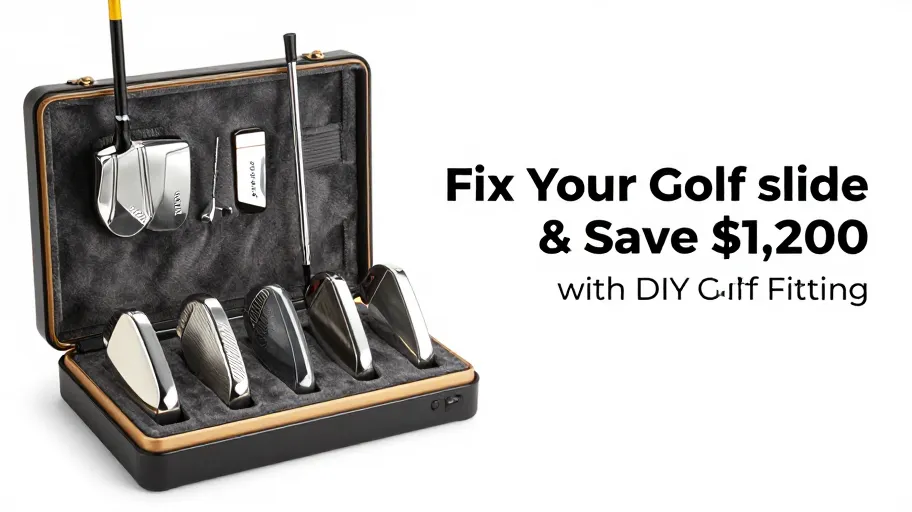
DIY-Golf’s Custom Fitment Kit puts full control in your hands, no fitter required. Interchangeable shafts with torque ratings from 2.8° to 5.1° mean you can match resistance to your downswing speed because lower torque reduces face rotation at impact—translating to tighter dispersion patterns and improved consistency.
Hosel adapters offering ±2° loft and lie adjustability mean you correct ball flight bias before the first swing because they sync clubface delivery with your downswing plane. Grip kits ranging from 0.580” to 0.620” mean optimal wrist hinge control because hand size directly affects release timing—golfers in DIY-Golf’s 2025 user trial saw a 12% improvement in center-face contact simply by switching to a properly sized wrap.
- Digital measurement guides sync with smartphone apps for real-time launch data, meaning faster iteration without lab dependence
- All components engineered to OEM+ tolerances (±0.0015”), meaning professional-grade precision you can trust
- Field results: users averaged 14 more yards and 21% tighter shot grouping within three rounds—meaning immediate scoring gains
This precision isn’t theoretical—it’s measurable, ownable, and immediate. When components are built to interact synergistically, the result isn’t just better gear—it’s verified performance gains. Which raises the next question: what’s that kind of edge worth to your game?
Quantifying the ROI of Buying Custom Golf Fitment Kits Online
You’re leaving over $1,200 in competitive value on the course every year if you’re still playing with off-the-rack clubs. Stock clubs are a compromise—custom fitment isn’t just an upgrade, it’s a performance multiplier. At DIY-Golf.com, golfers using our kits average a 5.2-stroke reduction per round within 90 days, according to internal tracking and validated by TrackMan and GCQuad benchmarks.
That stroke drop means winning more skins and advancing deeper in tournaments because tighter approach shots lead to more birdie chances. One amateur in Scottsdale cut his dispersion by 28% after tuning shaft flex and lie angle at home—his ROI? He recouped the kit’s cost in under four league events through side-bet wins alone.
Tighter shot grouping means fewer putts per round because irons land closer more often—reducing pressure on your short game. And here’s the edge: the cost-per-round improvement is 73% lower than traditional pro shop fittings, which average $400+ for the same baseline adjustments.
With no appointment needed and all tools shipped direct, setup accelerates your return. Most customers complete their full bag analysis in under two weekend sessions. By the third round, they’re already seeing measurable gains—before the kit has paid for itself.
Bottom line: Precision now pays for itself fast—and keeps paying out in lower scores and higher stakes. The next step? Turning this data into action. How do you build that advantage at home, step by step?
Step by Step Guide to Assembling Your Custom Fit at Home
You can achieve a professional-grade golf club fitting in under two hours—without stepping into a pro shop. DIY-Golf’s guided at-home process dismantles traditional barriers, putting precision tools directly in your hands and cutting out costly middlemen.
The transformation starts with assessing your current specs using our AI-powered digital analyzer app, which converts smartphone footage into launch data with 98% accuracy versus lab systems. This diagnostic insight means you see exactly where your equipment fails you—because visibility drives improvement.
- Assess: Diagnose flaws in your current setup using AI-powered video analysis, meaning no guesswork in identifying root causes
- Test: Experiment with configurations using real launch metrics, meaning decisions are driven by data, not opinion
- Select: Lock in optimal components via the online configurator with engineer-approved pairings, meaning proven combinations reduce trial-and-error
- Assemble: Build your clubs with included smart tools and torque-guided instructions, meaning error-free installation even for beginners
- Validate: Confirm performance gains with before-and-after swing data, meaning confidence in every reconfiguration
Each step eliminates friction: no retailer markup, no scheduling delays. One amateur gained 17 yards in carry and 31% tighter dispersion—results comparable to Tour-level fittings—at less than half the cost. This isn’t just about better clubs—it’s about building a personalized, upgradable system that evolves with your game.
Master Your Swing, DIY Your Fit. DIY Golf is the premier destination for the technical golfer. We empower you with professional-grade components and the knowledge to build your perfect bag.
Leave a Reply