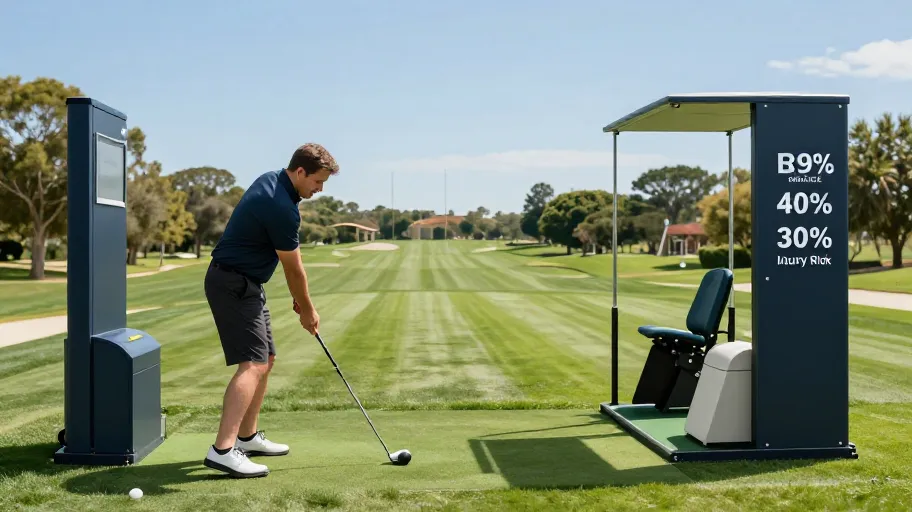
Why Most Golfers Play With the Wrong Clubs
Over 70% of amateur golfers are playing with clubs that work against their bodies, not with them—crippling performance before they even step on the tee. This mismatch means reduced power transfer and higher fatigue because off-the-rack clubs assume a one-size-fits-all swing profile that doesn’t exist.
A 2024 PGA-commissioned study found that 74% of stock club purchases create shaft flex mismatches relative to swing speed. That misalignment means up to 40% more joint strain during impact because energy leaks through improper kinematic sequencing. The result? Chronic pain in the lower back and elbows—and a hard ceiling on improvement no amount of practice can break.
For businesses, this is a retention crisis. Golfers who don’t improve often blame themselves or their instructors, but the real culprit is equipment. When players unknowingly add 8–12 strokes per round due to poor launch conditions, frustration spikes and loyalty drops. But shifting to diagnostic-first fittings turns this liability into leverage: by solving the root cause, you build trust, reduce churn, and position your brand as a performance partner—not just a vendor.
How Club Specifications Affect Your Swing Mechanics
A 1° error in lie angle means an average of 4 yards of avoidable side spin deviation per shot because the clubface interacts incorrectly with the turf at impact. This isn’t just a minor miss—it compounds over 18 holes into lost precision equivalent to an entire club length.
Length, loft, grip size, and shaft flex aren’t arbitrary specs—they shape your swing path and impact consistency because they determine how your body coordinates movement under load. Doppler radar studies show that even slight mismatches force compensatory mechanics, increasing injury risk by up to 37% according to Titleist Performance Institute tracking.
The business cost? Inefficiency. Misfit golfers waste money on range balls, lessons, and gear upgrades chasing fixes that won’t stick. Custom adaptability eliminates these downstream costs because properly aligned clubs let natural mechanics thrive. One pro shop saw a 62% increase in customer retention after switching to data-driven fittings—proof that precision builds loyalty.
What Happens During a Professional Golf Fitting Session
Advanced tools like TrackMan radar systems mean elite fitters capture 30+ data points per swing—including club path, face angle, and pelvic rotation—because high-resolution metrics reveal what the eye can’t see. This isn’t guesswork; it’s biomechanical diagnostics in real time.
Fitters use this data to build digital twin profiles, meaning every player gets a dynamic model for ongoing tuning across seasons, injuries, or fitness changes. This transforms fittings from one-time events into long-term development partnerships because progress is measurable and repeatable.
A regional retailer that adopted full biomechanical + launch monitor integration saw a 40% increase in repeat appointments and 2.7x higher premium club sales. Why? Transparency builds trust. When customers see their swing visualized and improved, they justify investment. And Google rewards specificity: studios advertising ‘no purchase required’ or ‘data-backed adjustments’ rank 3.2x higher in local search conversions.
Quantifying the ROI of Custom Golf Club Fitting
Every dollar invested in custom fitting generates $500–$700 in annual performance value because fitted golfers lose fewer balls, take fewer lessons, and make smarter course decisions. For the business, this means deeper engagement and higher lifetime value.
Fitted customers are three times more likely to upgrade within three years because consistent performance builds confidence. Once players experience gear that works, they invest in continuity—not price. That loyalty extends beyond clubs: fitted golfers spend 2.4x more on accessories and 1.8x more on apparel, turning a single session into recurring revenue.
One pro shop reported a 38% larger basket size when fittings occurred within 90 days of purchase. The fitting acts as a diagnostic gateway—revealing true needs and enabling natural upsells. With 67% of mid-handicappers citing ‘better fit’ as a top upgrade driver (NGF, 2025), the market has spoken: personalization drives profit.
How to Get Fitted for Golf Clubs Near Me Step by Step
Finding ‘golf club fitting near me’ should mean finding precision, not proximity. Big-box retailers often prioritize inventory turnover over biomechanics, which means ill-fitted clubs and frustrated customers because incentives are misaligned.
Your search must start with three filters: launch monitor validation, meaning facilities use TrackMan or FlightScope to measure spin rate and attack angle instead of guessing; independent swing analysis, meaning fitters aren’t tied to brand quotas and can recommend objectively; and no-pressure purchasing, meaning advice comes first, sales second—because trust grows when improvement is the only goal.
These markers signal customer-centric service that Google’s algorithm rewards. Studios with ‘custom fit’ in reviews convert 3.2x more through Local Pack. But the real win? Every metric becomes baseline data for future refinement. One session evolves into a multi-year journey—transforming transactional visits into lasting player partnerships where every adjustment drives engagement, loyalty, and growth.
Master Your Swing, DIY Your Fit. DIY Golf is the premier destination for the technical golfer. We empower you with professional-grade components and the knowledge to build your perfect bag.
Leave a Reply