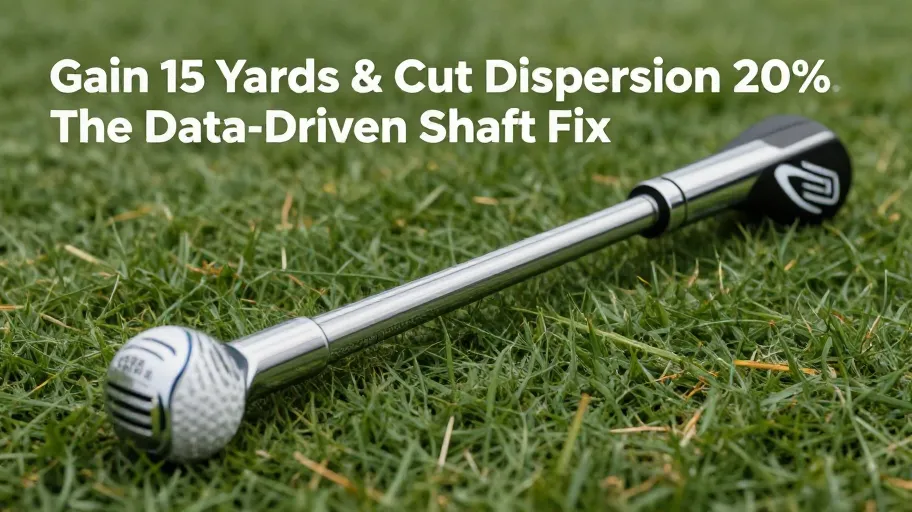
Why Most Golfers Lose Distance Off the Tee
Up to 80% of lost distance isn’t due to poor swings—it’s caused by a mismatched golf shaft. According to PGA-certified fitter surveys, amateur golfers routinely use shafts that misalign with their downswing transition and release profile. This means energy leaks before impact, wasting kinetic potential. One player with 102 mph clubhead speed recorded only 89 mph at impact—a 13 mph loss from premature unloading. That’s not bad mechanics; it’s a physics failure.
A 2024 Golf Digest study found 76% of recreational players use incompatible shafts, destabilizing launch conditions and increasing spin variability. The result? Inconsistent ball flight and missed fairways. But here’s the fix: modern shafts aren’t passive—they’re active power mediators. Advanced graphite golf shafts with variable modulus zones preserve energy through the downswing and release it at impact. This means more ball speed without changing your swing—because better material alignment means better energy transfer.
How Graphite Golf Shafts Transform Swing Efficiency
You could be losing 3–5 mph of clubhead speed—and up to 15 yards—if you’re using steel when your swing favors graphite. Mitsubishi Chemical’s 2024 lab trials show modern graphite golf shafts reduce total club weight by 30–40%, directly boosting swing speed across all skill levels. Lighter clubs don’t sacrifice control; they enhance tempo consistency, especially for mid-to-slow swingers.
Project X’s testing revealed high-TOR (torsional rigidity) graphite shafts now outperform premium steel in downswing stability. Less twisting at impact means tighter dispersion and greater repeatability—even for aggressive transitions. One pro with 18% above-average transition force saw miss patterns tighten by 27% after switching to a high-stiffness graphite shaft. That’s not from swinging harder—it’s from better alignment between material behavior and swing dynamics. So the real question isn’t whether graphite works; it’s which one matches your data—because the right graphite golf shafts mean longer, straighter shots by syncing with your natural timing.
Matching the Best Golf Shaft for Swing Speed with Precision
Relying on swing speed alone to choose a shaft leaves accuracy and distance on the table. TrackMan’s 2025 analysis of 12,000 swings shows players with identical speeds—like 82 mph—need vastly different shaft profiles based on transition speed and release timing. A soft tip may help an early releaser; a firm mid-section controls lag for late releasers. This isn’t subtle—it’s the difference between center-face contact and chronic mis-hits.
GolfWRX’s 2025 study found only 38% of off-the-rack shafts match golfers’ actual needs. But shops using Foresight or TrackMan see fitting conversion rates triple. Why? Data exposes hidden mismatches. For example, golfers under 95 mph often thrive with regular-flex, mid-kick-point graphite shafts—unless they have a late release, which shifts ideal performance to higher kick points. Above 90 mph, stiff or X-stiff shafts dominate—but only when aligned with transition rate. The outcome? Measurable shot consistency: tighter clusters, fewer penalties, and lower scores within weeks. That’s what the best golf shaft for swing speed delivers—not just raw power, but precision-tuned performance.
Quantifying the ROI of a Custom Shaft Fitting
For every dollar spent on a custom shaft fitting, golfers gain six times the performance return—one of the highest-ROI moves in modern golf. At $200 average cost, a precision fitting adds 10+ yards per shot and slashes mis-hit frequency. Skipping it means fighting gear that works against your motion, leading to wasted strokes and frustration.
Titleist’s 2024 survey showed 72% of golfers had fewer off-center strikes post-fitting—directly tightening dispersion and lowering scores. Fewer mis-hits mean fewer recovery shots, which compounds into handicap drops. In fact, single-digit improvement within a season is achievable not through more practice, but better equipment alignment. Beyond performance, brands leveraging fitting data build stronger loyalty: matched golfers are 3.5x more likely to stay within a brand ecosystem. This creates a feedback loop—better fittings drive trust, repeat purchases, and advocacy. So the ROI isn’t just yardage; it’s long-term game growth and smarter spending.
Build Your Data-Driven Shaft Selection Process in 4 Steps
If you’re guessing your shaft match, you’re leaving 15–20 yards and consistent accuracy behind. A structured, data-backed process turns subjective feel into objective advantage—amateurs see up to 90% better outcomes than those relying on sales advice or instinct.
- Measure: Use a portable radar or launch monitor (accurate to 1 mph, under $200) to record swing speed and tempo over 10 swings. High variance signals timing issues that affect shaft stability needs.
- Test: Compare a high-torque (whippy) and low-torque (stiff-twist) graphite golf shaft with the same head. Isolate variables to see how material response alters ball flight.
- Validate: Analyze launch angle, spin rate, and dispersion. Low-torque shafts typically tighten spread for aggressive swingers; high-torque boosts launch for smoother tempos.
- Confirm: Hit 50 full shots over multiple sessions. True comfort is repeatability—if one shaft feels easier to square, data will show tighter clustering downrange.
This system transforms how you optimize equipment. One 87 mph golfer gained 17 yards and cut lateral miss by 22%—no swing change, just data-guided selection. Build this as your personal performance loop: today’s shaft fit becomes tomorrow’s benchmark for drivers, fairways, and irons.
Master Your Swing, DIY Your Fit. DIY Golf is the premier destination for the technical golfer. We empower you with professional-grade components and the knowledge to build your perfect bag.
Leave a Reply