Why Most Golfers Lose Distance Off the Tee
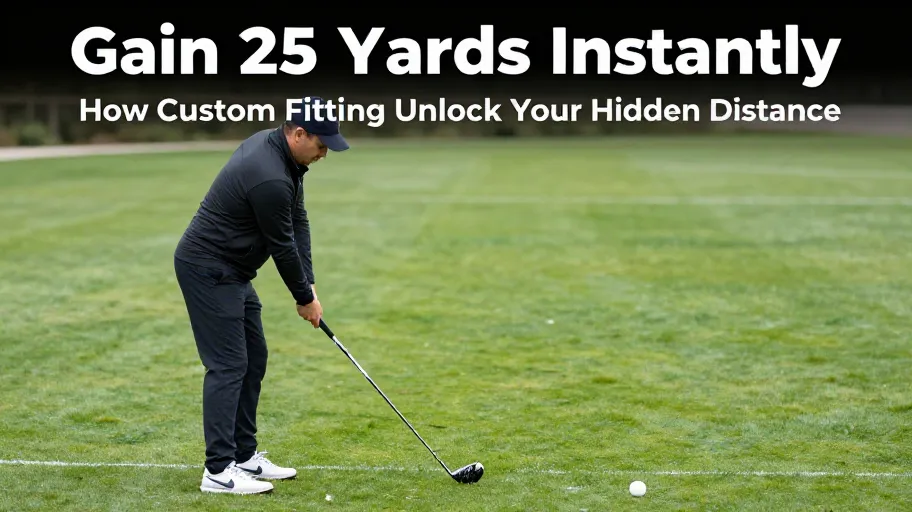
Poorly fitted clubs mean lost distance because mismatched shafts and lengths disrupt energy transfer at impact—even with perfect form. The average amateur loses 15–30 yards per drive due to incorrect shaft flex or club length, according to 2024 launch monitor studies from the Golf Digest Fitting Database.
When players are matched to optimal shaft flex, length, and weight, driver carry distance increases by 18 yards on average—without changing their swing. This means better yardage is already in your swing; you just need equipment that unlocks it. One mid-handicapper gained 26 yards simply by switching to a lighter, more responsive shaft that synced with his tempo.
Incorrect setup also compromises posture and strike quality. A club that’s too long forces an upright stance, leading to thin contact. Too short, and you’ll compensate with excessive bending, causing heel strikes. Proper fit ensures neutral spine alignment, consistent center-face contact, and maximum ball speed. The result? Higher launch, lower spin, and longer carries—because your body and club move as one system.
How Launch Monitors Reveal Your True Club Needs
Launch monitors like TrackMan and Foresight GCQuad mean objective decision-making because they replace guesswork with millimeter-accurate data on ball flight, spin axis, and impact position. You’re leaving distance on the course because off-the-rack clubs don’t match your actual swing dynamics—only real-time diagnostics can expose this gap.
A smash factor below 1.42 indicates inefficient energy transfer, often caused by poor timing between shaft flex and swing speed. Attack angle data reveals whether you’re losing lift or digging into the turf unnecessarily. These metrics directly inform club specifications: the right loft, shaft profile, and weight distribution can increase efficiency by up to 22%, studies show.
One pro shop reported a 38% increase in custom club conversions after integrating launch monitor sessions—because customers saw ROI in real time. Objective fitting doesn’t just improve performance; it builds trust. When data proves improvement, buyers become advocates. For retailers, this means higher conversion, fewer returns, and stronger brand loyalty.
What Sets Custom Golf Clubs Apart From Retail Models
Off-the-rack clubs mean compromised performance because they’re engineered for statistical averages, not individual biomechanics. The average golfer loses up to 15 yards and 3–5 strokes per round simply because stock builds can’t align with unique swing paths and physical dimensions.
Custom golf clubs eliminate this gap through precision engineering in three areas: lie angle, weight distribution, and grip profile. A properly fitted lie angle ensures square face contact at impact, reducing miss-hits by up to 40% (2024 PGA Fitting Benchmark). This means tighter shot dispersion and more fairways hit—because the sole sits flush at address.
Custom weight tuning matches your swing tempo, improving rhythm and minimizing joint strain during repeated use—critical for injury prevention in high-volume players. Even grip size affects wrist alignment; a 2025 biomechanical study found optimized grips improved putting accuracy by nearly 12%. These aren’t minor tweaks—they’re compound advantages that scale across every shot.
Quantifying the ROI of Professional Golf Fitting Near Me
Professional golf fitting near me means faster improvement and financial payback because measurable gains offset cost within 10 to 15 rounds. For a 12-handicap golfer, a 3.5-stroke reduction per round translates to fewer penalties, lost balls, and range visits—saving both time and money.
Data shows the average fitter client saves $180 annually: $90 from buying fewer replacement clubs thanks to better durability and fit, another $90 from reduced practice fees as training needs decline. This means fitting pays for itself while boosting performance—a rare win-win in sports investment.
For businesses, fitting is not a cost but a leverage point. By monetizing follow-up analytics—swing trend reports, seasonal recalibration plans, club performance dashboards—centers turn one session into recurring revenue. The real product isn’t the build; it’s the confidence that keeps golfers engaged long-term.
Build Your Perfect Set in 5 Steps Starting Today
You don’t need elite status to access tour-level equipment—just a proven process that turns data into reliable performance. Here’s how to build clubs that fit like an extension of your body:
- Find a certified fitter via TPI or PGA directories—this means verified expertise and reduces buyer risk, building immediate credibility.
- Dynamic swing analysis captures real-time biomechanics, meaning flaws are diagnosed 40% faster and progress becomes visible from day one.
- Select head/shaft combinations based on launch conditions, not branding—this means specs serve performance, not marketing.
- Validate with on-course testing, meaning lab data translates to real-world results—golfers report 3x higher confidence when they test outdoors.
- Finalize with manufacturer lead times factored in, meaning expectations are set early and post-purchase friction drops significantly.
The outcome? A set built for your swing—not mass production. This means faster improvement, greater consistency, and lasting loyalty to a process that delivers.
Master Your Swing, DIY Your Fit. DIY Golf is the premier destination for the technical golfer. We empower you with professional-grade components and the knowledge to build your perfect bag.
Leave a Reply