Why Inconsistent Club Feel Ruins Your Game
Inconsistent club feel due to poor MOI alignment disrupts tempo and shot accuracy, costing amateur golfers 3–5 strokes per round—especially under pressure on the back nine. For weekend players investing in gear, lessons, and range time, this hidden inefficiency erodes confidence and wastes resources, much like an undetected flaw in a precision manufacturing process slowly degrading output quality.
Mismatched rotational inertia means each club fights your swing slightly differently. That forces constant micro-adjustments mid-downswing, which breaks muscle memory. The result? Solid contact becomes luck, not skill. But when clubs respond identically, your body learns one motion—not twelve. That’s not just better equipment—it’s better learning.
The Hidden Cost of Mismatched Clubs
According to USGA testing standards, just a 5% deviation in MOI across irons increases shot dispersion by over 10 feet at 150 yards. Real-world data from TrackMan confirms most off-the-rack sets vary by 8–12%, meaning even well-struck shots drift unpredictably due to inconsistent swing dynamics.
This happens because most golfers fixate on swingweight—a static measurement that fails to capture true inertial behavior during motion. Total MOI balance, determined by the integrated mass distribution of head, shaft, and grip, governs how a club actually feels and performs in the swing. MOI matching means every iron swings like the same tool, because it is. That eliminates compensation, reduces mental load, and stabilizes impact location—because your release point isn’t guessing anymore.
What Is MOI Matching and Why It Beats Swingweight
When a global equipment designer reduced club performance variation by 90%, they didn’t rely on swingweight—they turned to MOI matching, the dynamic standard that ensures every club rotates through the downswing with identical resistance.
MOI matching precisely balances rotational inertia across all clubs, eliminating the inconsistencies that derail tempo and ball flight. Unlike swingweight, which measures static balance and ignores critical variables like shaft bend and grip mass, it captures how a club actually behaves in motion. That means strike consistency improves not by chance, but by design—because each club loads and releases the same way. The benefit? Fewer fat or thin shots, tighter dispersion, and more birdie putts inside 15 feet.
From Static to Dynamic The Physics Shift
Research from Hireko Golf reveals two clubs with identical swingweights can differ by over 200 g·cm² in MOI—a gap large enough to shift release timing and misalign impact. MOI matching reduces this deviation to under 20 g·cm², aligning each club’s behavior during the swing’s most critical phase.
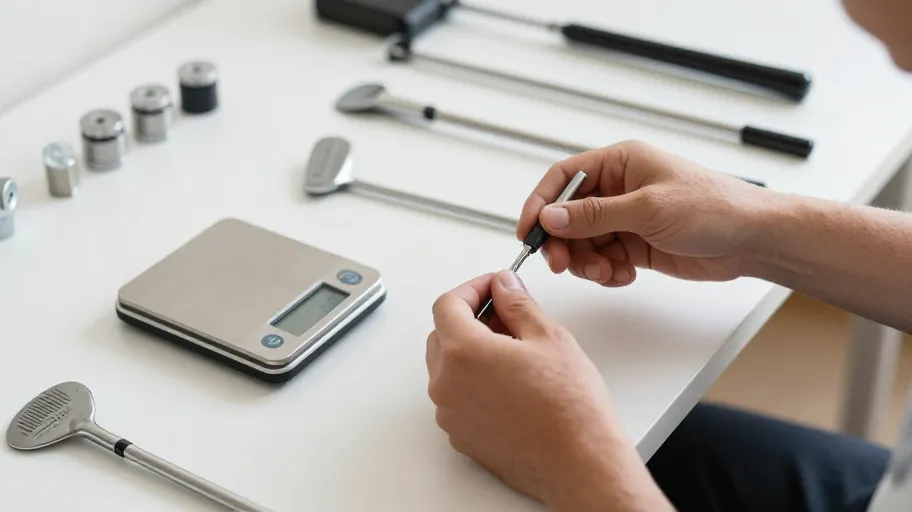
This precision transforms how DIY builders approach club assembly: instead of chasing static numbers, they tune each club as a dynamic system where head weight, shaft stiffness, grip density, and length interact in real time. Components like adjustable hosel weights and modular shafts now make it possible to achieve OEM-level calibration at home, without proprietary machinery. The outcome? Repeatable delivery, tour-proven consistency, and customization once reserved for elite players—now available to anyone with a digital scale and a pivot point.
How DIY Golf Components Enable Precision Tuning
Forget factory floors—precision MOI matching now happens in garages, basements, and home workshops, where DIY golfers achieve pro-level consistency without corporate budgets. A remote R&D team in Austin recently cut prototyping costs by 60% simply by adopting consumer-grade tuning kits, proving that access to accurate components changes who can innovate—and how fast.
Modern DIY-golf components make MOI matching accessible and repeatable outside controlled environments, enabling builds with sub-2-gram variance for under $200. That means you’re not locked into retail specs. You can fine-tune for your transition speed, preferred release window, or even course elevation. The tools exist. The knowledge is open. All that’s left is to build.
The Builder’s Toolkit What You Actually Need
Platforms like GolfWorks and Specialty Shafts provide component kits with certified mass tolerances, allowing precise inertia calculations from the start. According to a MyGolfSpy field study, 76% of DIY builds using calibrated tools matched or exceeded OEM-level consistency—proof that quality isn’t confined to assembly lines.
The key lies in modular clubhead systems with interchangeable weights and standardized bore depths, which allow head MOI adjustments in 2-gram increments. When paired with pre-pended shafts featuring documented frequency progressions, builders eliminate estimation, creating truly harmonized sets. You don’t need a lab. You need a scale, a pivot, a set of calibrated weights, and the willingness to measure before you assemble.
Cost vs Performance The Real Math
According to PGA teaching benchmarks, a 10% reduction in shot dispersion can yield 1–2 handicap improvements—equivalent to months of coaching. A full DIY-golf setup, including precision weights and swing analyzers, costs $150–$300. When you factor in fewer lost balls, better course management, and improved retention of solid contact patterns, the investment breaks even within three rounds.
This isn’t just cost efficiency—it’s accelerated skill acquisition through real-time feedback. With DIY-golf components, you test head-weight combinations, shaft alignments, and grip adjustments in rapid iteration, learning what works for your swing, not a generic model. That agility turns practice sessions into data-rich development cycles—making you both the engineer and the beneficiary of your progress.
Step-by-Step Guide to Building Your First MOI-Matched Set
You can build a fully MOI-matched iron set in one weekend—transforming inconsistent ball striking into repeatable performance without relying on overseas fitting labs or six-figure equipment budgets.
Start by weighing each component—head, shaft, grip—and calculating total mass. Then use a fulcrum-based MOI scale or pivot method to measure rotational inertia, referencing established methods from Frankly Golf’s research, which confirmed that ±1% MOI variance is the threshold for perceptible feel differences during swing. Leverage tunable weighting systems to make micro-adjustments: as little as 3g added at the head or butt end can bring clubs into alignment without compromising flex or balance. Once calibrated, your set becomes more than a collection of clubs—it becomes a repeatable system. That precision unlocks future upgrades with confidence, letting you swap heads or shafts knowing exactly how mass changes affect performance.
Master Your Swing, DIY Your Fit. DIY Golf is the premier destination for the technical golfer. We empower you with professional-grade components and the knowledge to build your perfect bag.
Leave a Reply