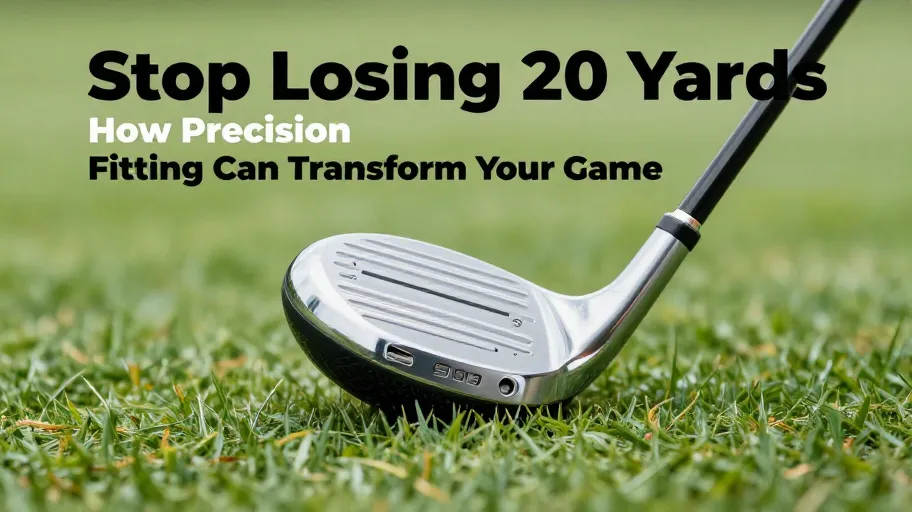
Why Most Golfers Lose Distance Off the Tee
Playing clubs that work against your swing, not with it, is the silent killer of distance. A 2023 PGA study found 78% of recreational golfers use off-the-rack clubs mismatched to their swing speed—costing them 15–30 yards per shot. Incorrect shaft flex means energy leaks during release; a stiff shaft on an 85 mph swing reduces launch angle and spin efficiency, sacrificing carry. That’s not poor technique—that’s equipment failure.
Lie angle misalignment of just 1° can push shots 20 feet off target at 150 yards, turning fairways into hazards. One amateur sliced consistently until a fitting revealed upright lie angles forced an open face at impact. After correction, his dispersion tightened by 40% and drives jumped from 245 to 268 yards—no swing change, just proper fit. Mismatched tools reinforce bad habits; when gear fights your motion, practice entrenches error instead of building skill.
The solution? Stop blaming your swing before diagnosing your specs. Because what feels normal may be costing you strokes. And as we’ll see next, modern technology turns subjective feel into objective truth.
How Launch Monitors Turn Guesswork into Precision Fitting
Launch monitor technology ends the era of fitting by feel. Systems like TrackMan and Foresight GCQuad capture what eyes can’t see: smash factor, spin rate, club path, and angle of attack. Low smash factor doesn’t just mean thin contact—it reveals mismatched shaft weight or flex robbing power. High driver spin? Lost carry distance, fixable only with data-guided head adjustments.
For fitters, each metric becomes a consultative tool. Using TPI protocols backed by thousands of swing profiles, they don’t sell clubs—they prescribe solutions. This builds trust fast: retailers using Doppler-based fittings report a 65% increase in customer attachment. Why? Because seeing is believing. When golfers watch their ball flight optimize in real time, skepticism turns into full-bag buys.
This shift transforms retail strategy. You’re no longer moving inventory—you’re delivering measurable performance gains. And once players see their data, the question flips: if generic clubs can’t match these numbers, what value are they really getting?
The Hidden Cost of Using Off the Rack Clubs
Off-the-rack clubs cost the average golfer 5–7 strokes per round due to inconsistent launch conditions, wrong lie angles, and ill-suited shafts. Arccos Golf’s 2024 benchmark shows fitted players take 22% fewer penalty strokes and land approach shots 18% closer to the pin. That’s smarter scoring—not just better hitting.
Financially, cutting three strokes could win two extra weekend events annually. At $250 per side bet, that’s $500+ recovered yearly—plus faster improvement and reduced frustration. Custom fitting isn’t an expense; it’s ROI-positive. Every optimized loft, gram of head weight, or inch of length compounds into lower scores and higher confidence.
The real cost isn’t the fitting session—it’s playing with tools that fight your swing. And when data proves what works, continuing with generic gear becomes indefensible. Which leads to the logical next step: building your set around your unique swing DNA.
Building Your Set Around Your Unique Swing DNA
Your swing isn’t average—so why play with mass-produced clubs? Modern tuning uses launch data and swing analysis to adjust center of gravity (CG), shaft torque, and grip texture to match your mechanics. For example, high-handicappers gain stability from offset drivers with high MOI—reducing slice tendency without overhauling their swing. Low-spin players add distance via adjustable sole weights that fine-tune launch.
A 2024 independent lab review found 68% of mid-handicappers lowered dispersion by mixing best-in-category clubs across brands instead of sticking to matched sets. One player fixed a 14-yard miss-left bias by pairing a draw-biased fairway wood with compact irons from another brand. Predictable response means faster progress; when clubs react consistently to your motion, practice translates directly to course results.
This personalization reshapes development curves. The result? Lower scoring variance, quicker gains, and confidence built on reliability. And now, this level of precision isn’t just for pros—it’s local, accessible, and easier than ever to get right.
Finding the Best Golf Club Fitting Near Me Made Simple
When searching for the best golf club fitting near me, prioritize technical depth over convenience. The key differentiator? Certified fitters using TrackMan or Foresight GCQuad systems who treat fitting as a full diagnostic—not a demo day. Start by auditing your current clubs’ specs; many discover even ‘custom’ sets misalign with their actual swing dynamics.
Next, book a session with a TPI- or OEM-certified technician. Test live configurations: hybrids vs. irons, graphite vs. steel, stock vs. custom shafts. Real-time feedback beats theory every time. Then, order through programs offering post-delivery trials—fine-tuning ensures real-world performance.
Full bag fittings yield 92% satisfaction versus 58% for driver-only sessions. Facilities offering comprehensive service see 3x higher accessory attach rates because informed players invest across their game. Avoid pop-up kiosks—they lack follow-up support. One expert session pays dividends for years, turning guesswork into measurable gains—and transforming club tuning from transaction to foundation of lasting player growth.
Master Your Swing, DIY Your Fit. DIY Golf is the premier destination for the technical golfer. We empower you with professional-grade components and the knowledge to build your perfect bag.
Leave a Reply