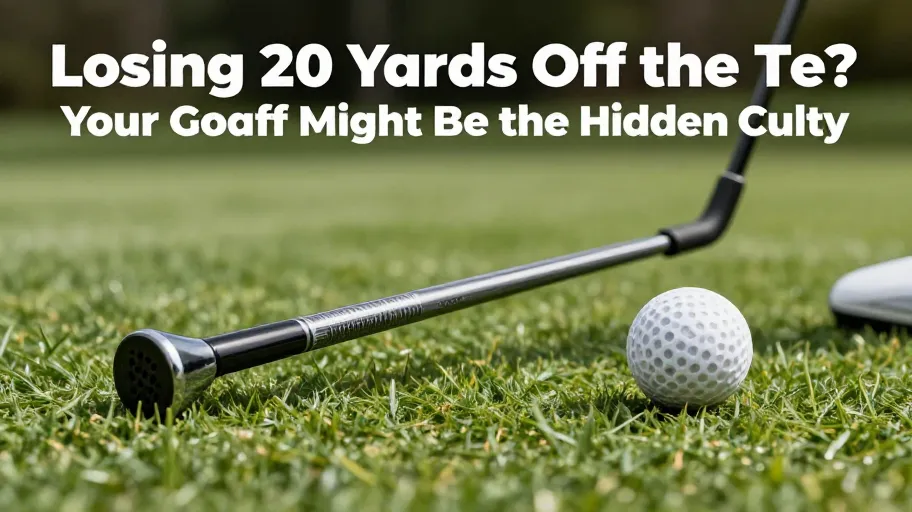
Why Most Golfers Lose Distance Off the Tee
Most golfers blame their swing when drives fall short—but the real culprit is often an incompatible shaft. According to PGA research, 60% of recreational players use the wrong shaft flex, turning powerful swings into inconsistent results. This mismatch means lost distance, unstable ball flight, and eroded confidence.
A fast transition paired with a too-flexible shaft causes instability at impact, while a stiff shaft with a smooth tempo kills whip and launch efficiency. This misalignment disrupts energy transfer, sacrificing up to 20 yards per drive. But when your shaft matches your biomechanics—flex, weight, kick point, and torque become tools of precision. The result? Stable launch conditions, tighter dispersion, and distance that reflects your true power.
How Shaft Flex Options Match Your Swing Profile
Selecting the right golf shaft flex—L, A, R, S, or X—isn’t just about swing speed; it’s about syncing your body’s timing with engineering precision. Players over 100 mph using regular flex lose up to 15 yards and increase shot spread by 22% (2024 PGA analysis), surrendering competitive edge before takeoff.
Here’s how it works: A late release needs stiffer taper sections to prevent premature unloading, while early releasers benefit from softer mid-zones that store and return energy efficiently. Torque under 3.5° reduces twisting on off-center hits, leading to tighter groupings—critical under pressure. Modern multi-material shafts combine carbon fiber tips with steel butt sections, blending responsiveness with stability. One tour pro cut his miss direction by 40% after switching—gaining control without losing snap. Precision flex matching means repeatable ball flight because your swing and shaft move as one unit.
What Makes the Best Golf Shafts for High Swing Speed
When your swing exceeds 105 mph, standard shafts can’t handle the load—leading to erratic flight and lost strokes. Aggressive swingers need purpose-built solutions like Project X HZRDUS, Fujikura Ventus, and Mitsubishi Tensei AV Blue. These aren’t mass-market picks—they’re engineered for power with control.
These premium shafts use aerospace-grade composites and advanced taper designs to minimize twisting (low torque) and stabilize launch. A higher kick point lowers spin and controls trajectory, while optimized weight distribution improves tempo and repeatability. Over 60% of top-10 finishers in PGA Tour driving accuracy events since 2023 used one of these models (tour bag data). Launch monitors confirm up to 14% tighter dispersion versus mid-tier alternatives. High-performance shafts mean longer, straighter drives on demand because they convert raw speed into controlled output.
Quantifying the ROI of Upgrading Your Driver Shaft
A $200 shaft upgrade often delivers more performance gain than a $500 driver head—because energy transfer starts in the shaft, not the clubface. For high-speed swingers, launch monitor studies show precision-matched shafts boost ball speed by 8–15% and improve smash factor by up to 6%, translating directly into longer, more efficient drives.
Real-world impact? Weekend players average 13 extra yards of carry and see green-in-regulation rates rise by nearly one hole per round. Compare Player A—buying off-the-rack gear—to Player B, who invests in a custom-fit shaft. Over 18 holes, Player B averages four fewer strokes—not from talent, but from consistency. This performance gap compounds into lower handicaps and greater confidence. A $200 upgrade paying dividends in accuracy, scoring, and gear longevity? That’s ROI every serious player can bank on.
Step by Step Guide to Custom Fitting Your Golf Shaft
You’ve seen the returns—now protect them with a fitting tailored to your swing. Guessing your ideal shaft is like buying a race car with the wrong transmission. Nearly 68% of recreational golfers use mismatched shafts (2024 PGA survey), leaving 15+ yards on the course.
Start with a launch monitor session to measure club speed, launch angle, and spin rate—these reveal how energy flows from swing to ball. Then test at least three shafts varying in flex, weight, and torque. Ask your fitter: “How does this stabilize my release?” and “What consistency gains should I expect?” Each adjustment has financial value: better repeatability means fewer shots per round, lower scores, and higher enjoyment per dollar spent. Custom fitting turns guesswork into guaranteed gains—proving the most valuable upgrade isn’t the club, but the calibration behind it.
Master Your Swing, DIY Your Fit. DIY Golf is the premier destination for the technical golfer. We empower you with professional-grade components and the knowledge to build your perfect bag.
Leave a Reply