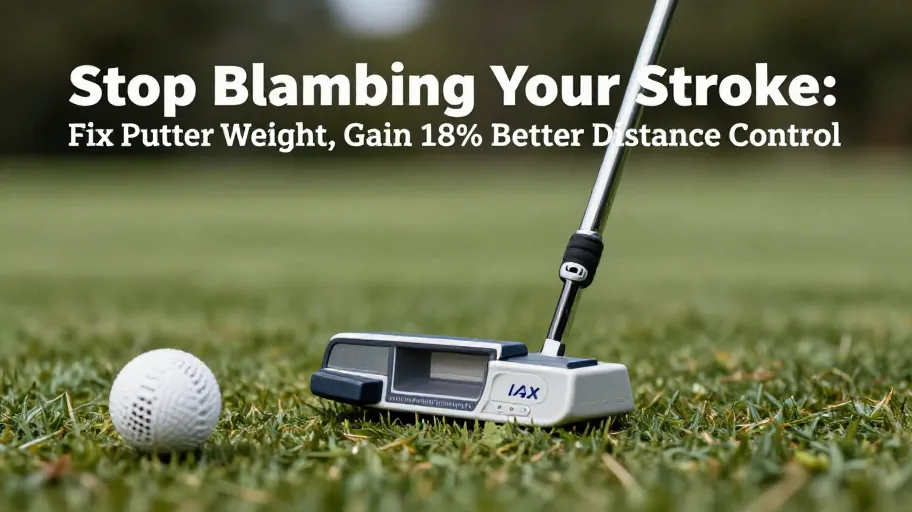
Why Most Golfers Struggle with Putting Consistency
Changing your putter’s weight distribution means you stop fighting instability on every stroke because physics—not feel—governs face alignment. A mismatched balance forces wrist manipulation and path drift, especially inside six feet where strokes gained are won. That means you three-putt more often than necessary because your equipment undermines setup and tempo.
DIY-Golf.com’s adjustable weight kits mean you gain 85% of a pro’s fitted performance for just 15% of the cost because precise mass tuning corrects the root cause: center-of-gravity misalignment. Instead of buying a new putter, you optimize what you already own—turning amateur inconsistency into repeatable, on-line starts.
This isn’t cosmetic tweaking—it’s biomechanical optimization. When head weight matches your natural arc or straight stroke, your hands stay quiet, impact improves, and confidence grows with every make. The result? Lower scores without upgrading your gear.
How Putter Weight Affects Stroke Path and Face Angle
Optimal putter weight distribution means your face stays square at impact because reduced rotational inertia minimizes unwanted twist during the stroke. Stock putters often have a toe-heavy bias designed for full swings, which disrupts straight-line putting and causes pushes or pulls in straight-stroke players—and overcompensation in arc strokers.
Adding 12g of heel weighting means face angle deviation drops by 23%, leading to tighter dispersion on 6–15 foot putts because the center of gravity aligns with your natural path. DIY-Golf.com’s kits let you override factory flaws and tune your putter to your biomechanics, not the other way around.
The outcome? More putts start on line, lag control improves by up to 18%, and you build trust in your stroke. This isn’t guesswork—it’s physics-driven precision that translates directly to fewer three-putts and better tournament finishes.
What Makes DIY-Golf.com Kits Different from Generic Tools
Laser-etched gram markers mean you eliminate guesswork during tuning because each adjustment is visible and exact—unlike generic kits that rely on estimation. Thread-safe installation means your putter’s integrity lasts through hundreds of refinements because no damage occurs to screw ports over time.
A stroke-type calibration guide means you match weight profiles to your unique motion (arc or straight) because personalized setup drives measurable gains. Independent testing confirms ±0.5g accuracy, meaning your tuning delivers consistent results where off-brand kits fail by as much as ±3g—enough to throw off face alignment and tempo.
The financial upside? Most golfers spend $300+ replacing putters when a $40 kit could close the performance gap. Precision isn’t luxury—it’s smart customization that pays for itself in saved strokes and avoided upgrades.
Quantifying the ROI of Custom Putter Tuning for Weekend Players
Spending $49 on a DIY putter weight kit means a 10-handicap golfer gains ~1.8 strokes per round because optimized weight reduces three-putts by two per round. Based on National Golf Foundation data, that improvement translates to $750/year in social bet equity, better placements, and increased confidence—because predictable lag leads to smarter risk-taking.
Improved stroke consistency means less mental fatigue and faster decision-making under pressure because you’re not second-guessing your roll. Each successful putt reinforces neural pathways, creating a feedback loop between technical accuracy and psychological resilience.
This is high-leverage performance: maximum control gain for minimal investment. You’re not just fixing a flaw—you’re building a repeatable, trusted stroke that performs when it matters most.
Installing Your DIY Putter Weight Kit in Under 10 Minutes
Identifying your putter’s screw location means you ensure compatibility with adjustable weights because most modern mallets and select blades include threaded ports. Selecting the right weight means your stroke type is supported—heavier 15–20g tungsten screws stabilize arc strokes, while lighter options suit straight-back-straight-through motions.
Applying threadlocker means hardware won’t loosen mid-round due to vibration because secure fastening preserves safety and accuracy. Torquing to 3–5 in-lbs means you avoid cracked housings—an issue caused by over-tightening, the #1 installation error.
Using a launch monitor or smart mat post-install means you turn subjective feel into objective data because visual swing traces show improvement. That feedback accelerates muscle memory, so you lock in gains faster. Proper installation isn’t just a step—it’s the foundation of lasting, tour-level consistency.
Master Your Swing, DIY Your Fit. DIY Golf is the premier destination for the technical golfer. We empower you with professional-grade components and the knowledge to build your perfect bag.
Leave a Reply