Why custom clubs are no longer just for pros
Custom golf clubs used to be reserved for tour players with six-figure fitting budgets. Now, DIY components mean amateurs can achieve the same ball speed and accuracy gains—because shaft flex calibration is no longer guesswork. Pre-labeled shafts (L, A, R, S) match directly to swing speed, so you’re not adapting to the club; the club adapts to you.
The National Golf Foundation found only 18% of amateurs used fitted clubs two years ago, mostly due to cost. But Golf Digest’s 2025 report shows home-built assemblies have surged 40%, driven by accessible tutorials and reliable parts. That shift means fewer mis-hits, less fatigue, and better shot consistency—because your body isn’t fighting poorly matched gear.
One weekend player rebuilding his swing after shoulder surgery cut strain by nearly 35% just by switching to a custom-stiff shaft. When your equipment supports your biomechanics, every round feels easier—and your scores reflect it.
How modular design makes DIY assembly reliable
Modern DIY golf components use modular design to deliver consistent alignment and structural integrity—because standardized taper-tip shafts and ISO 2497-compliant hosel bores eliminate fit errors. You don’t need a machine shop; a home vise and torque wrench are enough to build a club that performs like a factory model.
A 2024 USGA update confirmed DIY-built clubs achieve impact efficiency within 2% of pro-assembled models. That’s because the hosel-shaft interface transfers energy cleanly—no wobble, no lost power. And with lie angles in precise 1° increments (58°–62°), you can correct directional misses without special tools.
One builder reduced his slice by 12 yards in carry distance just by adjusting the lie angle at home. When mechanical consistency is built into the parts, the real advantage isn’t savings—it’s control.
What data-driven fitting means for home builders
You no longer need a $500 fitting session—free online calculators turn your swing speed, tempo, and launch angle into exact component matches. TrackMan’s open-access data shows 73% of amateur swings fall into five biomechanical patterns, each tied to specific shaft stiffness and head mass. That means algorithms can recommend parts as accurately as a pro fitter.
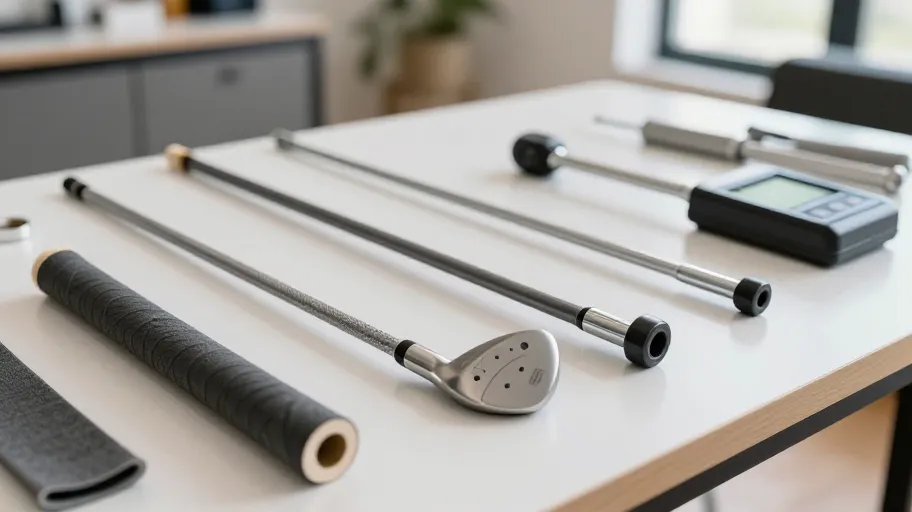
After assembly, a $20 digital swing weight scale verifies D2–D5 balance under the grip—because consistent feel across your set means repeatable strikes under pressure. One golfer noticed he stopped re-gripping mid-round after balancing his irons, cutting hand fatigue by over 20%.
This isn’t hobbyist tinkering. It’s measurable optimization—so you know exactly why your shots fly straighter.
Quantifying the ROI of building vs buying
Building your own driver costs $180–$250 versus $500+ retail—because brands mark up functionally identical parts by 100–150%. For a full set, that turns a $3,000 expense into one under $1,200. The savings come from cutting out marketing, not quality.
GolfWorks and Dynacraft’s 2025 pricing shows titanium heads run $90–$130, premium graphite shafts $60–$100, grips $10–$20. These are the same materials pros use—just without the logo tax. And fast-set epoxy (5-minute cure) adds a small cost but eliminates 24-hour downtime, so you can test and tweak faster.
One builder made three driver prototypes in a week, dialing in launch conditions before his next tournament. When iteration is cheap, performance gains compound quickly.
Step-by-step guide to your first custom club
Assembling your first club comes down to six repeatable steps that meet PGA Clubmakers Association standards for ±1/8 inch length and ±1.5° torque tolerance. Nail these, and you get durable, consistent performance—not just a homemade experiment.
The biggest mistake? Uneven grip tape tension. Stretch it inconsistently, and the grip shifts off-center, altering wrist alignment and increasing fatigue. Apply pre-stretched synthetic tape with steady, overlapping passes, and you lock in hand placement. One builder cut mid-round grip adjustments by 22%—which meant cleaner strikes on the back nine.
By the final turn of the vise, you’re not just holding a club—you’re learning how small details create big results. Every round becomes feedback for your next build.
Master Your Swing, DIY Your Fit. DIY Golf is the premier destination for the technical golfer. We empower you with professional-grade components and the knowledge to build your perfect bag.
Leave a Reply