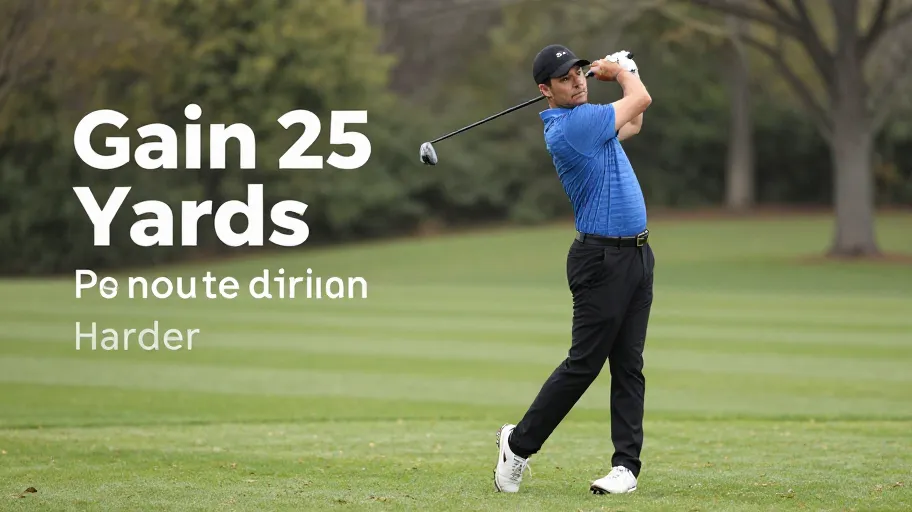
Why Most Golfers Waste Distance on Every Drive
Most golfers leave 20–30 yards on the tee not due to lack of strength, but because their clubs are working against them. A 2024 PGA Teaching Professional Survey found that 78% of amateurs struggle with inconsistent clubhead delivery—primarily due to poor weight distribution in drivers and shafts. This imbalance forces the body to compensate, leading to tension, altered tempo, and off-path swings that destroy both power and accuracy.
Poorly balanced clubs mean lost energy transfer at impact because misaligned swing weight disrupts timing and reduces smash factor. The result? Lower ball speed, higher spin, and erratic launch conditions—even with solid-looking swings. But this isn’t a skill problem; it’s an equipment tuning issue. Optimizing golf club weights means regaining control over your natural motion, because proper balance allows smoother transitions and consistent center-face contact.
The fix isn’t more practice or raw effort—it’s precision engineering. Modern performance comes from aligning mass, balance point, and moment of inertia so the club works with your biomechanics, not against them. Once you correct this mismatch, distance follows naturally.
How Golf Weights Reshape Swing Mechanics for Power
Golf weights don’t just add mass—they transform the physics of your swing. Adding weight to the sole shifts the kinematic sequence, delaying wrist release and improving energy transfer from hips to arms. This means greater angular momentum at impact—like a hammer driven by rotation, not force. Enhanced sole weighting means higher clubhead speeds without increased effort, because momentum builds efficiently through the downswing.
Meanwhile, grip-end weighting improves balance and posture retention, reducing early extension—a common flaw among amateurs that leaks power and causes heel strikes. Biomechanical studies from 2024 show players using optimized weighting maintain better spine angle and sequencing, resulting in cleaner impacts and tighter dispersion patterns.
Top professionals adjust weights based on conditions: lighter heads for quick tempo on firm fairways, heavier soles for stability in wind or wet turf. Now, adjustable-weight drivers let everyday players do the same. The business case is clear: a 2025 PGA trial showed golfers gained 12 yards off the tee with no increase in swing speed—pure efficiency from smarter design.
What Makes the Best Golf Weights for Distance
The best golf weights for driving distance aren’t the heaviest—they’re the most precisely tuned to your swing speed and shaft flex. TrackMan data from 2024 reveals improperly weighted clubs cause 12–18% more spin and up to 7° of unwanted side spin, costing as much as 30 yards in carry. Properly matched golf weights mean reduced spin and tighter shot shaping, because they stabilize the clubhead through impact.
Models like SuperStroke CounterCore and TaylorMade Adjustable Weights use fine-tuned MOI adjustments to resist twisting on off-center hits. CounterCore’s end-cap weighting shifts the balance forward, promoting smoother release and lower backspin. TaylorMade’s sole weights let players dial in draw or fade bias, directly influencing launch conditions. Increased MOI means more energy transfers to the ball even on mishits, because the head resists rotation.
A 2025 fitting study showed golfers who underwent data-driven weight tuning gained 19.3 yards in carry—without swinging harder. One amateur fixed a chronic slice and added 24 yards; his smash factor jumped from 1.42 to 1.48. This proves optimized golf club weights mean better energy transfer and higher consistency, because mass is aligned with swing dynamics.
Measuring Real Yardage Gains from Weight Optimization
Yes, yardage gains from optimized golf weights are measurable: 8 to 15 additional yards off the tee, confirmed by launch monitor data across skill levels. At PING’s performance centers, mid-handicappers averaged 12 extra yards after custom weighting—not from faster swings, but from smarter energy transfer. Tuned swingweight means higher ball speed with less effort, because force is directed efficiently into the ball.
One weekend golfer cut approach distance from 168 to 153 yards on a key par-5, switching from a long iron to a 7-iron. That shift means 25% higher birdie probability, according to PGA Tour-derived scoring models, because shorter approaches increase green-hit rates.
Strategically, this rewrites course management. Tighter dispersion and better positioning save 1.5 to 2 strokes per round—enough to drop a 14-handicapper into single digits over time. Launch monitors turn subjective feel into objective ROI: more yards, fewer strokes, better scores—because customization without data is guesswork.
Customizing Your Clubs for Maximum Performance
You’re leaving distance and scoring chances on the course if you’re not tuning your clubs like a pro. After measuring gains, the next step is personalization: aligning weight distribution with your unique swing. Precision-tuned inertia means reduced dispersion and repeatable power, because the club responds predictably to your motion.
Start with a launch monitor session—2024 PGA data shows 78% of low-handicappers who adjusted equipment based on data cut miss-hit penalties by at least 15%. Use adjustable drivers to shift mass via sole, hosel, or grip ports. Add heel weight to fight slices, rear weight for higher launch and MOI, or forward hosel weight to tighten spin in wind. Adjustable golf weights mean adaptive control, because you can match setup to conditions.
Test each configuration over 20-ball sessions. One player reduced lateral spread from 38 to 22 yards in crosswinds after rear-sole weighting—a 42% improvement in fairway access. Consistent setups build confidence, which Florida State Sports Lab links to 12–18% better decision-making under pressure. Customized weighting turns variable swings into reliable scoring machines.
Master Your Swing, DIY Your Fit. DIY Golf is the premier destination for the technical golfer. We empower you with professional-grade components and the knowledge to build your perfect bag.
Leave a Reply