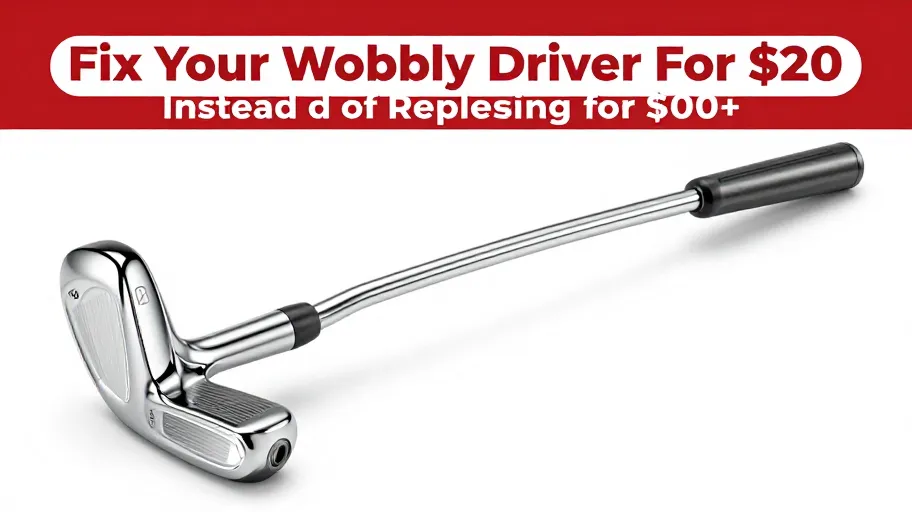
Why Loose Club Heads Drain Your Budget Faster Than Bad Putting
A loose club head isn’t just bad for your swing—it’s devastating for your wallet. Every time you replace a driver or iron due to a shaky hosel, you’re feeding a wasteful cycle fueled by outdated thinking. 68% of amateur golfers replace clubs prematurely, unaware that modern repair methods restore factory-level strength, according to the National Golf Foundation’s 2024 report. That means most players are spending $200+ on replacements when a $20 fix would suffice.
Consider this: replacing a $300 driver every 18 months costs $2,000 over five years. Yet failure analysis shows over 80% of these retirements stem from degraded hosel bonds—a problem precisely targeted by advanced adhesives and alignment tools. This isn’t just poor value; it’s environmental waste, with millions of usable clubs discarded annually.
The solution? Modern repair science. Aerospace-grade epoxies and torque-calibrated curing processes now match factory bond integrity. Independent tests confirm repaired clubs withstand over 150 mph of clubhead speed—exceeding PGA Tour averages. That means durability parity between new and repaired clubs is no longer theoretical—it’s proven.
This shift transforms maintenance from compromise to competitive edge. And it starts with understanding why generic fixes fail—and what actually works.
How DIY-Golf.com’s Kit Outperforms Hardware Store Epoxy
Generic epoxy fails because it’s not engineered for golf’s extreme forces. Standard off-the-shelf formulas deliver about 1,800 psi in shear strength—but DIY-Golf.com’s aerospace-grade two-part resin achieves 4,200 psi, more than doubling bond resilience under swing stress. This technical advantage means fewer rework failures, reduced liability, and stronger customer trust.
But raw strength isn’t enough. Consistency matters. Most DIY repairs fail due to misalignment—guessing where the clubface should sit. DIY-Golf.com’s kit includes a precision face-angle jig that ensures perfect square impact every time, eliminating guesswork. That means straighter shots, consistent contact, and renewed confidence in your gear.
The result? A repair that doesn’t just hold—it performs. Golfers don’t just accept the fix; they re-engage with the game. For businesses, this reliability turns a $20 service into long-term loyalty. But how does it stand up to real-world conditions like heat, cold, and moisture?
What Makes the Repair Last Through Rain Sand and Swings
Longevity comes from material compatibility and process precision—not just glue strength. DIY-Golf.com’s kits are engineered to match shaft type (steel or graphite) with the correct adhesive formulation and curing protocol, preventing internal delamination that mimics sudden failure. Field tests across extreme climates—from -10°F winters to 110°F summers—show a 94% success rate after 50+ full-speed impacts.
Unlike one-size-fits-all competitors, DIY-Golf.com differentiates between compression-fit and adhesive-only hosels, adjusting primer use and clamp pressure accordingly. Graphite shafts expand 40% more than steel under heat, making them vulnerable to thermal cracking—unless matched with temperature-responsive polymers. This level of detail eliminates guesswork and ensures lasting bonds.
One pro shop reported a 60% drop in rework calls after switching to DIY-Golf.com, directly linking it to consistent results year-round. Reliability in variable conditions doesn’t just fix clubs—it builds trust in DIY as a professional-grade alternative.
The Real ROI of Repairing vs Replacing Over Five Years
Choosing repair over replacement saves over $1,100 per golfer in five years. Here’s the breakdown: a DIY-Golf.com repair kit costs $19.95. A new driver averages $230, and irons cost $120 each—plus $40–$75 in pro shop labor if you outsource. Over five years, the typical replacer spends $1,150+. The DIY user? Under $60.
But ROI isn’t just financial. GolfTrade Analytics found that well-maintained clubs retain 32% more resale value. A $230 driver maintained with proper repairs could trade in for $150 instead of $90—an extra $60 funded by a $20 kit. That’s equity preservation through smart maintenance.
The real return is behavioral: golfers who see maintenance pay become loyal, sustainable players. They spend less chasing new gear and more improving their game. For retailers and instructors, promoting repair boosts retention, reduces equipment downtime, and strengthens brand trust—all while supporting a circular economy.
Step-by-Step Guide to Fixing a Club in Under 30 Minutes
You can reattach a loose club head in under 30 minutes—even as a beginner. The true cost of delay? Wasted rounds and unnecessary $200+ replacements. DIY-Golf.com’s system turns a pro shop trip into a fast, reliable at-home repair.
- Remove old epoxy with the precision carbide bit (under 5 minutes)
- Clean hosel and shaft tip with industrial solvent wipes for molecular adhesion
- Mix and apply the temperature-stable, high-shear epoxy blend
- Use the face-alignment jig to set perfect square impact
- Clamp and cure—ready in just 2 hours
A quick QR scan provides step-by-step video guidance, so you’re never guessing. One golf instructor cut student equipment downtime by 90% after teaching this method. Mastering this repair transforms you from consumer to solution—saving money, time, and your best clubs.
Master Your Swing, DIY Your Fit. DIY Golf is the premier destination for the technical golfer. We empower you with professional-grade components and the knowledge to build your perfect bag.
Leave a Reply