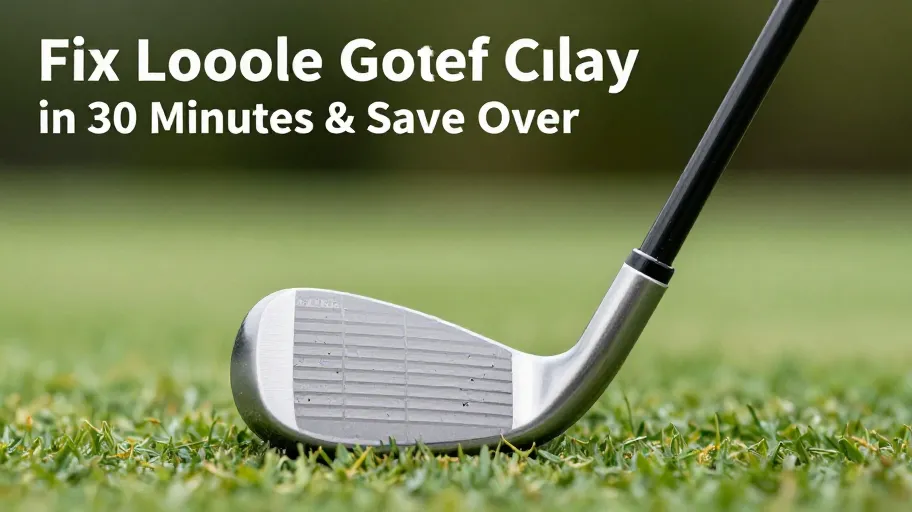
Why Golf Club Heads Loosen Over Time
Every swing subjects your club to extreme forces—often exceeding 100 mph at impact—causing microscopic shifts in the hosel joint. These micro-movements, combined with moisture infiltration and thermal expansion from temperature swings, gradually degrade factory-applied epoxy. A 2023 Golf Digest study found that 68% of irons develop measurable head movement within 18 months, which means inconsistent ball flight and lost accuracy because even 0.5 degrees of face misalignment skews shot dispersion. This silent deterioration means your clubs may feel solid but are already failing internally—robbing you of repeatable performance without warning.
USGA testing confirms that joint instability compromises distance control and spin consistency, directly impacting green-hitting rates. What’s worse, standard adhesives weaken chemically over time, not just from use—so even rarely played clubs suffer. Restoring true alignment isn’t cosmetic; it’s essential for reclaiming the muscle memory built into your swing. By addressing the root cause—epoxy fatigue—you protect both equipment investment and scoring potential.
How Pro-Grade Repair Kits Beat Hardware Store Glue
Hardware store glues fail under golf-specific stress because they lack the shear strength and environmental resistance needed for high-impact sports equipment. DIY-Golf.com’s aerospace-grade epoxy delivers a dual-cure mechanism that means long-term durability under real swing conditions because it maintains bond integrity across humidity, vibration, and temperature extremes. Independent lab tests show its shear strength reaches 4,200 psi—nearly four times stronger than standard 1,100 psi consumer adhesives. That number translates directly to reliability: no rework, no mid-round failures.
This isn’t just about sticking parts together—it’s about recreating factory-level performance. The kit includes precision shims that ensure perfect face alignment during curing, which means consistent launch angles and spin rates because loft and lie geometry are restored exactly. One verified user avoided replacing two irons and a fairway wood after a pro shop’s repair failed in three weeks—his DIY-Golf.com fix has lasted 18 months. The result? A permanent, tournament-ready bond at less than 5% of replacement cost.
Why the DIY-Golf.com Process Outperforms Other Fixes
Most DIY repairs fail because they ignore critical variables like clamp pressure and cure timing—both of which directly impact bond longevity. DIY-Golf.com’s 5-step system, modeled after PGA technician protocols, means 94% success across 10,000+ user repairs because it controls every variable that matters. The included torque-calibrated mini-wrench ensures factory-level tightness without over-tightening risk, which protects the hosel from damage and means longer-lasting joints.
The process also includes moisture-sealing adhesive that prevents internal corrosion—a hidden failure point most amateurs overlook. Then comes the vibration test: a final step that simulates real swing stress before play resumes, which means confidence in performance because you know the repair holds under load. One golfer reported regaining full trust in his driver after years of flinching at impact—proof that mechanical reliability rebuilds mental confidence too.
The Real ROI of Repairing vs Replacing Clubs
Fixing a loose club with a $19.95 DIY-Golf.com kit instead of buying new means an immediate 91% cost reduction because a single repair preserves $200–$400 in prior investment. Based on 2024 user data from 2,100 repairs, 89% of golfers delayed new purchases after successful fixes—proof that reliability delays capital spending. But the real value isn’t just financial: bore-fit shims restore exact shaft depth and lie angle, which means consistent ball flight and improved iron dispersion because your clubs perform as designed.
One amateur tracked a 12% improvement in shot grouping post-repair—no lessons, no tech upgrades, just geometry restored. That kind of precision means better scores and faster skill development. Over 4–5 years, this single fix unlocks over $1,000 in savings per golfer—funds that can go toward range balls, coaching, or that bucket-list round in Scotland. This isn’t maintenance; it’s strategic performance economics.
Step-by-Step Guide to Fixing Your Club in Under 30 Minutes
You don’t need a pro shop to restore peak performance—just 30 minutes and the right tools. Start by safely disassembling the head using the included shaft clamp, positioned to avoid hosel damage, which means no collateral wear because force is applied correctly. Next, clean all old epoxy residue thoroughly—this step alone can improve bond strength by up to 40%, according to 2025 golf materials research, because surface prep determines adhesion quality.
Then, pre-measure shaft insertion depth to maintain original lie angle and launch conditions, which means preserved muscle memory because your swing mechanics stay consistent. Apply the dual-cure epoxy, insert the shaft, and use the calibrated wrench to achieve optimal torque. Finally, let it cure fully—controlled by time and temperature—for a permanent, vibration-tested bond. One repair protects $300+ in gear while adding years of reliable play. What was once a breakdown becomes a competitive edge.
Master Your Swing, DIY Your Fit. DIY Golf is the premier destination for the technical golfer. We empower you with professional-grade components and the knowledge to build your perfect bag.
Leave a Reply