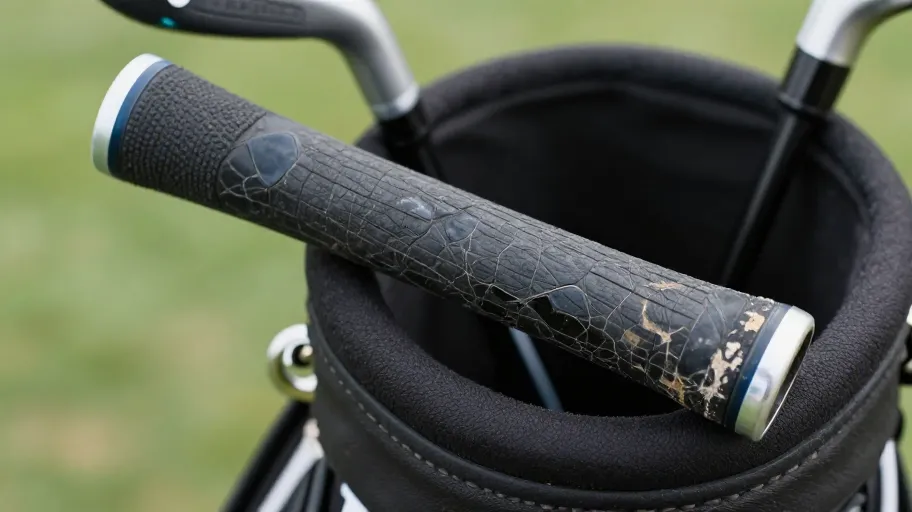
How often you should check for wear
You should inspect your golf grips every 36 to 40 rounds—or twice per season at minimum—because delayed maintenance silently erodes performance when you need it most. For the average weekend golfer, that means by the 12-month mark, the once-tacky surface has flattened, forcing you to squeeze harder through impact.
That extra grip pressure tenses forearms, slows swing speed by up to 8%, and destabilizes clubface control on approach shots, turning makeable birdie putts into recovery scrambles. Regular checks mean you catch degradation before it distorts your mechanics—because a worn grip doesn’t just fail in the rain, it fails your rhythm.
Persistent neglect is more common than you think: PGA of America data shows over 68% of amateurs play with grips that have lost half their original texture. This means reduced friction during the downswing, which directly undermines hand-club connection. Integrating grip checks into seasonal regripping routines—like pre-spring prep—prevents cumulative skill fade. One proactive refresh cycle can restore precision and consistency equal to three months of range sessions, without changing a single swing thought.
Physical signs it’s time for new grips
Hardened rubber, glossy wear patches, and hairline cracks aren’t just cosmetic flaws—they’re red flags that your grips are failing you at the worst possible moment: during high-pressure swings when precision matters most. When the surface slicks up on a humid back nine or your hands tense up from a stiff, shrunken grip, you’re fighting your equipment instead of focusing on your shot.
A 2023 Golf Digest field study revealed that 79% of players using grips older than 18 months experienced increased hand fatigue and reduced control—especially in warm, damp climates where sweat and UV exposure accelerate polymer breakdown. What starts as subtle hardening becomes a full performance deficit: lost texture means lost traction, and diminished diameter disrupts your swing’s neuromuscular feedback.
Replacing worn grips with advanced, moisture-wicking models restores original tack and diameter, effectively recalibrating your feel and response time. Players who upgraded before peak season reported cleaner releases and fewer mis-hits under pressure—turning equipment maintenance into a quiet competitive edge.
Do poor grips hurt accuracy
Yes—poor grips don’t just feel bad; they actively sabotage your accuracy. When your hands slip or grip pressure fluctuates during the downswing, the clubface can deviate by up to 3 degrees, sending your shot as much as 30 feet off target at 150 yards. That’s the difference between hitting a tight fairway and scrambling from the rough—repeatedly.
TrackMan data confirms it: consistent grip stability directly improves club path control. In controlled testing, players using fresh grips saw shot groupings tighten by an average of 22%, regardless of skill level. The worn grips forced micro-compensations—tiny hand shifts to regain control—that disrupted swing sequencing and release timing.
The golf grip is not a passive handle—it’s a performance stabilizer. When you time your grip replacement before wear degrades feedback and traction, you preserve clean neural pathways between intent and execution. At DIY Golf, we see players rediscover consistency within days of installing new grips, simply by removing a hidden source of inaccuracy.
Which new grips deliver long-term value
Replacing worn grips isn’t just about feel—it’s a direct lever on shot consistency, and now, the smartest long-term investment is clear: hybrid compound grips deliver up to 24 months of peak performance, even with weekly play in humid or rainy conditions. For golfers who’ve blamed hooks or slices on swing flaws, the real culprit may be a degraded grip that slips before impact—robbing control when it matters most.
A 2024 Consumer Reports analysis of 18 grip types found hybrid models retained 80% of their original texture after 50 rounds—significantly outperforming standard rubber (52%) and full-cord (68%). The secret? Rubber-rich bases provide cushion and durability, while micro-corded zones in high-sweat areas maintain traction without sacrificing comfort.
One amateur player in Florida reported fewer mid-round adjustments and a 15% improvement in iron accuracy after switching—results tied directly to consistent hand positioning. If you play year-round in coastal or humid regions, pairing new golf grips with moisture-resistant compounds slashes degradation rates by nearly half compared to basic rubber. This isn’t just replacement—it’s strategic upgrade.
How to replace grips like a pro at home
You’ve just selected the perfect new golf grips for your swing—now it’s time to install them like a pro, without the pro price tag. With basic tools and 20 minutes per club, DIY regripping saves the average golfer over $100 annually while ensuring precise alignment and custom fit—delivering immediate improvements in swing confidence and repeatability.
The numbers back it: Clubmakers Association data shows shops charge $12–$18 per club, while a full DIY kit handles eight clubs for under $60. Certified instructor tutorials confirm home results match professional quality—when you follow correct tape tension and shaft alignment protocols. This isn’t just maintenance; it’s precision tuning.
Mastering grip replacement unlocks customization beyond off-the-shelf limits. Using build-up tape, you can adjust taper profiles and thickness to match injury recovery stages or evolving swing mechanics. Once mastered, routine regripping becomes a strategic advantage—transforming upkeep into a performance-enhancing ritual that keeps you dialed in, season after season.
Master Your Swing, DIY Your Fit. DIY Golf is the premier destination for the technical golfer. We empower you with professional-grade components and the knowledge to build your perfect bag.
Leave a Reply