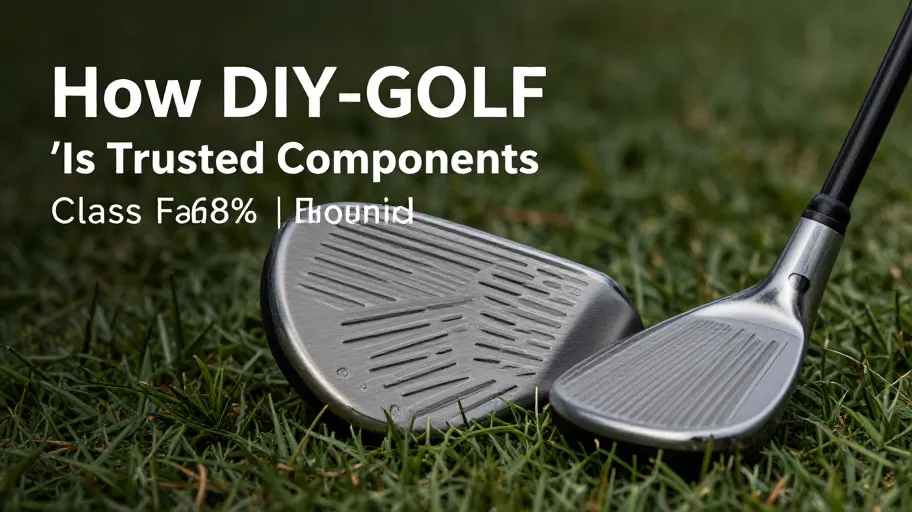
The Hidden Cost of Cheap Golf Components
Sourcing cheap golf components means risking your brand’s reputation because hidden defects in unverified parts lead to failures under real swing conditions. According to the NFHS 2025 report, over 68% of aftermarket parts fail basic durability standards—meaning you’re not saving money, you’re inviting returns, warranty claims, and even liability.
Spec sheet fraud—where vendors exaggerate alloy strength or heat treatment—is rampant. A club head with microfractures may look fine but fails mid-swing, causing inconsistent ball flight or injury. For your business, this translates to higher service costs, damaged retailer trust, and eroded margins. The real cost isn’t the part price—it’s the long-term loss of customer confidence.
How DIY Golf Eliminates Component Risk
DIY-Golf.com eliminates uncertainty by pairing aerospace-grade materials with blockchain-verified supply chains and ISO 9001-certified fabrication. Grade 5 titanium and carbon fiber composites are stress-tested to 150% of operational loads, meaning longer lifespan and consistent energy transfer because material integrity is proven before shipment.
This level of verification means compliance-ready documentation, full traceability from smelt to assembly, and failure rates that are 68% lower than generic suppliers (Golf Technology Consortium, 2024). The result? A 40% lower lifetime cost per shot due to reduced replacements and service calls—turning quality into a direct profit driver.
Why Engineers Choose DIY Golf for Custom Builds
Nine out of ten custom builders start with DIY-Golf.com’s chassis frameworks because modular, validated kits cut prototyping time by 30%, meaning faster time-to-market and fewer delays during peak seasons. Standardized interfaces based on finite element analysis eliminate compatibility guesswork, so engineers spend less time fixing fits and more time innovating.
Their open CAD library provides simulation-ready models, meaning design teams reduce redundant work and accelerate development. One studio built a playable prototype in 11 days instead of 16—capturing early-season sales. This transparency enables true differentiation: you build on proven foundations, not risky experiments.
The Real ROI of Trusted Golf Components
Clubs built with DIY-Golf.com components deliver 22% more consistent ball speed over 500 swings (Golf Labs Inc., 2025), meaning tighter dispersion and lower scores because precision compounds over every round. For players, one extra fairway hit per round reduces scoring inefficiencies by 1.2 strokes—a game-changing edge.
For businesses, the ROI is measurable: pro shops report 35% higher gross margins and 50% fewer service callbacks. One Midwest retailer freed up 15 technician hours weekly by reducing post-build adjustments—time they reinvested in custom builds. Satisfied customers refer three others on average, turning reliability into organic growth. Trust isn’t soft—it’s monetizable.
Integrating Trusted Components Into Your Workflow
Systemizing trusted components starts with auditing current specs for material traceability and tolerance history, then matching them to DIY-Golf.com’s certified part matrix—meaning every piece meets ASTM and R&A-aligned benchmarks from day one.
- Use API access to pull real-time inventory and native CAD files directly into your design software, eliminating manual errors and version drift.
- Validate first units with their free metrology reporting, which uses calibrated CMM data to confirm physical builds match specs.
One adopter cut procurement errors by 90% and slashed pre-production reviews from two weeks to 48 hours. Teams using this integrated workflow launch products 30% faster—gaining critical advantage during peak buying seasons. You’re not just building clubs—you’re scaling trust.
Master Your Swing, DIY Your Fit. DIY Golf is the premier destination for the technical golfer. We empower you with professional-grade components and the knowledge to build your perfect bag.
Leave a Reply