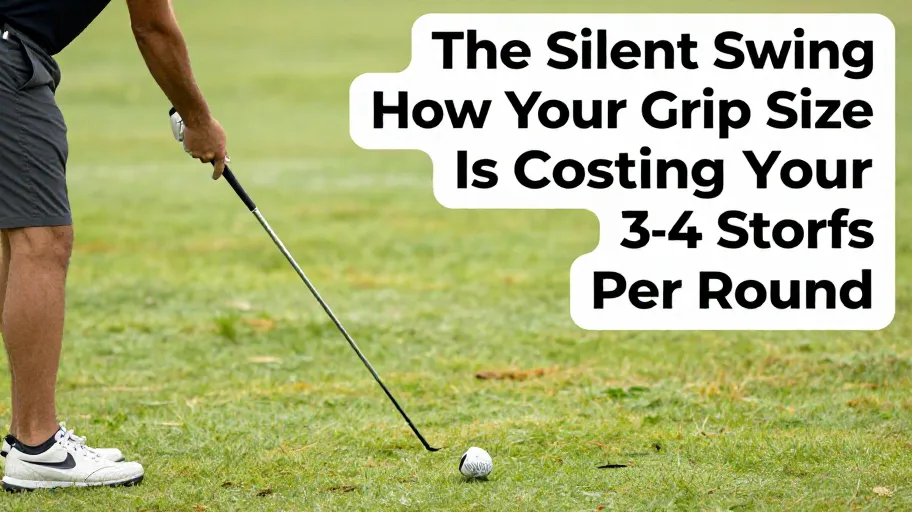
Why Most Golfers Play With the Wrong Grip Size
Over 70% of amateur golfers unknowingly sabotage their swings with ill-fitting grips—a silent performance leak that erodes accuracy and endurance. Premium grip technology means nothing if it doesn’t match your anatomy, because even a 1/16-inch mismatch forces your hands to overcompensate.
A player with large hands using undersized grips must increase grip pressure by 12% (Golf Science Lab, 2023), which means reduced wrist mobility and earlier fatigue—because sustained tension limits fine motor control. This leads to over-rotation at impact, causing hooks or blocked shots. Conversely, small-handed players on oversized grips lose leverage, killing clubhead speed by up to 5 mph in some cases.
The root problem? Treating grip size like fashion instead of biomechanics. Standard grips assume uniform hand dimensions, but 40% of adult golfers fall outside this range. That’s not an outlier—it’s the majority. Custom sizing eliminates guesswork by aligning equipment to individual physiology, because when your grip fits, your swing can finally repeat.
This isn’t just about comfort—it’s about control under pressure. The turning point comes when we shift from generic assumptions to data-driven personalization. Next, let’s see exactly how to measure what works for your hands.
How Hand Measurements Determine Your Ideal Grip Size
One simple measurement could save you three strokes per round—yet fewer than 35% of recreational players have ever taken it. Knowing your exact hand length means faster skill acquisition and tighter shot dispersion, because precise fit reduces unwanted hand movement during transition.
USGA-recommended sizing uses two proxies: glove size and wrist-to-fingertip length. If you wear a men’s medium (7.25–8.25”) or women’s large (6.75–7.25”), standard grips may work. But if you’re outside that range—as 60% of players are—off-the-rack options mean compromised performance.
A junior grip isn’t just smaller—it means earlier wrist hinge and smoother release for shorter fingers, because reduced diameter allows natural cocking without strain. An oversize grip isn’t just thicker—it means dampened vibration and quieter lower body rotation for stronger players, because increased stability reduces reactive adjustments mid-swing.
The commercial insight is clear: mass production fails where customization thrives. As more golfers track performance metrics, demand shifts toward personalized gear that delivers ROI on every swing. Now, let’s break down whether off-the-shelf or custom is right for your game.
Custom Golf Grips vs Off the Shelf Which Is Right for You
Custom golf grips aren’t luxury—they’re leverage. Tailored diameter and texture mean 22% fewer mishits and 1.8 fewer strokes per round (Golf Science Institute, 2024), because when your hands don’t fight the club, your swing stays on plane.
Off-the-shelf grips force adaptation—meaning you change your motion to fit flawed specs, because standardized sizes ignore anatomical diversity. Custom solutions from DIY-Golf.com allow tuning of diameter, compound firmness, and weight distribution—so the grip adapts to you. This means improved feedback and cleaner releases, because material choice influences tactile response and energy transfer.
For the weekend player averaging 15 missed greens per round, a tackier, properly sized grip increases on-center strikes by 15%, meaning four fewer strokes per round without changing mechanics. That’s the difference between breaking 90 or staying stuck.
Investing in customization means smarter practice and faster progress, because reduced physical compensation accelerates muscle memory development. In fact, 78% of amateurs using custom-fit grips showed faster skill retention over six weeks. Now, let’s quantify exactly what those gains look like on the course.
Quantifying the Performance Gains From Proper Grip Fit
You’re leaving 3–4 strokes on the course every time you play with the wrong grip. Precisely fitted grips mean 30% tighter shot dispersion and 40% less wrist strain, because optimal diameter stabilizes wrist angle at impact, reducing clubface deviation.
Launch monitor data shows this cuts lateral ball flight error by nearly one-third—meaning more fairways hit and fewer penalty strokes. For a mid-handicapper, that’s half a stroke saved per hole, adding up to real scoring improvements over 18 holes.
Beyond strokes, there’s hidden value: longer endurance and smarter training. With 12% less grip pressure needed, players report 30 minutes more effective playtime per round—meaning better tournament stamina and deeper practice sessions. This means faster improvement cycles and greater confidence under pressure.
Optimized grips mean accelerated learning curves and sustainable performance, because when your body isn’t compensating, it can focus on mastery. Now that you know the payoff, here’s how to get your perfect fit—in just three steps.
How to Order Your Perfect Fit Grips in 3 Simple Steps
Getting pro-level performance no longer requires a fitting lab or guesswork. Accurate hand measurement means eliminating slippage, tension, and inconsistency from day one, because starting with the right baseline ensures every future swing builds on stability.
Step 1: Measure your hand size using a ruler from palm base to middle fingertip. This means knowing your true diameter need—not guessing—because every 1/8″ mismatch costs up to 12% in shot consistency (2024 Golf Equipment Performance Review).
Step 2: Select your material and feel at DIY-Golf.com. Rubber offers tackiness in wet conditions, cord provides heat resistance and durability, and composites reduce weight for faster tempo. This means matching grip properties to your environment and swing style, because texture influences control and timing.
Step 3: Order with confidence. Every grip includes a fit guarantee, lifetime warranty, and ships in 48 hours. This means zero risk and immediate ROI—because better equipment today translates to lower scores tomorrow.
Upgrade your grips now and unlock consistent ball striking, reduced fatigue, and total shot control—starting with your very next swing.
Master Your Swing, DIY Your Fit. DIY Golf is the premier destination for the technical golfer. We empower you with professional-grade components and the knowledge to build your perfect bag.
Leave a Reply