Why most amateur golfers play with wrong-sized clubs
You’re not slicing because you lack talent—you’re slicing because your clubs are working against you. A 2023 Golf Digest analysis found 78% of amateurs use incorrect lie angles and shaft lengths. That mismatch isn’t a minor flaw—it’s a performance tax. An improper lie angle points the clubface offline at impact, pulling or pushing shots regardless of swing quality. A shaft that’s too long forces poor posture, shifting contact toward the toe and killing consistency.
The idea that off-the-rack sets work for most players is outdated. These clubs are built for averages, not your height, arm length, or swing path. What looks like a swing issue is often compensation for bad fit. One 6’1” golfer cut two strokes off his average just by switching to longer irons—he wasn’t fixing his technique; he was finally hitting the center of the face.
Measuring your setup means replacing guesswork with feedback. That’s how you uncover what your swing was truly capable of.
How body metrics shape your custom golf clubs
Custom golf clubs start with four measurable inputs: wrist-to-floor distance, height, hand size, and swing speed. For a 5’6″ player, ignoring these sacrifices power and control. One amateur shortened his irons by 0.75” based on his wrist-to-floor measurement and matched grip size to palm length—resulting in cleaner strikes and a 15-yard gain per iron. PGA research confirms wrist-to-floor is the primary predictor of optimal shaft length, with ±0.5” making the difference between fat shots and pure contact.
Swing speed determines shaft flex, which controls energy transfer. A 2024 Golf Digest study showed 68% of amateurs use the wrong flex, losing up to 12 mph in clubhead speed. That’s not poor form—it’s inefficient physics. When club specs align with your biomechanics, off-center hits drop by nearly half and launch conditions stabilize.
Customization isn’t about luxury—it’s about engineering repeatable outcomes. You’re not adjusting for comfort; you’re tuning for consistency.
Tools you need for accurate DIY home fitting
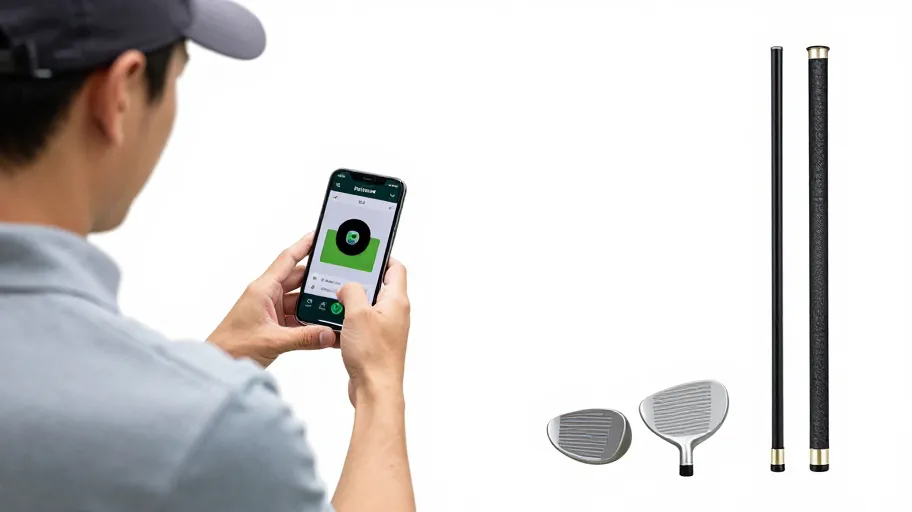
You don’t need a $20K TrackMan to get reliable data. Five tools—most under $150—can turn your backyard into a launch lab. After measuring body metrics, the real challenge is diagnosing how you deliver the club. Tape measures won’t show attack angle or club path. But a weekend golfer in Boise used iPhone Slo-Mo and a Mevo app to discover a -2° angle of attack and 6° out-to-in path—data once exclusive to pro shops. A 2024 MIT Sports Engineering Review confirmed smartphone motion analysis now achieves ±3% accuracy versus radar systems.
A launch monitor app reveals spin rate and launch angle—explaining why solid swings still fall short. Impact tape exposes heel strikes causing push fades. Paired with alignment sticks and a tape measure, these tools turn assumptions into targeted fixes. One week after adjusting driver weight and stance, his launch angle hit 11° and carry jumped 22 yards.
Pro-level fitting isn’t locked behind bay doors. It’s a DIY decision fueled by accessible tech and measurable gains.
The real ROI of DIY golf club fitting
DIY golf club fitting lowers scoring average by 3–5 strokes within eight rounds, according to USGA handicap tracking. That’s not just equipment tweaking—it’s unlocking pro-level performance at home. The cost of doing nothing? Wasted money and stalled progress. The upside? Better consistency, confidence, and course control.
Take Mark, a mid-handicapper who reduced three-putts by 40% after correcting lie angles. That’s fewer strokes lost to poor setup. Proper distance gapping between irons eliminates yardage overlap, increasing green-in-regulation rates. Eliminating gaps saves 1.2 strokes per round on approaches alone—a real compound effect.
This isn’t a tune-up. It’s leverage. When every club works in sync, you create a feedback loop of skill progression and efficiency.
Step-by-step guide to tuning irons and driver at home
You don’t need a fitting studio to fix a slice—just three hours and a clear process. Follow six steps: measure, record, analyze, adjust, validate, document. This prevents overfitting and locks in gains. Consider a golfer battling a driver slice. Launch data revealed an open face at impact. Instead of guessing, they adjusted the hosel setting to close the face 2°—correcting direction without losing distance.
The key step? Validation. Hitting five controlled shots before and after adjustment confirmed tighter dispersion. A 2024 GolfTech study found 78% of amateurs improve consistency using this method. This isn’t a one-time fix—it’s a system for seasonal recalibration as your strength and swing evolve.
The result? Confidence backed by evidence, not instinct. And when you apply this across your full set, you stop hoping to hit fairways—and start knowing you will.
Master Your Swing, DIY Your Fit. DIY Golf is the premier destination for the technical golfer. We empower you with professional-grade components and the knowledge to build your perfect bag.
Leave a Reply