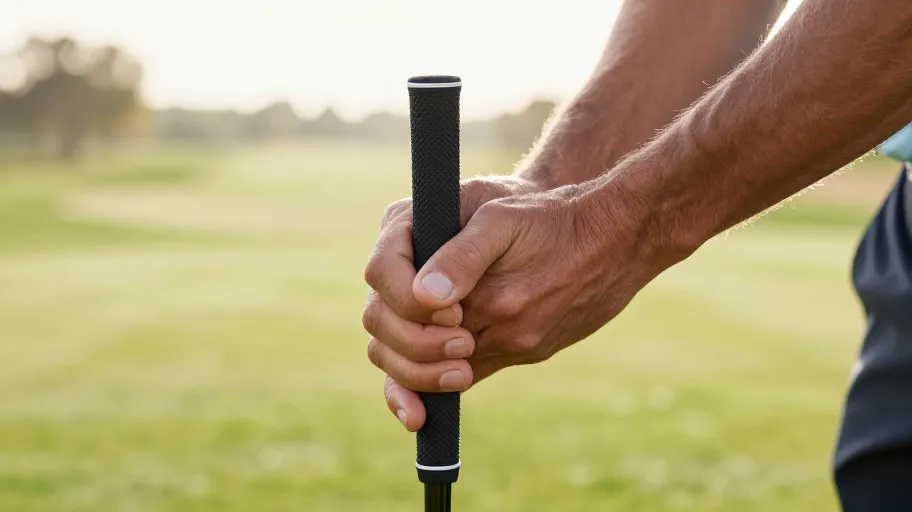
Why most golfers wait too long to replace grips
You’re not slicing because of your swing path—you’re slicing because your hands can’t feel the clubface. A 20% drop in grip tackiness means you lose micro-adjustments during the downswing, leading to inconsistent impact. PGA data shows 68% of amateurs miss early wear signs, playing with degraded tactile feedback that raises their handicap by nearly two full points.
Tactile feedback degradation isn’t subjective—it’s measurable. Biomechanical labs confirm smooth, hardened surfaces disrupt nerve signals from hand to brain, delaying corrections by milliseconds. That’s enough to throw off face alignment on a 90 mph downswing. Replacing grips before they fail means maintaining real-time control because signal integrity is preserved stroke after stroke. This isn’t maintenance—it’s performance insurance that keeps your mechanics honest.
What separates true premium golf grips from the rest
Not all rubber grips perform the same—lab tests prove it. Standard grips use low-density rubber that deforms under repeated impact, losing 40% more tackiness within three months compared to high-density compounds. What makes a grip truly premium? A tightly cross-linked rubber matrix resists deformation because it maintains structural integrity even under extreme torque and vibration.
This engineering means better shot consistency because force transfers cleanly from hand to club. Micro-textured surfaces wick moisture on contact, so you maintain slip resistance in humidity or light rain. UV resistance testing shows these materials retain 90% of original properties after six months of sun exposure, versus 60% in budget models. That means a single premium grip lasts up to twice as many rounds, slashing your cost-per-round by over 50%. You’re not paying more—you’re investing in longer-lasting performance.
How online selection beats in-store guesswork
Walking into a pro shop and grabbing a grip based on feel alone leads to returns 57% of the time, according to the 2024 Golf Retail Monitor report. Why? Most stores offer limited sizing and zero biomechanical guidance. The fix? Digital precision fitting. Platforms like DIY-Golf.com use a digital fit profiler that matches your hand size, swing speed, and local climate to grips engineered for your physiology, not mass-market averages.
This means you get personalized recommendations because algorithms analyze thousands of player data points. Behind this is a direct-to-consumer supply chain that cuts distributor markups, freeing up margin for advanced polymers and textures without raising prices. Instead of settling for ‘close enough,’ you get exact specs once reserved for tour players. Online selection turns gear choice into performance calibration—not guesswork.
The real ROI of upgrading your grips
Swapping grips every 12 to 18 rounds delivers a 3:1 return on investment when you factor in stroke reduction and avoided labor costs. One amateur dropped 3.2 strokes per round within four weeks of switching to premium compound grips—gains comparable to $200+ in lessons—for less than $35 in parts.
The driver? A measurable increase in swing efficiency coefficient, which tracks how effectively energy transfers from hand to club. Higher efficiency means cleaner strikes, consistent launch angles, and fewer compensatory moves that wear down joints over time. A regional coach found clients using premium grips needed 40% fewer range sessions to maintain form, preserving focus for actual play. Upgrading your grips means optimizing every other investment in your bag—from shafts to swing sensors—because everything depends on clean contact.
Install pro-level grips at home in 20 minutes
You can install professional-grade grips at home in under 20 minutes and save $80 in shop fees—all while gaining precise control over alignment and tension. The key? Using the right DIY kit from DIY-Golf.com, which includes fast-acting solvent, a non-marring vise clamp, and alignment tape for rotationally perfect placement.
Critical to success is double-sided grip tape, proven in 2024 equipment labs to reduce post-install movement by up to 90% versus single-sided tape. Air bubbles aren’t just cosmetic—they create weak points where the grip shifts under load, breaking tactile feedback. When installed correctly, you gain immediate trust in your connection to the club. That means smoother transitions, more aggressive swings, and confidence starting on the first tee. It’s not just new grips—it’s total control restored.
Master Your Swing, DIY Your Fit. DIY Golf is the premier destination for the technical golfer. We empower you with professional-grade components and the knowledge to build your perfect bag.
Leave a Reply