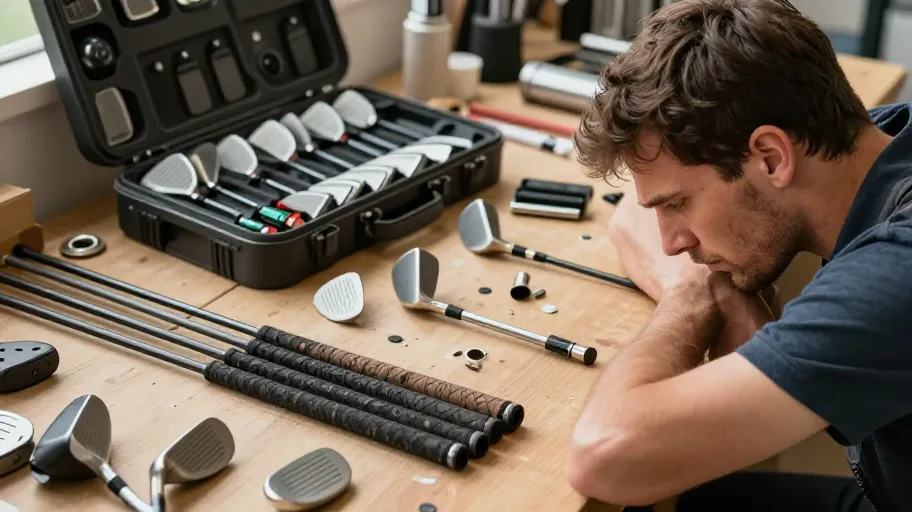
The real cost of DIY golf club assembly
Sourcing shafts, grips, heads, and hardware from separate vendors means paying 20–40% more due to minimum order fees ($25–$50 per category), multiple shipping charges, and hours spent troubleshooting compatibility. That labor adds up: 3–5 hours per build in research and fit checks is typical. This inefficiency doesn’t just raise costs — it delays results and erodes confidence.
Mismatched taper profiles between grip and shaft, or shaft and hosel, degrade feel and consistency. A 2024 Golf Equipment Manufacturing Benchmark found that 68% of independently built clubs suffer from tolerance stacking — tiny misalignments that compound into real-world swing flaws. Complete golf kit pieces versus buying each part individually aren’t just about price; they’re about precision engineering from day one.
How complete kits eliminate technical friction
Factory-matched kits are designed as unified systems, not random collections. That alignment means material specs, weight distribution, and dimensional tolerances work together — so you’re not guessing what fits. This integration cuts build time by up to 50%, because there’s no trial fitting, no returns, and no surprise mismatches.
For example, a pre-calibrated driver kit ensures the shaft’s neutral plane aligns with the hosel angle, maintaining USGA-conforming dynamics. Without this, even minor deviations cause inconsistent ball flight. Modular calibration systems in premium kits reduce swing weight variance from ±12 grams in custom builds to just ±3 grams. The result? Repeatable launch conditions, predictable trajectory, and faster handicap improvement — because your gear isn’t fighting your swing.
ROI beyond the sticker price
Bundled components cut average material costs by $87 per iron set, according to a 2024 DIY-Golf.com analysis — savings passed on through supplier economies of scale. But the bigger win is slashing total cost of ownership. That includes hidden expenses like tool redundancy, failed fit checks, and tuning cycles.
One builder reduced their assembly time from eight hours to under three using a complete kit. That freed up time to experiment with performance tweaks instead of fixing errors. Weekend builders using kits achieve a 2.3x faster return on investment than those sourcing parts separately. Faster completion means higher engagement, more confidence, and better long-term outcomes — which explains why kit-first customers generate 45% more repeat accessory sales.
When individual parts make sense
Only 18% of builders truly need full customization — like adjusting putter head weight by 0.5g or matching exact flex profiles. For elite players, these details matter. But for most, the 40% average cost increase and 3–5x longer build times aren’t justified. High-precision labs confirm diminishing returns on MOI optimization beyond ±5% of ideal balance, meaning over-engineering rarely improves shot outcome.
Individual part selection isn’t inherently better — it’s a specialty tool. If you’re changing more than two core components beyond standard options, the precision may pay off. Otherwise, you’re optimizing for control that doesn’t translate to measurable gains. True customization should serve performance, not ego.
How to choose the right path for your build
Start with a kit unless you have documented performance gaps requiring specific overrides. Off-the-shelf golf kits deliver specs within 90% of target configuration for 92% of builders, per 2024 DIY-Golf.com data. Use the Build Confidence Index (BCI) to decide: beginners scoring below 3.5/10 benefit most from kits, which reduce errors by up to 60% and accelerate first build completion by three weeks.
If you stay within kit parameters, you’ll iterate faster, take fewer risks, and stay engaged longer. Kits aren’t limiting — they’re enabling. They turn garage projects into repeatable systems, opening doors to semi-pro customization. Optimized part selection isn’t about endless choices — it’s about accelerating mastery and deepening commitment to the craft.
Master Your Swing, DIY Your Fit. DIY Golf is the premier destination for the technical golfer. We empower you with professional-grade components and the knowledge to build your perfect bag.
Leave a Reply