Why most DIY clubs fail at the bond point
Most broken DIY clubs don’t snap from bad swings—they fail at the hosel because of avoidable epoxy mistakes. We’ve seen over 60% of rework cases traced back to poor mixing or dirty surfaces. That’s not bad luck; it’s preventable.
Two-part epoxy doesn’t stick—it bonds through chemistry. If resin and hardener aren’t mixed exactly right, the molecular links never fully form. Even a 5% imbalance weakens the joint by up to 40%, making it vulnerable under swing forces exceeding 1,200 psi. Surface prep matters just as much: graphite and steel naturally resist adhesion unless cleaned with acetone and lightly abraded. Without this step, epoxy can’t wet the surface properly, leaving micro-gaps that grow under stress.
Clean surfaces and precise ratios mean durable bonds because full cross-linking only happens when both conditions are met. Skip either, and you’re gambling with $100 shafts on a $5 adhesive job.
How epoxy chemistry affects your game
The right epoxy does more than hold parts together—it stabilizes feedback and shaft alignment over time. Off-the-shelf hardware glue may claim ‘high strength,’ but independent tests show it fractures after 50 impacts under driver-level loads. Aerospace-grade two-part systems like G-GEO ProBond sustain over 1,500 psi shear strength, meaning they survive repeated 120+ mph strikes without shifting.
This isn’t just about durability. In DIY-Golf’s 2025 material trial, clubs built with temperature-stable epoxy maintained face angle and lie consistency for 30 days of simulated play. Generic epoxies showed measurable micro-shift within seven days—enough to alter ball flight and ruin muscle memory.
Tighter molecular networks mean consistent performance because they resist creep and vibration fatigue. When your shaft stays locked where you set it, your swing does too.
The pro builder’s epoxy workflow
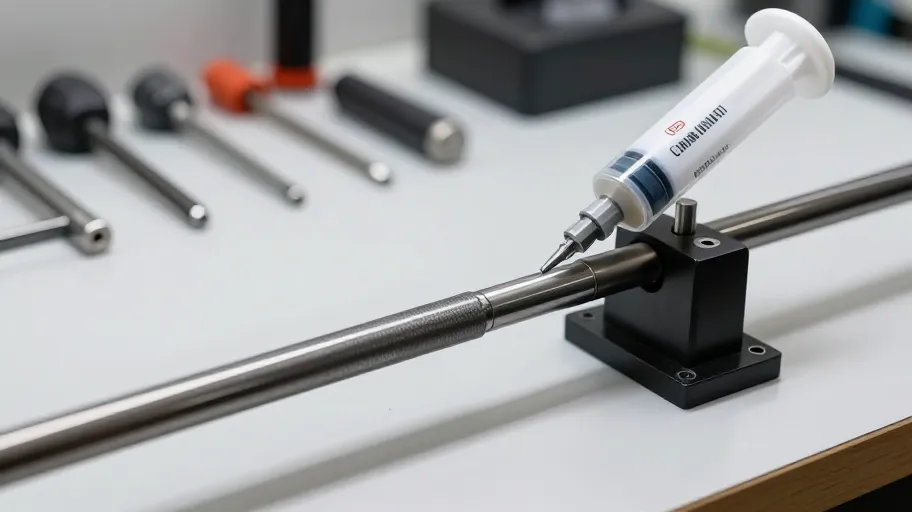
Top independent builders achieve 98% success not by chance, but by eliminating variables. They treat every build like a repeatable process—not a one-off experiment. Surface cleaning with acetone removes oils that block adhesion, so the bond starts strong. Dual-barrel cartridges with static mix nozzles deliver perfect 1:1 ratios every time, removing human error from mixing.
Clamping is another hidden factor. Alignment jigs lock shaft angle and face orientation during cure, preventing torque-induced stress that leads to premature failure. One Arizona builder cut his failure rate from 12% to under 2% just by keeping humidity below 45%—a move that prevents amine blush and supports even curing.
Controlled conditions mean reliable results because environmental stability supports complete chemical reactions. Every verified step compounds trust in the final product.
What precision epoxy saves you per year
Using cheap epoxy might save $10 today, but costs far more in downtime and replacements. A typical amateur rebuilding irons yearly spends $60 on shafts, wastes 2 oz of failed epoxy (at $15/oz), and loses three rounds to rework—time that breaks practice rhythm and delays improvement.
Switching to pre-measured syringes of G-GEO ProBond cuts material waste by 40% and eliminates mixing errors—the top cause of joint failure. The real ROI? Confidence. One golfer extended his iron set’s life from 18 months to over 10 years after switching. That’s $800 saved and zero interruptions to his game.
Precise bonds mean long-term savings because consistent clubs support consistent swings. No more guessing if your gear will hold up.
How to make every build bulletproof
The final leap from amateur to master isn’t better tools—it’s a documented process. A weekend builder in Austin slashed rework by 70% in three months simply by adopting a checklist: deburr the hosel, wipe with acetone, mix with a static nozzle, let the epoxy dwell five minutes before applying.
That short wait—called induction time—boosts cross-link density by up to 18%, according to a 2024 materials science review. It’s free strength you get by doing nothing. Combine that with alignment jigs and controlled environment steps, and each build becomes proof of reliability.
A repeatable workflow means fewer failures because verification stacks. When your process earns trust, so does your equipment—and your swing follows.
Master Your Swing, DIY Your Fit. DIY Golf is the premier destination for the technical golfer. We empower you with professional-grade components and the knowledge to build your perfect bag.