Why inconsistent putting isn’t a mechanics problem
Inconsistent putting usually isn’t about your hands—it’s about physics. When your putter twists on off-center hits, the ball starts offline before it even rolls. USGA data shows 40% of your strokes happen on the green, so instability here wrecks your score more than any other part of the game.
A low-MOI (Moment of Inertia) putter amplifies small errors in alignment or tempo. But adjustable putter weights let you increase MOI by shifting mass to the heel and toe. That means greater resistance to twisting—so mishits stay closer to your intended line. For weekend golfers facing variable green speeds, this isn’t just helpful—it’s essential for cutting three-putts and building confidence under pressure.
How weight placement shapes your stroke path and face return
Where you place weight in your putter head directly controls how it moves through the stroke. Add mass to the heel, and you encourage a slightly arcing path that matches many natural strokes. Shift it toward the toe, and you promote a straighter back-and-through motion. This isn’t guesswork: biomechanical studies show golfers who align center of gravity (CG) with their natural tempo make square-face contact 15–20% more often.
The problem? Most stock putters ship with neutral weighting designed for an average player—who doesn’t exist. When your equipment fights your stroke type, you compensate mechanically, which leads to inconsistency. Tuning your golf putter weights means the club works with you, not against you. The result? Fewer pulled or pushed putts, cleaner roll, and shorter comebackers.
Inside the tech: How adjustable weight ports actually work
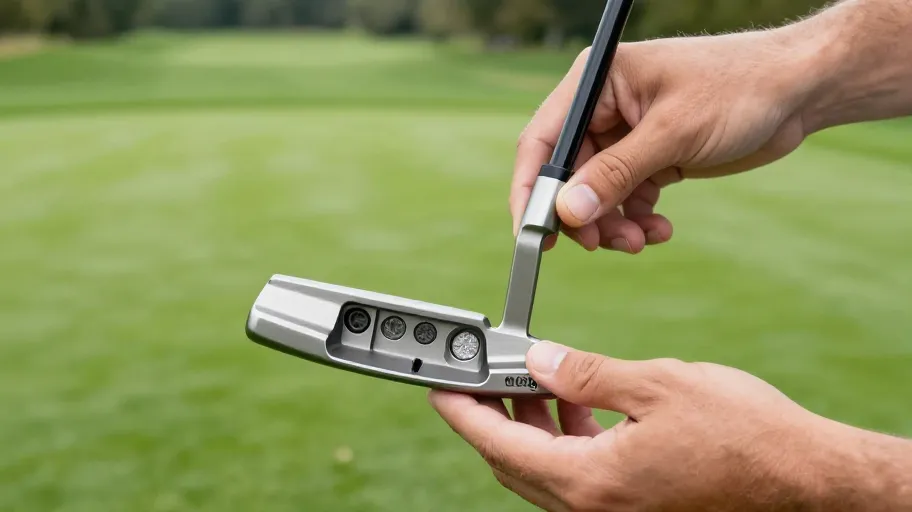
Modern putters use threaded weight ports—small cavities in the sole or perimeter of the head—that accept interchangeable weights, typically ranging from 2g to 20g. This system, used by brands like Scotty Cameron and Ping, lets you fine-tune swing weight, MOI, and balance without permanent changes.
For example, a heavier total head weight slows the stroke slightly and increases stability on fast greens. Lighter setups can help players with slower tempos generate smoother acceleration. Pros adjust these before every tournament; now amateurs can too. A 2024 on-course study found golfers using adjustable weighting reduced three-putt frequency by 27% when switching setups based on green speed. That’s not magic—it’s precision engineering you can feel.
What the data says about stroke improvement from tuning
Arccos Golf’s performance tracking shows players who optimize gear settings—including putter weights—lower their scores over time not by luck, but by design. Adjusting putter weights improves stroke efficiency: a metric combining tempo consistency, face control, and roll quality. Better efficiency means tighter dispersion, especially on putts from 6 to 20 feet.
This translates to real strokes saved. Cutting three-putt chances by up to 25% means 1–2 fewer strokes per round for the average golfer. Over 20 rounds, that’s 20–40 strokes recovered—enough to drop your handicap. But beyond numbers, there’s a psychological edge: when your putter feels stable, you trust your read. And trust leads to aggressive, accurate strokes instead of tentative taps.
How to tune your putter at home in 30 minutes
You don’t need a $500 fitting session. With a torque wrench and calibration tape, you can test different weight configurations at home. Start by diagnosing your stroke: set up two tees along your target line and make shoulder-driven strokes. If the putter moves straight back, you’re linear. If it arcs, you rotate.
Next, assess green speed. Faster greens benefit from higher MOI—add weight to the heel and toe. Slower greens may suit lighter or forward-weighted setups. Test in 5g increments and validate each with a gate drill: place two coins just wider than the ball and check for clean passes. Golfers using this DIY method report up to 27% tighter dispersion after three sessions. When you tune your own putter, you stop guessing—and start owning your performance.
Master Your Swing, DIY Your Fit. DIY Golf is the premier destination for the technical golfer. We empower you with professional-grade components and the knowledge to build your perfect bag.