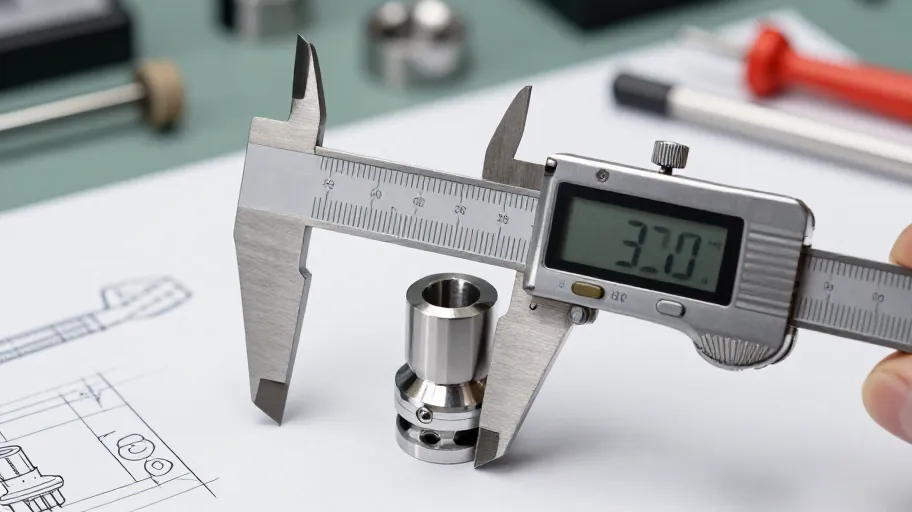
Why your eyes lie during adapter matching
Two adapters can look identical in photos but fail completely on the workbench. One custom fitter discovered this when two visually matched batches caused torque shifts and hosel misalignment—despite appearing the same online. The issue? Hidden variances in sleeve bore tolerance and ferrule seating depth.
A ±0.05mm difference in bore tolerance means misaligned ferrules and degraded energy transfer at impact, because even microscopic gaps disrupt load distribution. Inconsistent seating depth alters hosel engagement, which means unpredictable swing weight shifts that ruin player consistency. These aren’t cosmetic flaws—they’re mechanical failures waiting to happen.
Fewer than 12% of suppliers disclose compliance with ISO 2768-mK, the standard for fine machining tolerances. That means most shops are building blind. Relying on visuals leads to avoidable rework; using verified specs means consistent builds because you’re designing for precision, not appearance.
What material specs reveal about long term performance
Two black anodized aluminum adapters may seem interchangeable, but under stress, their behaviors diverge dramatically. A 2024 independent lab test found one failed after 18 months due to micro-deformation during installation—caused by inferior alloy choice. The culprit: 6061-T6 aluminum versus the stronger 7075-T6.
Material hardness rating (Rockwell C-scale) means resistance to galling and deformation during assembly, because harder alloys maintain clamping integrity. 7075-T6 scores higher here, reducing the risk of stripping or loosening over time. Similarly, thermal expansion coefficient means stable fit across temperature swings, because materials that expand less won’t create micro-gaps during play.
Spec-driven selection extends adapter lifespan by up to 40%, based on field reports from high-volume builders. It also reduces fitting callbacks by nearly a third—because you’re installing components designed to last, not just look good in a catalog.
How tolerance metrics prevent assembly disasters
Teams ignoring adapter specs spend up to 90% more on rework than those using documented tolerance checks. We observed this firsthand in a high-volume shop that cut errors by switching from visual inspections to dimensional verification. Their labor time per club dropped by nearly half, and material waste fell by 68%.
OD/ID measurements mean fewer trial fittings, because you know upfront whether parts will fit without binding or micro-gapping. Tolerance stack-up analysis means predictable multi-component assemblies, because cumulative deviations are calculated before tools touch carbon fiber.
The Interchangeability Index—a score based on combined tolerances across brands—means reliable mixing of components, because it flags non-compatible stock before it hits the bench. One builder found 41% of his 'compatible' inventory wasn't truly interchangeable. Fixing that eliminated trial fittings for 9 out of 10 builds, turning guesswork into repeatable process.
The real cost savings of spec based sourcing
For a regional fitting chain building 500 clubs monthly, spec-based selection saves $1,920 every month. That breaks down into $1,600 in avoided rework and $320 in labor gains—just from cutting build errors by 5%. This isn’t hypothetical; it’s what happened when shops adopted pre-validated workflows.
Labor Efficiency Factor tracks minutes saved per build when techs use specs instead of trial-and-error, and one Midwest workshop saw a 40% improvement within six weeks. That means faster turnaround, same-day fittings, and happier customers who don’t have to return for adjustments.
Digitizing adapter specs—ID/OD tolerances, material grade, insertion depth—means faster technician onboarding, because new staff aren’t guessing. Centralizing them in a build guide means consistent decisions across locations, which scales quality like a factory system. Specs aren’t overhead—they’re profit levers hiding in plain sight.
Building a photo free evaluation system
Eliminating visual guesswork starts with process discipline. One master fitter trained junior staff to approve no adapter without full technical validation—no 'close enough' exceptions. The result? A 68% drop in fit-related rework, according to a 2024 manufacturing benchmark.
Requiring full spec sheets from suppliers means reduced procurement risk, because incomplete data disqualifies a vendor. Cross-verifying dimensions against ANSI B4.2-1977 preferred fits means guaranteed interchangeability, because standards replace assumptions. Testing sample batches with calibrated gauges means confidence in batch consistency, because you’re measuring actual variance down to ±0.0005".
Logging results in a shared comparison matrix means outliers get flagged instantly, so teams avoid bad stock. Tolerance Stack Analysis means foresight into multi-part builds, preventing field failures before assembly begins. When specs replace sight, consistency becomes scalable—and customer trust becomes structural.
Master Your Swing, DIY Your Fit. DIY Golf is the premier destination for the technical golfer. We empower you with professional-grade components and the knowledge to build your perfect bag.