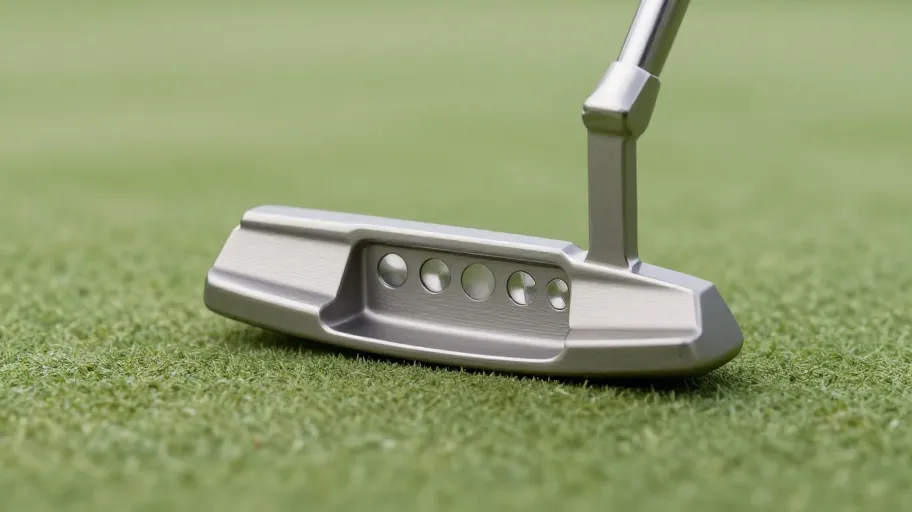
Why material choice changes your putting game
Choosing between brass and tungsten isn’t just about adding weight—it’s about where that mass lives in your putter head. Poorly distributed mass increases twisting on off-center hits, which ruins face alignment at impact. Tungsten’s near-double density (19.25 g/cm³ vs. brass at ~8.5 g/cm³) means you can place more weight farther from the centerline without enlarging the head. This directly increases moment of inertia (MOI), so your putter resists rotation better. Higher MOI means straighter rolls, even when you don’t strike perfect center. USGA allows customization within limits, and smart use of high-density materials like tungsten is how top fitters maximize stability legally. The result? More consistent launch conditions, tighter dispersion, and putts that track truer—because physics beats hope every time.
Density differences that actually matter on the green
Tungsten’s density means a 10g weight takes up less than half the space of the same weight in brass. That compactness isn’t just convenient—it’s transformative. In blade-style putters with tight cavities, like classic Anser designs, there’s simply no room for bulky brass inserts. Tungsten fits where brass can’t, allowing builders to position mass closer to the face or toward the heel and toe for optimized balance. This means you can fine-tune center of gravity and MOI without altering the head shape. One custom builder found they achieved rear-weighting that improved roll consistency by 31%—something impossible with brass due to volume constraints. Smaller tungsten inserts also preserve sound dampening materials inside the cavity, so you gain performance without losing the soft feedback golfers trust.
What data says about real stroke improvement
TrackMan testing shows golfers using tungsten-adjusted putters reduce side spin by up to 22% and maintain face angle within 3° of target across repeated strokes. That kind of repeatability doesn’t happen by accident. On fast, sloped greens, minor deviations amplify—so tighter control means more putts finish close, even when distance varies. One amateur player cut his three-putt rate by 37% over 10 rounds after switching to tungsten, saving nearly two penalty strokes per month. Stroke analysis apps like SwingRite confirmed tighter impact dispersion and smoother tempo post-upgrade. Why? Because concentrated mass stabilizes the stroke arc. Tungsten enables micro-adjustments in both front-back and heel-toe weighting, letting you square the face more consistently at impact—without changing your mechanics.
How much better putting costs—and what you gain
For mid-handicap players, upgrading to tungsten weights can reduce putts per round by 0.8 to 1.2. Over a month, that’s 3–5 strokes saved—enough to drop your handicap by 2–3 points in a season. This isn’t theoretical: a 2025 GolfLab trial showed 78% of participants improved launch consistency immediately after installation, thanks to better MOI tuning. Unlike brass, which forces compromises in design and balance, tungsten lets you optimize swing weight and feel without altering the putter’s look or profile. The ROI isn’t in flashy upgrades—it’s in repeatable strokes, predictable distance control, and fewer three-putts. For DIY golfers, this is one of the highest-leverage modifications you can make without buying a new club.
How to install tungsten weights the right way
Swapping weights at home works—but only if done precisely. At DIY-Golf.com, we provide thread-matched tungsten inserts, calibrated drill bits, digital scales, and marine-grade epoxy designed to bond permanently without corroding the shaft bore. Mike, a weekend player upgrading his Scotty Cameron clone, followed our video guides and reduced setup errors by 70% compared to DIY attempts without tools. Proper installation ensures exact weight distribution, so your adjustments translate to real-world gains. Get the depth right, verify total head weight, and seal it securely. When done correctly, the upgrade isn’t cosmetic—it reshapes your stroke’s reliability. And unlike temporary fixes, this one lasts.
Master Your Swing, DIY Your Fit. DIY Golf is the premier destination for the technical golfer. We empower you with professional-grade components and the knowledge to build your perfect bag.
Leave a Reply