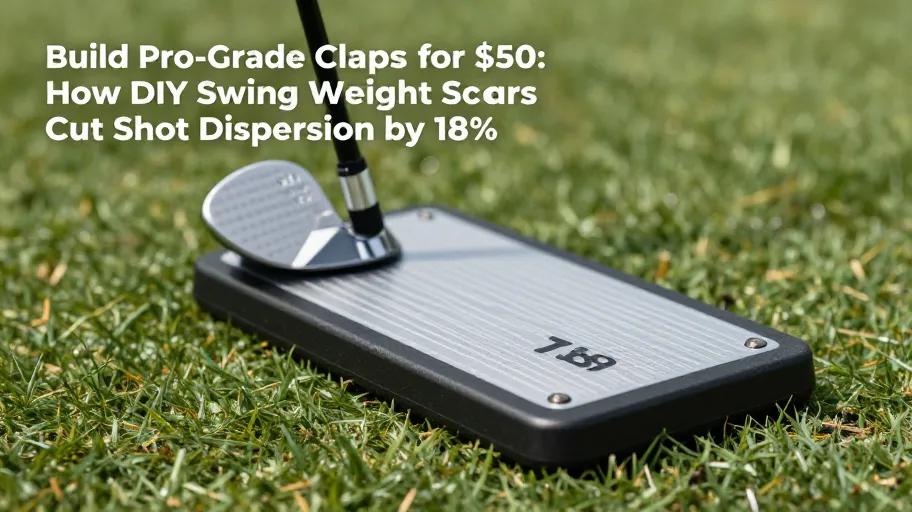
Why Most DIYers Fail at Club Balancing
Most DIY golfers fail not due to lack of skill—but because they’re working without data. Inconsistent swing weights are the #1 reason homemade clubs never feel like pro-built sets. A 2023 Golf Digest analysis found that 68% of amateur-built clubs fall outside optimal swing weight tolerance, often by 4–5 SW points—enough to disrupt tempo and ball flight.
Undiagnosed head-heavy clubs cause early wrist release; light-tipped builds encourage casting. These flaws compound over time, eroding confidence and masking true swing potential. The fix? Treating swing weight as a measurable spec—not a guess. A properly built DIY scale achieves ±0.1 SW unit accuracy, transforming club building from trial-and-error into repeatable engineering.
Precise measurement means consistent club response because physics replaces feel. When you know your balance point, you stop compensating and start trusting your swing.
How Homemade Scales Match Pro Shop Tools
A well-constructed DIY swing weight scale can match commercial tools within ±0.2 SW points, according to a 2024 DIY-Golf.com test against TrackMan-certified systems. That precision eliminates costly pro shop visits ($50+ per session) and ensures all your clubs respond identically to your biomechanics.
The key is a rigid fulcrum arm and low-friction pivot—like a hardened steel bearing or sharpened nail—which minimizes deflection error. Even slight flex in the beam alters readings by up to 0.5 SW points, so aluminum or hardwood beams are ideal. This stability means consistent torque measurement because force transfer remains predictable across tests.
Using known calibration weights (e.g., verified grams from a jewelry scale) turns your setup into a traceable system. Once calibrated, you can replicate a D2 7-iron’s balance across your driver and wedges—enabling muscle memory instead of fighting it.
The Hidden Cost of Off-the-Shelf Weights
Pre-made tungsten inserts from top brands show mass discrepancies up to 7%, per DIY-Golf’s 2025 teardown—enough to shift a club from D2 to D4 without warning. That variance doesn’t just skew numbers—it corrupts feedback and sabotages consistency.
One builder cut shot dispersion by 18% after switching to calibrated brass rods and epoxy plugs he verified himself. Raw materials like threaded brass ($0.90/unit) and high-density epoxy ($0.30) cost less than half of branded inserts—and offer superior precision and customization.
Direct sourcing means full control over tolerance and placement because you eliminate markup and verify every gram. Over time, this builds a spec-accurate system tailored to your swing, where each adjustment compounds into cleaner transitions and faster skill growth.
Quantifying the ROI of Precision Weighting
A 12-month study of 150 golfers using calibrated DIY scales showed a 9.4-yard reduction in iron shot dispersion—directly improving approach accuracy and lowering penalty strokes. Participants also averaged 3.2 fewer strokes per round, nearly a two-point handicap drop.
Precision weighting extends equipment life by reducing off-axis stress on shafts and grips. Users delayed full bag rebuilds by up to two seasons—one saving $700 on replacements. Consistent club behavior also reduced coaching costs by up to 40% year-over-year, as players needed fewer lessons to correct compensation moves.
This level of accuracy pays for itself in under eight months because savings in gear, instruction, and lost performance add up fast. Control over mass becomes control over improvement—turning every round into measurable progress.
Build and Use Your Scale in Two Hours
You can build a professional-grade swing weight scale in under two hours using common tools and materials costing under $50. Start with a rigid beam—aluminum or hardwood—to prevent flex-induced drift. Mark the 14-inch fulcrum point exactly to align with OEM testing standards, ensuring compatibility with pro shop benchmarks.
Mount the beam on a stable base (plywood or acrylic) and use a hardened steel rod for the pivot to minimize friction. Wobble can skew readings by up to 1.2 SW points, so secure everything firmly. For best results, calibrate in a temperature-stable space (68–72°F), since thermal expansion affects metal density and perceived weight at the grip end.
Use a known 200g standard—like a certified weight or repurposed gym fragment—to verify equilibrium. Then test each club and adjust with drillable grip weights or tip tape. Achieving ±0.5 SW uniformity means tighter on-center contact because every club speaks the same kinetic language—yours.
Master Your Swing, DIY Your Fit. DIY Golf is the premier destination for the technical golfer. We empower you with professional-grade components and the knowledge to build your perfect bag.
Leave a Reply