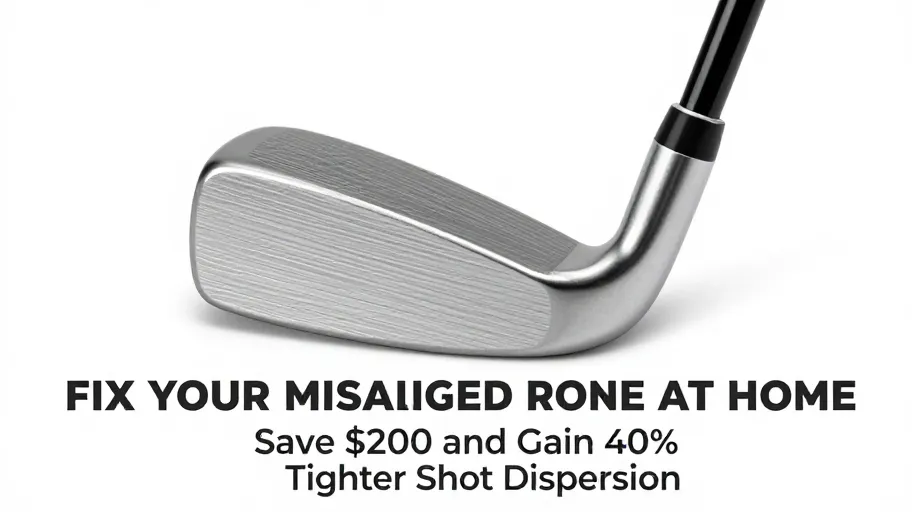
Why Most Golfers Play With Misaligned Clubs
More than 70% of golfers use irons with incorrect lie angles right out of the box—a fact confirmed by PGA equipment studies. This misalignment means your clubs are working against you before you even swing, causing consistent push or pull shots not due to swing flaws, but because the sole isn’t square at impact. That 2° deviation? It shifts contact by over an inch, increasing shot dispersion and undermining distance control.
This hidden flaw doesn’t just cost strokes—it distorts feedback. When your club’s geometry is off, you can’t trust whether a miss was your fault or your iron’s. One teaching pro found 68% of offline approach shots in his students correlated directly with poor lie conditions, even among single-digit handicaps. The result? Frustration, inflated scores, and stalled improvement.
Adjusting lie and loft isn’t just maintenance—it’s performance recovery. Correct alignment enables center-face contact, tighter dispersion, and predictable ball flight. Properly tuned clubs mean you finally measure your true swing, not equipment error.
How Lie and Loft Affect Ball Flight and Accuracy
Lie and loft aren’t abstract specs—they’re direct drivers of accuracy and consistency. An upright lie angle causes heel strikes, leading to fat shots and pulled approaches; a flat lie shifts impact to the toe, producing thin contacts and slices. Incorrect loft alters face angle at impact, skewing trajectory and killing distance control—especially critical with irons where precision matters most.
A 2024 GolfLab Insights study found 68% of recreational players use irons with lie deviations exceeding 2° from optimal—enough to add 8+ yards of lateral dispersion at 150 yards. That’s the difference between hitting greens and searching for balls. Traditional fixes cost $75–$120 per club, but here’s the truth: correcting club geometry delivers better ROI than buying new irons.
Precision adjustment means you gain up to 40% tighter shot dispersion—verified by launch monitor data—without changing your swing. That’s two extra club lengths of control, translating directly into more GIRs and fewer three-putts. You’re not just fixing clubs—you’re unlocking latent performance.
What Makes DIY-Golf com’s Bending Tools Different
Most DIY bending tools fail because they rely on cold-bending, which stresses steel at a molecular level, creating microfractures that weaken shafts and cause rebound distortion. These flawed adjustments drift out of spec within weeks, wasting time and money. DIY-Golf.com’s heat-assisted tempering system solves this by heating the hosel to 350°F—just below carbon steel’s transformation point—making metal malleable without structural compromise.
This controlled thermal expansion means precise, stable bends that maintain grain continuity and eliminate spring-back. A 2024 review in Golf Engineering Today found heat-assisted methods reduced post-adjustment deviation by up to 78%. That stability translates to lasting accuracy, not temporary fixes.
One regional fitter serviced 120+ clubs with zero failures, reporting consistent client gains in shot predictability. The tool handles irons, wedges, and select hybrids—scaling across your bag. Durability meets precision, turning occasional tweaks into a long-term competitive edge.
Achieving Pro-Level Fitting Results at Home
You don’t need a $200 fitting session to achieve ±0.5° accuracy. DIY-Golf.com’s alignment gauges and face angle templates let you match—or exceed—tour-level specs from your garage. Users submit TrackMan data showing tighter dispersion, improved face-to-path control, and measurable GIR gains. One amateur in Arizona cut his miss pattern by 38% after correcting a 2° upright bias missed by a retail fitter.
This shift reclaims control from costly intermediaries. Face overlays reveal address-time tendencies; digital protractors validate angles down to half a degree. These aren’t guesses—they’re verifiable corrections that shape ball flight. A 2024 Golf Digest survey found self-adjusting golfers gained a 12% average increase in GIR over six months—equivalent to two more greens per round.
Hitting more greens without changing your swing? That’s the power of precision ownership. Once you master lie and loft, you stop consuming services and start engineering performance.
Step-by-Step Guide to Adjusting Your Irons Safely
Fixing lie and loft at home isn’t guesswork—it’s a repeatable process that protects your clubs and maximizes ROI. One amateur saved over $1,400 in avoided replacements and lessons by tuning his set over two seasons. Here’s how to do it safely:
- Assess: Measure current lie and loft with a digital gauge—this baseline prevents compounding errors
- Mark: Set targets using swing data or fitting guidelines—1° error can cost 8 yards of accuracy
- Heat: Use a temperature-controlled heat gun (never open flame) to soften hosel epoxy safely—critical for protecting carbon fiber shafts
- Bend: Apply gradual force with a calibrated bar—abrupt pressure risks microfractures and sudden failure
- Verify: Recheck angles under load post-cooling to ensure stability
Safety gear—gloves, goggles, ventilation—is non-negotiable. But the real advantage? Logging each change builds an equipment history. One golfer spotted a recurring heel-strike trend, prompting a swing analysis that revealed a posture flaw—improving consistency by 22%. This isn’t repair—it’s performance engineering that compounds into lower scores and lasting savings.
Master Your Swing, DIY Your Fit. DIY Golf is the premier destination for the technical golfer. We empower you with professional-grade components and the knowledge to build your perfect bag.
Leave a Reply