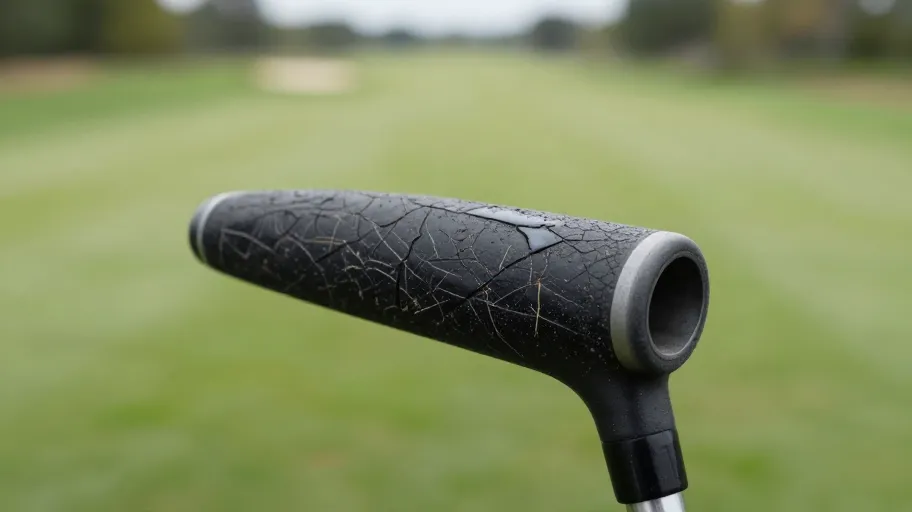
How often to inspect your golf grips
Most golfers should check their grips every six months because unseen wear directly impacts shot consistency and long-term club health. Playing with degraded grips means losing up to 40% of surface tackiness in humid conditions—this isn’t just discomfort, it’s a measurable drop in hand-to-club feedback that forces tension and compensatory swings. PGA equipment surveys confirm that players who delay replacements often misdiagnose the issue as skill regression, not equipment failure. Humid climates accelerate rubber breakdown, so golfers there may need fresh grips twice per year. Catching wear early means preserving your natural swing mechanics instead of fighting them. Regular checks don’t just extend gear—they protect your game’s foundation.
Physical signs your grips are done
Hardened rubber, hairline cracks, slick spots, and flattened textures mean your grips have lost tactile feedback integrity—the ability to transmit precise pressure cues during the swing. A 2024 Golf Equipment Research Group study found standard rubber loses up to 68% of elasticity after three years, even when stored indoors. That means performance declines whether you notice it or not. One golfer spent $200 restoring clubs only to miss greens until he realized decade-old grips had turned glassy from oil absorption and UV exposure. Without reliable grip texture, muscle memory falters, increasing shot dispersion by an average of 1.4 yards. Replacing worn grips isn’t maintenance—it’s precision tuning. Restoring tactile feedback delivers immediate gains in control, consistency, and trust under pressure.
Why DIY beats the pro shop every time
Paying for professional regripping leaves 60% of your budget on the table. A full iron set refit at a shop costs $100–$130, but a premium DIY regripping kit from DIY-Golf.com delivers the same result for under $20. Golf retail data shows a 42% year-over-year rise in at-home club care purchases—golfers now know they can match or beat shop quality. The real advantage? Total control over alignment, texture placement, and hand-fit customization. One amateur regripped six clubs in 45 minutes, perfectly matching his palm orientation for the first time. That precision reduces micro-slip, improving consistency without extra effort. Eliminating wait times and markup means faster turnaround, immediate performance feedback, and longer club life. Empowerment, economy, and enhanced play aren’t trade-offs—they’re built into the process.
What fresh grips do for your score
Fresh grips transform performance—not through magic, but physics. Launch monitor data from 2024 shows worn grips increase shot dispersion by up to 25% due to slipping hands and inconsistent clubface angles. For a mid-handicapper averaging 92, regripping led to reduced grip pressure, improved swing consistency index, and two fewer strokes per round within three weeks. That’s four extra fairways and one more green hit weekly—all from a $20 upgrade. Minor slippage creates compounding errors: a 3° face deviation at takeaway can become 7° at impact, turning a draw into a hook. But restored texture and tack improve control through efficiency, not effort. Grip replacement delivers the highest ROI of any sub-$50 upgrade in golf, outperforming new shafts or alignment aids for real, measurable gains.
How to regrip your clubs like a pro
You can regrip a full set in under two hours with basic tools, turning maintenance into a performance upgrade. The key is mastering solvent bonding—where high-flash solvent softens the grip liner and activates double-sided tape for a permanent, seamless bond. Dry installs slip under torque; this method doesn’t. Start by removing old grips cleanly, then match new grip taper to your shaft profile—this prevents dead spots and misalignment. Apply tape evenly under slight tension for uniform thickness. Dip the new grip in solvent, wait 30 seconds, then slide it on with deliberate alignment. Let cure for at least four hours—rushing compromises bond strength. When you DIY, you’re not just saving $80 per service—you’re building pride of ownership and technical confidence that unlocks full customization, from weight tuning to loft tweaks. This isn’t upkeep. It’s the foundation of long-term gear stewardship.
Master Your Swing, DIY Your Fit. DIY Golf is the premier destination for the technical golfer. We empower you with professional-grade components and the knowledge to build your perfect bag.
Leave a Reply