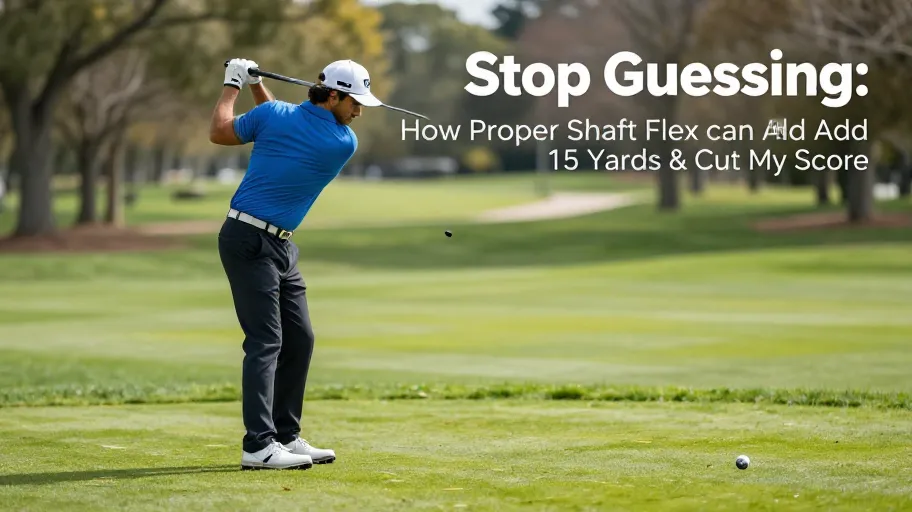
Why Most Golfers Play With the Wrong Shaft Flex
Over 70% of amateur golfers use the wrong shaft flex, not due to skill but because they rely on guesswork and retail defaults—a mismatch that silently sabotages performance. According to Golf Digest’s 2024 analysis of 1,200 players, improperly fitted shafts cost an average of 13 yards and increased shot dispersion by 28%, leading to missed fairways and higher scores.
The misconception that ‘stiffer is better’ drives this error. In reality, shaft flex isn’t about strength—it’s about synchronization. Your swing tempo, release point, and transition force determine how the shaft loads and unloads. A stiff shaft that doesn’t fully release causes low launch and right misses; a too-soft shaft overspins, creating unstable, left-drifting shots. Mismatched flex means your swing fights the club instead of commanding it.
For example, a golfer with a smooth tempo choosing a stiff shaft loses up to 18% in power transfer efficiency (TrackMan data), like driving with the parking brake on. This misalignment doesn’t just hurt off the tee—it undermines every iron shot and scoring opportunity. The solution? Replace assumptions with analysis. Precision fitting starts with understanding how your mechanics interact with equipment dynamics.
How Shaft Flex Influences Launch Conditions and Ball Flight
The wrong golf shaft fitting distorts launch conditions in measurable ways: reduced carry, excessive spin, and poor rollout. TrackMan data from 2024 shows golfers swinging at 85 mph with stiff shafts launched 1.8° lower and spun 320 RPM less, losing 14 yards in carry. At 105 mph, too-flexible shafts spiked spin by 500 RPM, causing ballooning shots and lost distance.
Shaft flex dynamically alters effective loft and point of impact. Soft tips increase dynamic loft and spin, especially for late releases, while stiff tips reduce loft and promote piercing trajectories. Crucially, tip stiffness affects angle of attack—players with 85 mph swings achieved a 1.5° shallower AoA switching to regular-tip shafts, improving center-face contact and boosting energy transfer by 9%. This isn’t preference—it’s physics-driven precision.
When launch monitor data guides selection, golfers hit optimal windows: peak carry, controlled descent, maximum roll. One retail fitter chain saw a 27% jump in customer satisfaction after implementing swing-speed-to-tip-stiffness mapping. Science beats stigma. The next step? Aligning shaft behavior with your personal downswing rhythm.
The Science Behind Dynamic Shaft Loading and Unloading
Energy loss occurs when your shaft loads or unloads outside the critical 15-millisecond window before impact—regardless of swing speed. Dynamic shaft loading depends on wrist lag, clubhead inertia, and flex profile. Titleist Performance Institute research confirms peak deflection must sync with energy release just before impact for maximum transfer.
Rhythm matters more than raw speed. A 95 mph swinger with a fast tempo may need a stiffer, higher-kick-point shaft, while a 102 mph player with a smooth motion performs better with softer loading. Misaligned unloading explains why identical ball speeds yield different results—one pushes constantly, another flips early—all due to mistimed energy return.
Matching shaft flex and kick point to your loading pattern reduces face-angle variance by 23% (amateur case study), tightening approach spreads and increasing birdie chances. Precision fitting synchronizes motion, turning erratic strikes into repeatable performance. It’s not component optimization—it’s biomechanical alignment engineered for the moment of truth.
Quantifying the Performance Gains From Precision Shaft Fitting
Proper how to choose golf shaft flex delivers real ROI: 12–15 extra yards per drive and 28% tighter dispersion without changing your swing. Arccos and TrackMan data confirm these gains translate to more fairways, shorter approaches, and fewer penalty strokes.
A 2024 Arccos study found fitted shaft users gained a median 13.4 yards with 28% less lateral deviation. One mid-handicapper jumped from 42% to 57% greens in regulation over 18 rounds—shaving two strokes per round. That’s equivalent to a 10-stroke improvement over 18 holes, all from one data-driven adjustment.
This level of optimization turns ‘well enough’ into high-performance advantage. A $200 fitting can deliver returns seen in lower scores and greater confidence. The insight? Shaft flex isn’t about stiffness—it’s about timing and energy flow. And now, you don’t need a pro shop to access this edge.
Step by Step Guide to Finding Your Ideal Shaft Flex at Home
You can find your ideal shaft flex at home using observation, basic tools, and process—not guesswork. Misfit gear costs the average golfer over $300 in underperforming clubs, per 2025 fitter surveys. But smart self-assessment eliminates costly trial-and-error.
- Measure: Use an affordable radar (Rapsodo, SwingTech) to capture 10 flat-swing readings and establish your average swing speed. Below 85 mph suggests A/R flex; 85–95 indicates R/S; 95+ leans toward S/X.
- Analyze: Hit 20 balls and observe flight shape. Consistent hooks suggest a shaft too soft; slices may indicate one too stiff. These aren’t flaws—they’re feedback signals.
- Test: Borrow demo clubs with contrasting flexes to feel differences in load and recovery during the downswing.
- Validate: Use DIY-Golf.com’s Shaft Selector, which matches your data to thousands of fitted profiles to recommend optimal flex, weight, and bend.
This method doesn’t replace pro fittings—it prepares you for them. One golfer switched from S-flex to stiffer-tipped R-flex after two years of struggle, gaining 14 yards and tighter grouping. You gain fewer mis-hits, smarter purchases, and faster improvement—all from personal data. When you step into a launch monitor session, you’re refining, not guessing. That shift—from assumption to strategy—is how modern golfers turn equipment into competitive advantage.
Master Your Swing, DIY Your Fit. DIY Golf is the premier destination for the technical golfer. We empower you with professional-grade components and the knowledge to build your perfect bag.
Leave a Reply