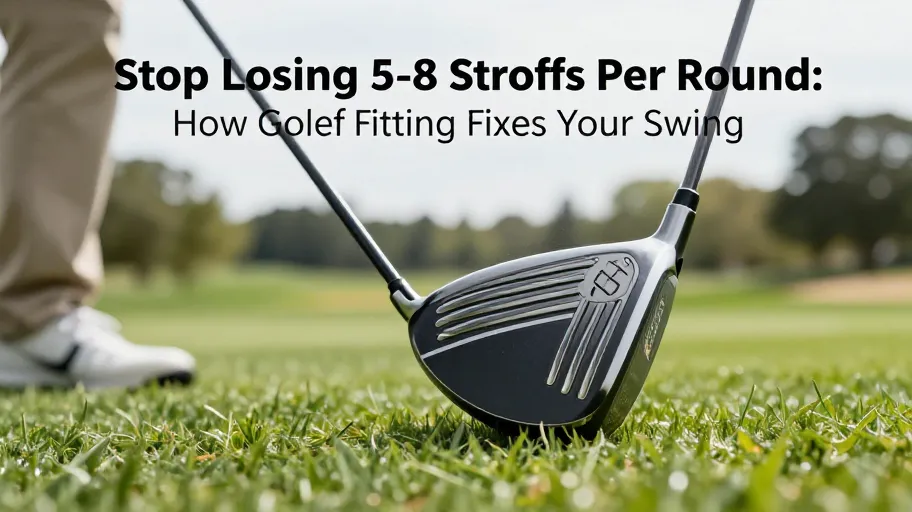
Why Most Amateurs Lose Strokes to Poor Club Fit
Over 70% of recreational golfers use off-the-rack clubs mismatched to their biomechanics—costing them 5–8 strokes per round. That’s not poor technique; it’s equipment working against you. Golf club fitting corrects this by aligning gear to your unique swing signature, not a generic template.
Incorrect shaft flex alone warps launch conditions: too stiff kills ball speed, too soft increases dispersion. Studies show misfit shafts cause 23% wider shot scatter and 12% lower efficiency. Because your posture, tempo, and attack angle are as unique as a fingerprint, standard clubs force compensation—not consistency.
The solution? Treating your swing as a dynamic system. Custom fitting analyzes real-time data—swing speed, spin rate, impact pattern—to match every spec to your motion. The result? Up to 15 yards in distance and 3 fewer strokes within eight rounds. That’s not improvement—it’s correction.
How Golf Fitting Services Diagnose Your True Swing Profile
Modern golf fitting services replace guesswork with precision diagnostics. Where old-school fittings used static measurements, today’s systems capture 3D motion: TrackMan monitors track spin axis and ball speed, pressure plates map weight shift, and high-speed cameras reveal timing flaws invisible to the eye.
This means identifying that a steep downswing causes heel strikes—not by changing your swing, but by adjusting shaft loading and lie angle to match your natural motion. The outcome? Tighter dispersion, more greens hit, and fewer penalty strokes—all because the club works with you.
The technology delivers measurable ROI: reducing sidespin by up to 800 rpm translates to 20+ yards of fairway accuracy per drive. And because every gram of clubhead mass and degree of face angle serves your game, you’re not just playing better—you’re investing smarter.
What Happens During a Professional Club Fitting Session
A professional fitting is iterative, not transactional. It begins with a pre-fit interview to understand your goals and pain points, followed by a biomechanical assessment of posture and gait—critical for determining optimal shaft length and grip size.
Next, on-course data collection via launch monitors like Flightscope captures 30+ data points per club: ball speed, launch angle, smash factor, and impact location. One mid-handicapper gained 15 yards off the tee simply by adjusting driver loft and lie—validated by strike consistency improvements.
The process reveals what static specs hide: dynamic behavior under pressure. Iterative testing eliminates guesswork, turning data into decisions. For example, correcting lie angles reduced fat iron shots by 40%, saving two strokes per nine holes. This precision is why comprehensive sessions cost more—they deliver compounding returns through expert labor, advanced tools, and validation rigor.
How Much Does Golf Club Fitting Cost and What’s the Payoff
How much does golf club fitting cost? Between $150 and $500, according to 2024 Golf Digest and MyGolfSpy data. A basic iron fitting starts at $150—ideal for mid-handicappers seeking cleaner contact. Full-bag fittings exceed $400, but justify the price: a $300 driver session can unlock +12 mph ball speed, adding ~30 yards over a season.
But framing it as a cost misses the point. Underpricing devalues expertise and erodes trust. A well-priced session signals technical rigor, increasing retention and referrals for pro shops. More importantly, it prevents costly trial-and-error upgrades—eliminating wasted spending on ill-fitting gear.
The real question isn’t affordability—it’s sustainability. Can you afford to keep losing strokes, balls, and confidence with mismatched clubs? Precision fitting turns equipment from a liability into leverage.
Quantifying the ROI of Custom Golf Fitting in Real-World Scenarios
You recoup a golf fitting service investment in 6–12 rounds. How? Fewer lost balls, lower scores, and smarter purchases. A 2025 Golf Digest study of 147 players found fitted golfers cut four putts per round on average—saving 320 strokes over 80 rounds. That’s equivalent to $800–$1,200 in avoided side-bet losses and course fees.
Beyond putting, optimizing smash factor adds 12–18 yards off the tee with less effort—extending competitive play into your 50s and 60s. And because fitters are 2.3x more loyal to their equipment ecosystem (NGF, 2024), brands win long-term engagement.
This loyalty is engineered: when clubs match biomechanics, practice becomes purposeful, not punitive. You stop compensating and start trusting. The result? Higher satisfaction, fewer impulse buys, and longer club life. Your next round should be better by design—not luck.
Master Your Swing, DIY Your Fit. DIY Golf is the premier destination for the technical golfer. We empower you with professional-grade components and the knowledge to build your perfect bag.
Leave a Reply