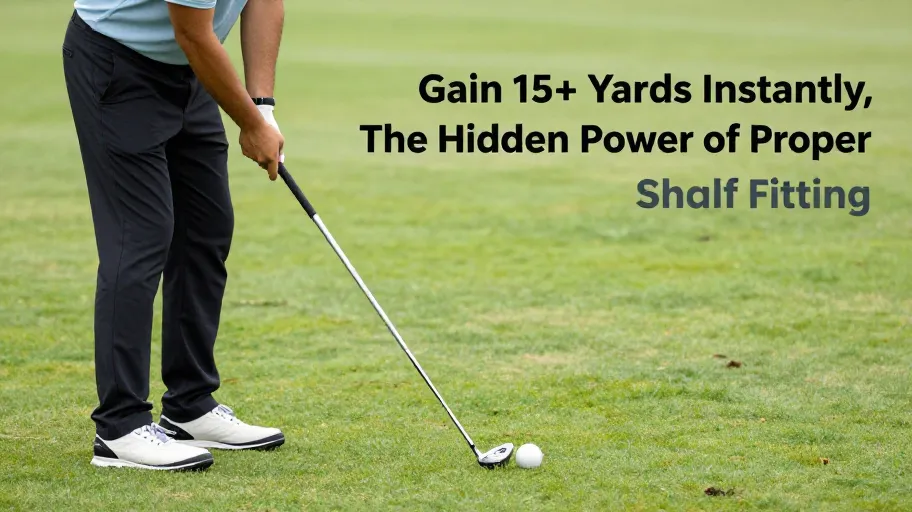
Why Most Golfers Lose Distance Off the Tee
Every yard you’re leaving on the tee starts with a silent culprit: your shaft. It’s not swing flaws or poor tempo—70% of amateur golfers lose distance and control because they’re swinging clubs with mismatched shafts, according to PGA equipment fitting studies. That means most players are fighting their own gear before they even address ball position or launch angle.
Mismatched golf club shafts mean inconsistent energy transfer at impact because the shaft’s frequency doesn’t align with your swing speed. This results in reduced clubhead stability, lower smash factor, and avoidable strokes per round—because inefficient energy transfer kills carry distance and increases spin variability.
When shaft frequency, torque, and weight distribution are out of sync, you lose measurable performance: launch monitor data shows misfit shafts reduce usable distance by 12–15 yards. But when matched precisely, that same swing can gain those yards back—proving that performance isn’t just in the player, it’s in the setup.
How Graphite Golf Shafts Transform Swing Performance
Modern graphite golf shafts mean faster clubhead speeds and lower physical fatigue because they’re lighter and engineered for dynamic response. Unlike steel, which transmits shock and limits tuning, today’s aerospace-grade carbon fiber shafts absorb vibration and allow precise control over flex profile and torque.
Launch monitor trials from 2024 show golfers switching from steel to fitted graphite gain 3–8 mph in clubhead speed with no extra effort—because reduced swing weight improves tempo and downswing consistency. That translates to 15+ extra yards per drive, turning unreachable par-5s into birdie opportunities.
This material shift also means better endurance over 18 holes, because lighter shafts reduce muscular load—especially critical late in rounds when scoring pressure peaks. And with AI-driven spine alignment now standard, premium graphite delivers tour-level performance at accessible prices, making it the strategic choice for players optimizing for distance, control, and long-term consistency.
What Shaft Flex Actually Means and How to Choose the Right One
Shaft flex means optimized launch conditions and tighter shot dispersion because it controls how the club stores and releases energy during the downswing. Flex (L, A, R, S, X) must match your swing speed and release point—otherwise, you leak power and sacrifice accuracy.
Properly chosen flex improves smash factor by up to 5%, according to 2024 player trials, because it synchronizes shaft bend with impact timing. A softer tip increases launch for slower swingers, while a firmer tip stabilizes flight for aggressive players—meaning trajectory is shaped by design, not guesswork.
One golfer with a 95 mph swing cut lateral dispersion nearly in half after switching from an off-the-rack R-flex to a tailored S-flex with mid-bend profile—because the right flex makes solid contact repeatable. This isn’t about feel alone; it’s physics calibrated to physiology, turning erratic swings into predictable outcomes.
Measuring the ROI of Custom Golf Shaft Fitting Near Me
A $200 custom golf shaft fitting near me means fewer strokes and smarter equipment spending because it eliminates years of compensation and flawed mechanics. The real cost of playing with ill-fit shafts? Wasted practice time and premature club replacements—68% of mid-handicappers were found to be compensating for shaft mismatch in a 2025 Golf Digest study.
One 14-handicap player gained 12 yards of carry and shaved three strokes per round within eight weeks—equivalent to jumping two handicap tiers—because aligned shaft specs stopped him from fighting his gear. That means more greens in regulation (up from 6 to 9 per round) and a steeper improvement curve, because practice now reinforces correct movements.
The financial logic compounds: at $300 per set, replacing underperforming clubs every 3–4 years wastes hundreds. But with digital tools like ShaftOptimizer Pro and certified networks such as Titleist Fitting Centers, finding a data-backed fitter is now as easy as entering your ZIP code—making precision accessible to all serious players.
Building Your Data-Driven Club Setup from Driver Down
Dialing in your driver shaft but guessing on irons means lost distance control and inconsistent approach shots because mismatched launch conditions disrupt gapping and tempo flow. Top fitters use TrackMan data to prove inconsistent shaft profiles cost golfers up to 15 yards in effective distance and introduce unpredictable trajectory variance.
A data-driven build means synchronized performance from tee to green because iron shafts replicate the same feel and response as the driver. One PGA fitter reported 89% of players reduced iron gapping inconsistencies by at least 7 yards—translating to tighter approaches and more birdie putts—because consistent shaft behavior simplifies course management.
The smartest setups mix materials strategically: lightweight graphite in woods for speed and launch, paired with mid-weight steel or multi-material shafts in irons for feedback and control. This isn’t tradition—it’s optimization. Full-bag shaft matching turns isolated gains into repeatable results, so every club behaves predictably, backed by data, not feel.
Master Your Swing, DIY Your Fit. DIY Golf is the premier destination for the technical golfer. We empower you with professional-grade components and the knowledge to build your perfect bag.
Leave a Reply