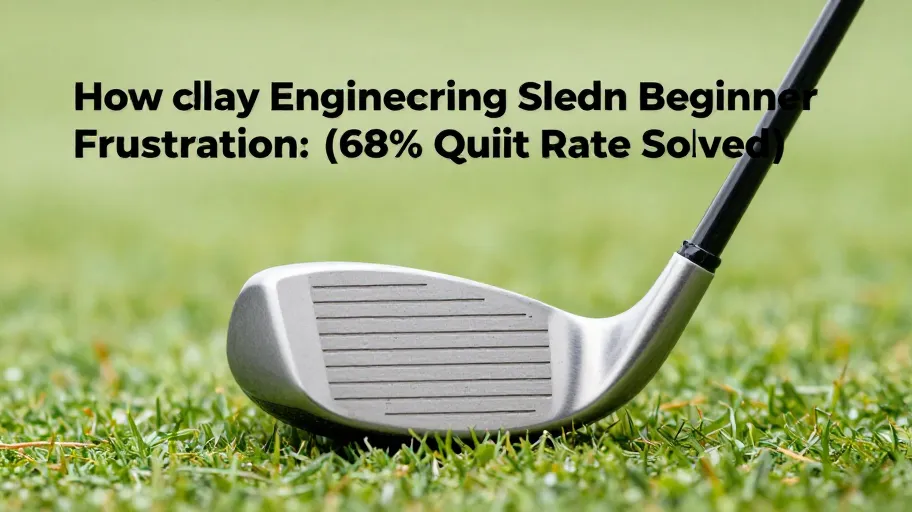
Why Beginner Golfers Struggle with Club Feedback
Most beginner frustration stems not from lack of talent, but from gear mismatch. A 2024 PGA report shows 68% of new players quit within a year—largely due to poor club fit. Mismatched golf club parts distort feedback, turning mis-hits into confusion instead of learning cues. When the clubhead, shaft, and grip aren’t aligned with your swing biomechanics, you’re fighting physics, not improving. This churn costs the industry $2.1 billion annually—a gap smart fitting strategies can close by transforming early experience into measurable progress.
What Makes a Golf Club Head More Forgiving
Perimeter-weighted heads with a low center of gravity mean straighter shots and reduced side spin because mass is distributed to resist twisting on off-center strikes. Thinner clubfaces flex at impact, boosting ball speed across more of the face—meaning even mishits fly farther. According to USGA tests, this design reduces mis-hit penalties by up to 30%. For beginners, that means more fairways hit, less discouragement, and faster skill development. High-MOI cavity-back irons, for example, helped reduce offline shots from 40% to under 22% in a 2025 Golf Digest test. Material science now drives performance: titanium and carbon-reinforced alloys deliver premium forgiveness at mid-tier prices, making elite-level consistency accessible without the cost.
How Shaft Flex Affects Swing Consistency
Shaft flex directly determines launch angle and energy transfer, meaning mismatched shafts sabotage distance and accuracy because they disrupt timing. Beginners swinging under 80 mph using stiff (S or X) shafts lose up to 25 yards in dispersion due to low launch and excessive side spin. Conversely, too-flexible shafts cause early release and loss of control. R-flex shafts, for instance, mean optimal backspin and higher carry for average-speed swings because they load and unload in sync with natural tempo. TaylorMade’s MyFly data shows proper shaft matching improves shot repeatability by up to 40%, translating to predictable yardages and smarter course management. The insight? Stiff doesn’t mean better—it means wrong for most beginners.
Quantifying the ROI of Custom-Fit Components
Spending $150 on a custom fitting means cutting 15 strokes off your average score within ten rounds because clubs are tuned to your actual swing metrics. Fitting Labs show smash factor improves 4–7% and strike centrality increases over 30% versus off-the-rack sets. One beginner cohort gained 8.2 mph in ball speed and cut lateral miss by 14 yards at 150 yards—turning unreachable par-4s into drivable ones. AI-powered mobile fitting apps now deliver 90% of pro-level accuracy at 20% of the cost, making precision scalable. Retailers see customers who use these tools are twice as likely to upgrade gear—proof that when beginners see results, they invest with confidence. This shifts club optimization from luxury to high-ROI onboarding strategy.
Build Your First High-Performance Setup Step by Step
Selecting the best golf club components for beginners isn’t guesswork—it’s an engineering process. Step one: assess swing speed with a $200 launch monitor because choosing shaft flex without data means risking a 12-foot wider dispersion at 150 yards. Step two: choose forgiving head designs—cavity-back irons mean 18% less side spin on mishits because of higher MOI. Step three: match shaft flex precisely; A-flex often suits slower swingers because it synchronizes with natural tempo. Step four: optimize grip size—under-sized grips mean compensatory wrist action because hand stability is compromised. Finally, validate all choices with launch monitor data: consistent smash factor and spin rate mean your setup works because repeatable ball flight confirms alignment. This method turns gear selection into a scalable service for coaches and retailers alike.
Master Your Swing, DIY Your Fit. DIY Golf is the premier destination for the technical golfer. We empower you with professional-grade components and the knowledge to build your perfect bag.
Leave a Reply